
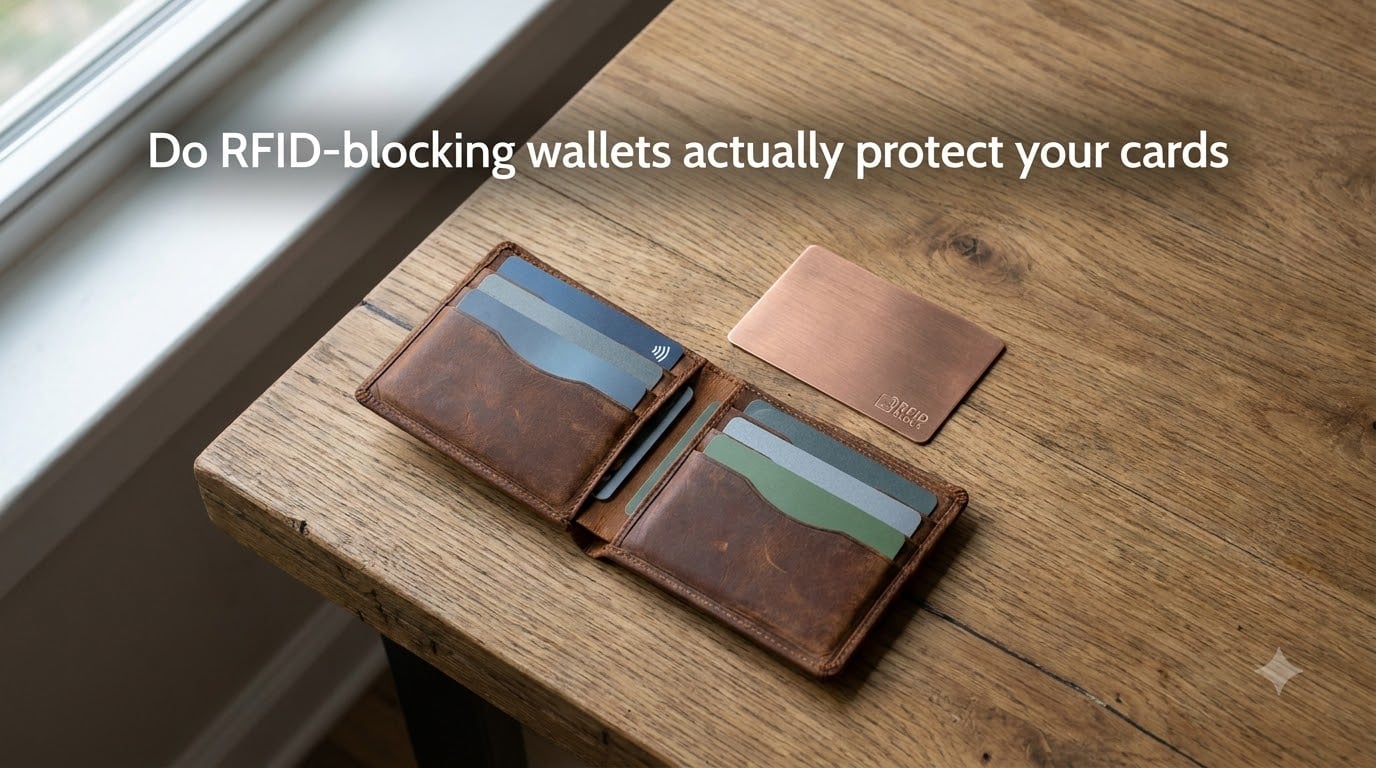
RFID-blocking wallets do block radio signals from reaching your cards, but the actual threat they protect against is almost non-existent. Modern contactless payment cards already use encryption, one-time transaction codes, and tight read-range limits that make electronic pickpocketing impractical for criminals. In 2026, the real dangers to your card data come from physical skimmers, data breaches, and online fraud, not from someone scanning your wallet in a crowd.
I dug into the research, the security industry consensus, and the actual mechanics of how these cards work. Here’s what I found, and what the experts at Norton, AARP, and the Identity Theft Resource Center actually say about RFID-blocking wallets.
Table of Contents
- What Is RFID and How Does It Work?
- How RFID Blocking Wallets Work?
- The Short Answer: Do RFID-Blocking Wallets Actually Work?
- Why RFID Theft Is Largely Theoretical
- What Are the Real Threats to Your Cards?
- Do You Even Need an RFID-Blocking Wallet?
- What About Passport RFID Chips?
- How to Actually Test an RFID-Blocking Wallet?
- Frequently Asked Questions
- Conclusion: The Bottom Line on RFID Protection
What Is RFID and How Does It Work?
RFID stands for Radio Frequency Identification. It is a wireless technology that uses electromagnetic fields to transfer data between a reader and a small chip embedded in an object, like the contactless card in your wallet. The chip has no battery of its own; it is powered by the radio waves coming from the reader, which is why these are called “passive” RFID tags.
When you tap your credit or debit card at a checkout terminal, the terminal sends out a 13.56 MHz radio signal. Your card’s chip harvests a tiny amount of energy from that signal, powers up for a fraction of a second, and transmits your card data back. The whole exchange takes about 50 milliseconds.
RFID is not the same as NFC, though people often use the terms interchangeably. NFC (Near Field Communication) is actually a subset of RFID, designed for very short distances (under 4 centimeters or about 1.5 inches) and two-way communication. Your phone uses NFC for Apple Pay and Google Pay. Your contactless card also uses the NFC protocol. So when someone says “RFID skimming” in the context of credit cards, they usually mean NFC.
The cards themselves contain three components: a small antenna coil, a microchip with your card data, and sometimes a tiny capacitor. Together, they look like a flat metal square on the front of your card. The technology is governed by the ISO/IEC 14443 standard, which limits the read range to about 10 centimeters in ideal conditions, and far less in real-world environments.
How RFID Blocking Wallets Work?
RFID-blocking wallets create an electromagnetic shield around your cards using conductive materials. When radio waves hit a sheet of copper, aluminum, carbon fiber, or mu-metal, they are absorbed or reflected instead of passing through to your card’s antenna. The result is that a would-be scanner cannot power up the chip or read the data.
The most common materials used in RFID-blocking products are:
Aluminum foil. Cheap and surprisingly effective. Several independent tests have shown that wrapping a card in regular kitchen foil blocks RFID signals almost as well as purpose-built products.
Copper. Excellent conductivity and a common lining in premium RFID wallets. Copper is denser than aluminum, which means better shielding in a thinner layer.
Carbon fiber. Used in lighter wallets because it is strong and conductive. Slightly less effective than copper at the same thickness.
Mu-metal. A nickel-iron alloy specifically engineered to block magnetic fields. More expensive and used in higher-end products.
From an engineering standpoint, yes, these wallets work as advertised. If you put a contactless card inside a well-constructed RFID-blocking sleeve, the reader will not get a response. That part is not in dispute.
The real question is whether anyone is trying to read your card in the first place.
The Short Answer: Do RFID-Blocking Wallets Actually Work?
RFID-blocking wallets successfully block RFID signals. They are technically functional. However, they protect against a crime that almost no one is committing, making them a solution in search of a problem.
Why RFID Theft Is Largely Theoretical
Despite years of marketing claims about “electronic pickpocketing,” there are several concrete reasons the threat is mostly hypothetical.
1. The Read Range Is Extremely Short
Contactless cards are designed to work at a maximum distance of about 4 centimeters, and most readers need the card to be nearly touching. Criminals would need to press a hidden reader directly against your wallet or bag in a public place. In practice, this is far harder than simply watching you enter your PIN at an ATM or cloning a card through a compromised gas pump.
2. Encryption and One-Time Codes Limit What a Scammer Can Steal
Modern contactless cards do not transmit your full card number, expiration date, and CVV in plain text. Instead, they generate a unique cryptogram for each transaction. As Visa and Mastercard have publicly stated, even if a criminal intercepted the data, they could not use it to create a working clone for in-person or online fraud.
The Identity Theft Resource Center (ITRC) has confirmed in interviews with AARP that they have never seen a documented case of RFID-based credit card theft in the United States. The threat simply has not materialized at scale.
3. The Effort-to-Reward Ratio Is Terrible for Criminals
A criminal who successfully skimmed your card in a crowd would still need to encode the stolen data onto a physical card, hope it had enough usable information to make purchases, and run those purchases through without getting flagged by fraud detection systems. Modern payment networks use machine learning and velocity checks that would catch this almost immediately.
Compare that to phishing emails, which can be sent to millions of people at zero cost and produce a steady stream of stolen card numbers. It is no surprise which method criminals prefer.
4. No Documented Mass Incidents Exist
In over a decade of contactless card adoption across Europe, Asia, and North America, there has never been a publicly reported case of a mass RFID skimming attack. Security researchers have demonstrated proof-of-concept attacks, but these required specialized equipment and direct, sustained contact with the target. Real-world criminal adoption has been essentially zero.
What Are the Real Threats to Your Cards?
If you want to protect your money, focus your attention on the threats that are actually happening.
Physical Skimmers at Gas Pumps and ATMs
Skimmers are small devices that fit over a card reader and capture the data from the magnetic stripe when you swipe. They have been found on gas pumps, ATMs, and even point-of-sale terminals in retail stores. Combined with a hidden camera to record your PIN, skimmers have caused millions of dollars in fraud losses every year.
Shimmers Inside Card Readers
Shimmers are the chip-card equivalent of skimmers. They are thin inserts placed inside a card reader that capture data from the EMV chip when you insert your card. They are harder to detect than skimmers and have been found in ATM machines worldwide.
Online Data Breaches
The vast majority of credit card fraud originates from data breaches at retailers, restaurants, and online services. If you shopped at a major retailer during a breach, your card data may already be for sale on the dark web. No wallet protects against this.
Phishing and Social Engineering
Scammers send fake emails and text messages claiming to be from your bank, asking you to verify your account or reset your password. Click the link, enter your card details, and you have just handed over your information. This is how most consumers actually lose money.
Lost or Stolen Physical Cards
A stolen wallet, a misplaced card, or a card left in a hotel room is still one of the leading causes of fraud. A thief who finds your physical card can use it for tap-to-pay transactions up to your card’s contactless limit, often without needing a PIN.
Do You Even Need an RFID-Blocking Wallet?
For most people, the answer is no. The actual risk is so low that an RFID-blocking wallet provides almost no practical security benefit. Your money is better spent on monitoring your credit reports and turning on transaction alerts.
That said, there are a few situations where one might be worth considering:
Peace of mind. If knowing your cards are shielded makes you feel safer, that has value on its own. Just understand what you are paying for.
Frequent international travel. Some regions have reported isolated cases of RFID skimming, particularly in busy tourist areas. The risk is still low, but travelers who want to be cautious may benefit.
Working with sensitive credentials. If you carry government-issued cards with embedded chips, you may want an extra layer of physical protection.
If you do want RFID protection without buying a whole new wallet, consider an RFID-blocking card. These are thin cards (about the size of a credit card) you place inside your existing wallet. They generate a jamming field that disrupts any nearby scanning attempt. They cost a fraction of a full RFID wallet and work with any wallet you already own.
What About Passport RFID Chips?
U.S. passports issued since 2007 contain an RFID chip that stores your photo, biographical data, and a digital signature. Some travelers worry about this data being read without their knowledge.
The same logic applies: the read range is short, the data is encrypted, and the U.S. State Department uses Basic Access Control, which requires the physical passport book to be opened before the chip can be read. In practice, this means a thief cannot skim your passport while it sits closed in your bag.
Still, if you are traveling to a high-risk area or simply prefer the protection, a passport-specific RFID-blocking sleeve is a low-cost option.
How to Actually Test an RFID-Blocking Wallet?
If you already own an RFID-blocking wallet and want to confirm it works, you can test it yourself in about two minutes.
Find a contactless payment terminal. Most stores have one at the checkout.
Remove a contactless card from your wallet and tap it on the terminal. Confirm that it triggers a payment prompt or beep.
Place the same card back inside the wallet and close it.
Try tapping the closed wallet on the terminal. If the wallet is blocking properly, nothing should happen.
If the terminal reads the card through the wallet, your wallet is not providing the protection it claims. Most reputable RFID-blocking products pass this basic test.
Frequently Asked Questions
Do RFID card blockers actually work?
Yes, RFID card blockers work as advertised. They create an electromagnetic barrier using conductive materials that prevent scanners from reading your card. However, the threat they protect against is largely theoretical, as modern contactless cards already use encryption and one-time transaction codes that make skimming impractical.
Can my debit card be scanned while in my wallet?
In theory, yes, but it would require a scanner to be pressed almost directly against your wallet (within 4 cm). In practice, this is extremely rare. There are no documented cases of mass RFID skimming attacks on contactless cards in the United States, according to the Identity Theft Resource Center.
Do RFID blocking wallets mess up my cards?
No, RFID blocking wallets do not damage your cards. The shielding material simply blocks incoming radio signals. Your card’s chip, magnetic stripe, and EMV functionality are unaffected by being stored inside an RFID-blocking wallet or sleeve.
What are the drawbacks of RFID blocking wallets?
The main drawback is cost: you pay a premium for protection against a threat that is statistically rare. Other drawbacks include thicker designs, fewer style options, and the false sense of security they may create, distracting from real threats like phishing, data breaches, and physical card theft.
Conclusion: The Bottom Line on RFID Protection
RFID-blocking wallets work, but they protect you from a crime that is rarely attempted. For most people, the bigger risks come from data breaches, phishing scams, and physical card theft. If you want to protect your money in 2026, focus on enabling transaction alerts, monitoring your credit reports, and using strong unique passwords for every account. That is where your attention will pay off far more than an RFID-blocking wallet.