
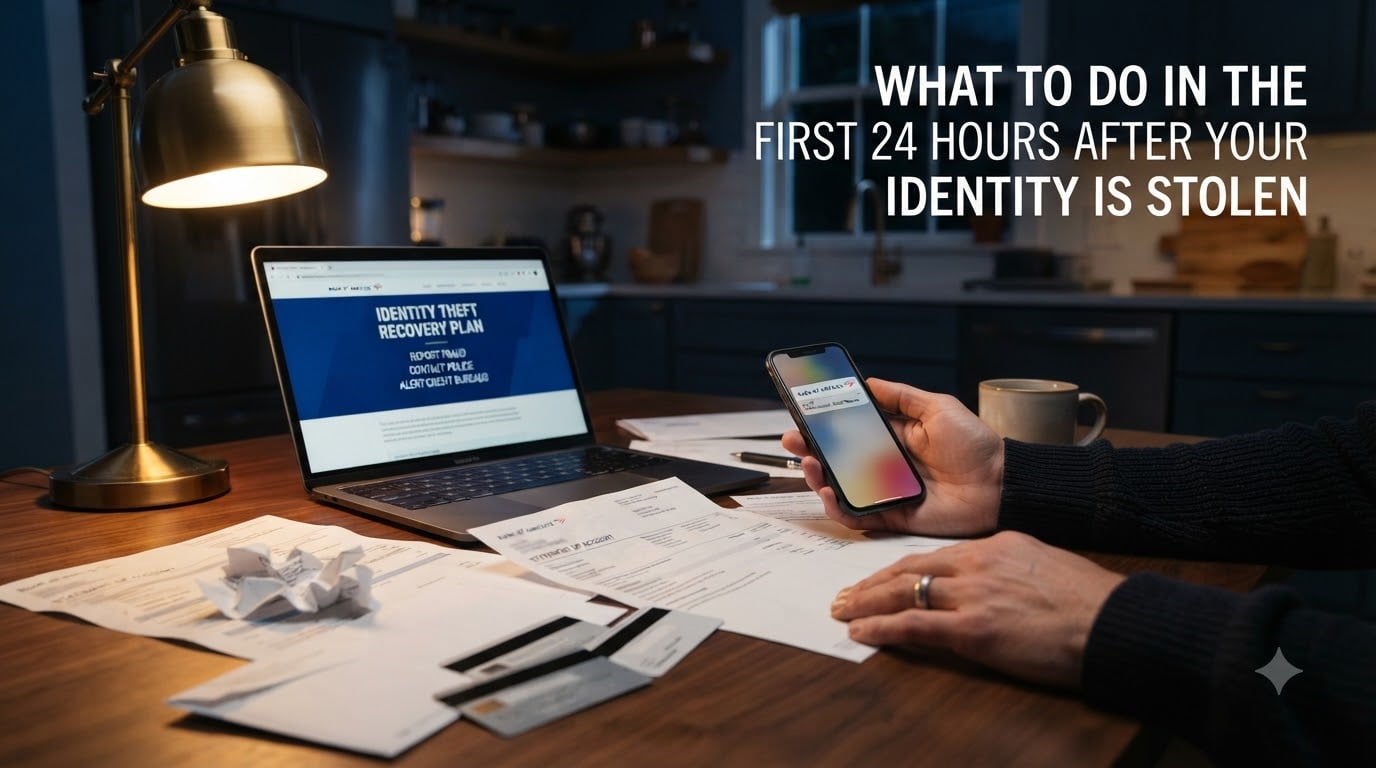
I remember the moment my aunt called, panicked, because someone had opened a credit card in her name using her Social Security number. Her voice shook. She kept asking, “What do I do first?”
That call is why I wrote this guide. When your identity is stolen, the first 24 hours matter more than the next 24 weeks. Every hour you delay gives the thief more time to drain accounts, open new lines of credit, or sell your data to other criminals.
This guide breaks down what to do in the first 24 hours after your identity is stolen, hour by hour. I have included the exact phone numbers, the order of steps, and the documentation that helped my aunt recover. I have also added the scam warnings she wished she had known, so you do not get hurt twice.
Table of Contents
- Hour 1: Contain the Damage and Lock Down Your Accounts
- Hours 1-6: Place a Fraud Alert on Your Credit Reports
- Hours 6-12: File Your FTC and Police Reports
- Hours 12-24: Secure Your Online Accounts and Phone
- Your Identity Theft Documentation Checklist
- Warning Signs That Your Identity Is Still Being Used
- Beware of Scams Targeting Identity Theft Victims
- Frequently Asked Questions About Identity Theft Recovery
- Take a Breath – Then Take These Steps
Hour 1: Contain the Damage and Lock Down Your Accounts
The first hour is about stopping the bleeding. You are not trying to fix everything yet. You are trying to make sure the thief cannot do anything else while you figure out the full picture.
Step 1: Call your bank and credit card companies. Use the number on the back of your card or the official number on your statement. Do not call a number from a suspicious email or text.
Tell the fraud department you believe your identity has been stolen. Ask them to freeze or close any account that shows unauthorized activity. Most banks will issue you new account numbers and cards within 24 to 48 hours.
Ask about provisional credit so you are not held liable for fraudulent charges. The Fair Credit Billing Act limits your liability to $50 for credit card fraud, and many banks waive even that.
Step 2: Change your passwords immediately. Start with your email, your bank, and any account that holds payment information. Use a password manager to generate unique passwords.
Never reuse a password across accounts. If your email was compromised, change that first, because it is the master key to every other account.
Step 3: Open a dedicated folder or notebook. Start writing down every call, every name, every case number, and every time stamp from this moment forward. This documentation is what makes the difference between a smooth recovery and a months-long fight.
Hours 1-6: Place a Fraud Alert on Your Credit Reports
A fraud alert tells creditors to take extra steps to verify your identity before opening new accounts in your name. It is free, and one bureau is required to notify the other two.
Contact any one of the three major credit bureaus to place an initial fraud alert, which lasts 90 days:
- Equifax: 1-800-525-6285
- Experian: 1-888-397-3742
- TransUnion: 1-800-680-7289
You only need to call one. That bureau is legally required to notify the other two. After you file your FTC Identity Theft Report, you can upgrade to an extended fraud alert, which lasts 7 years and requires creditors to call you before issuing any credit.
Fraud Alert vs Security Freeze: Which One Do You Need?
Many readers confuse these two protections. Here is the difference in plain language.
A fraud alert requires businesses to verify your identity before issuing credit, but it does not block access to your credit file. A security freeze (also called a credit freeze) locks your credit file completely. No one, not even you, can open new credit while the freeze is in place.
Forum users on Reddit and other communities almost universally recommend placing a security freeze as the single most effective step. It is free in every state, and you can lift it temporarily when you actually need to apply for credit.
My aunt placed both a fraud alert and a freeze within the first 6 hours, and the freeze alone stopped two more applications that arrived that week.
Hours 6-12: File Your FTC and Police Reports
Once you have stopped the immediate bleeding, the next priority is creating official documentation. Two reports matter: the FTC report and the police report. Together, they form your identity theft report, which is what creditors and agencies will ask for.
File Your FTC Report at IdentityTheft.gov
IdentityTheft.gov is the federal government’s one-stop resource for identity theft victims. The site walks you through a step-by-step recovery plan tailored to the specific type of theft you experienced, whether it is credit card fraud, tax identity theft, or a compromised Social Security number.
You will be asked to describe what happened, list the accounts affected, and provide details about any communication with the thief. When you finish, the site generates an FTC Identity Theft Report and a personal recovery plan.
Save both as PDFs. Print them. Email them to yourself. The report is what creditors will request when you dispute fraudulent charges.
Warning: Real FTC staff will never call you to ask for money or to verify your identity. Scammers often pose as FTC agents after someone files a report. If you receive such a call, hang up and report it at IdentityTheft.gov.
File a Police Report With Local Law Enforcement
Many readers ask whether the police will actually do anything about identity theft. The honest answer is that most cases will not lead to an arrest, but the police report is still essential documentation.
It serves as proof for creditors, collection agencies, and the IRS that you are the victim, not the perpetrator. Bring your FTC report, a government-issued ID, proof of address, and any evidence you have collected, such as fraudulent letters, emails, or account statements.
Ask for a copy of the report and the case number. Some jurisdictions allow you to file online or by mail. If your local police department will not take the report, contact your state attorney general’s office for guidance.
Hours 12-24: Secure Your Online Accounts and Phone
Once you have filed the official reports, spend the rest of the first 24 hours hardening your digital life. Identity thieves often try to escalate within the first day by taking over additional accounts linked to your phone or email.
Set up two-factor authentication everywhere. Use an authenticator app rather than SMS when possible. SMS codes can be intercepted through SIM swapping, where a thief convinces your carrier to transfer your number to their device.
Call your mobile carrier and add a SIM PIN or port-out freeze. This prevents anyone from transferring your phone number without your permission. Major carriers including Verizon, AT&T, and T-Mobile all support this protection, and it is free.
Review your email account for forwarding rules. Thieves sometimes add a forwarding address so they receive copies of every email you send and receive. Delete any rules you did not create, and check your sent folder for messages you never sent.
Audit your social media accounts. Look for unrecognized logins, posts you did not make, and changes to your profile. Remove any third-party apps you no longer use.
Your Identity Theft Documentation Checklist
Detailed records are what separate a quick recovery from a months-long fight. Every victim I have spoken with said the same thing: the time you spend documenting now saves dozens of hours later.
For every phone call, record:
- Date and time of the call
- Name of the representative and their employee ID
- Case or reference number
- What was discussed and what actions were promised
- Follow-up commitments and timelines
For every letter or notice, keep:
- The original document
- A scanned digital copy backed up to the cloud
- Notes on when you received it and what you did in response
When sending important letters, send them via certified mail with return receipt requested. The receipt becomes proof that the company received your dispute, which matters if they later claim they never got it.
Set up a dedicated email folder for identity theft correspondence. Forward every related message to that folder, and never delete anything. This is the single habit that forum users said saved them the most time during recovery.
Warning Signs That Your Identity Is Still Being Used
The first 24 hours are just the start. Identity theft often unfolds over months as thieves wait for you to relax. Knowing the warning signs helps you catch new fraud quickly.
Watch your mailbox and email for:
- Bills or statements for accounts you never opened
- Notices from the IRS, especially IRS Letter 5071C or 6331C about a suspicious tax return
- Medical bills for services you never received
- Debt collection calls about unfamiliar debts
- Credit card or loan denials when you have good credit
If you receive an IRS notice about a tax return you did not file, complete IRS Form 14039, the Identity Theft Affidavit, and submit it immediately. You can also request an IP PIN, a six-digit number the IRS uses to confirm your identity on future returns.
Beware of Scams Targeting Identity Theft Victims
Within hours of my aunt filing her FTC report, she received three calls from people claiming to be from the FTC, all asking for her Social Security number and a fee to “expedite her recovery.” None of them were real.
This is one of the most common follow-up scams and it traps thousands of victims every year.
Remember these rules:
- The FTC never charges fees and never asks for your full Social Security number by phone
- The IRS contacts you by mail first, not by phone or email
- Legitimate credit bureaus will not call you to confirm a fraud alert you did not request
- No legitimate company will ask you to wire money, gift cards, or cryptocurrency to recover from fraud
If anyone pressures you to act immediately, demands payment, or refuses to provide written verification, hang up. You can verify any suspicious contact by calling the agency directly using a number from their official website.
Frequently Asked Questions About Identity Theft Recovery
What is the very first thing to do if your identity is stolen?
Call your bank and credit card companies to report the fraud and freeze any compromised accounts. Then change the passwords on your email and financial accounts. These two steps take less than an hour and stop most additional damage.
How long does it take to recover from identity theft?
Most victims spend 3 to 6 months recovering, though complex cases involving Social Security number theft or tax fraud can take a year or longer. The first 24 hours set the tone, but ongoing monitoring is essential for the next several months.
Will the police actually do anything about identity theft?
Most police departments will file a report but not actively investigate unless the theft involves large amounts of money or organized crime. The police report is still essential because it serves as legal proof of the crime for creditors and the IRS.
Can my bank help me with identity theft?
Yes. Banks have dedicated fraud departments that can freeze accounts, issue new cards, reverse fraudulent charges, and provide documentation for your recovery. Call the number on your statement as soon as you suspect fraud.
What is the difference between a fraud alert and a security freeze?
A fraud alert requires businesses to verify your identity before issuing credit but leaves your credit file accessible. A security freeze locks your credit file completely so no new credit can be opened. Both are free, and most experts recommend doing both.
Take a Breath – Then Take These Steps
I know how overwhelming this feels. My aunt cried during her second call to the bank, and she is a retired HR director who handles crisis well. Identity theft violates your sense of safety, and there is no shortcut past that feeling.
But here is what I want you to remember about what to do in the first 24 hours after your identity is stolen: every step in this guide is something concrete you can do right now, today, from your kitchen table.
Call the bank. Place the freeze. File the FTC report. Document everything. Each action is small, and together they give you back control.
If you have already started this process, you are ahead of where you were an hour ago. If you have not, start with one phone call to your bank. That single call is the most powerful first step you can take in 2026.