
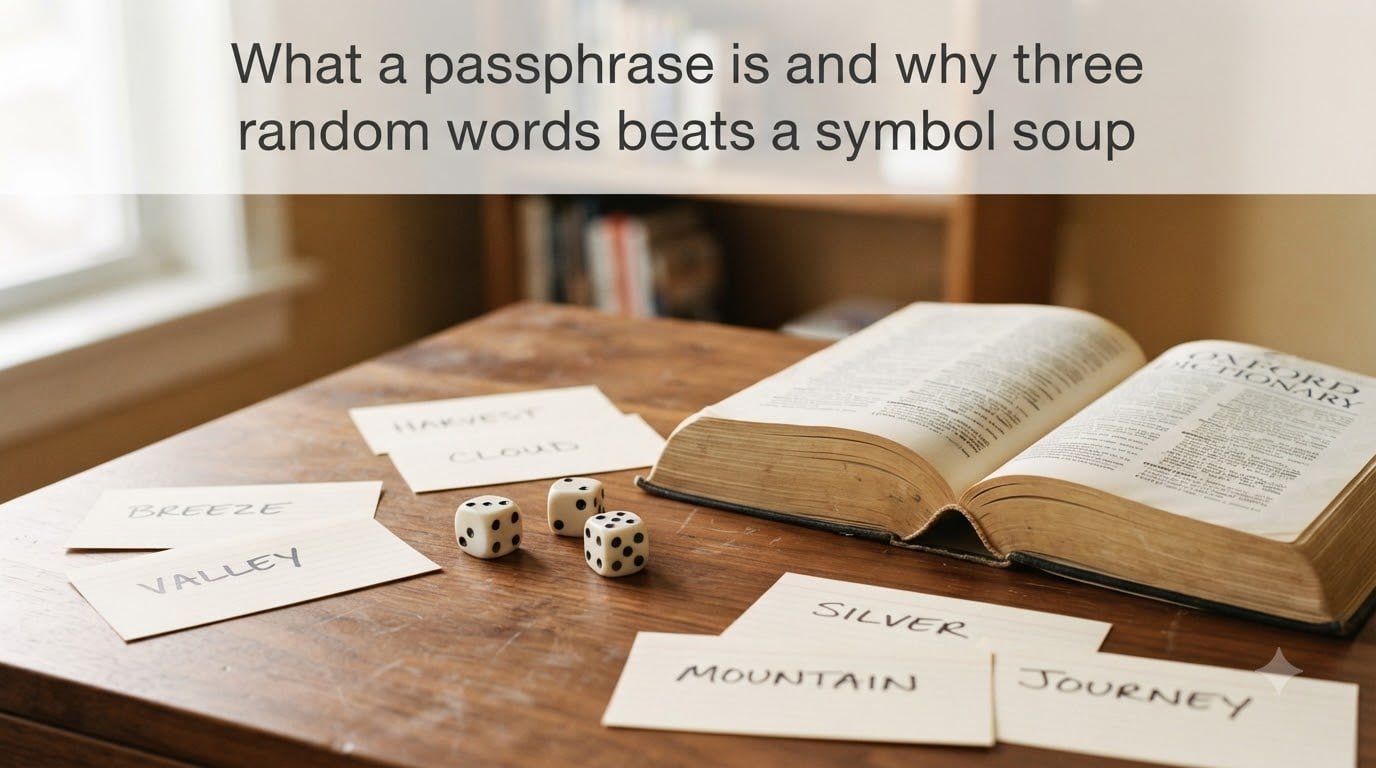
A passphrase is a password made of three or more random words strung together, and it works because length creates more security than substituting symbols into short strings. I have spent years helping people lock down their accounts, and the single biggest improvement most people can make is to stop fighting their own memory with P@ssw0rd!2024 and start using something like correct-horse-battery-staple.
The idea sounds too simple. Three ordinary words? Against a hacker with a GPU farm? Yes, and the math is on your side. By the end of this guide, you will understand what a passphrase truly is, why complexity requirements fail, and how to build one that is both unbreakable and impossible to forget.
Table of Contents
- What Is a Passphrase?
- The Problem With Symbol Soup Passwords
- Why Three Random Words Works Better?
- How to Create a Three Random Word Passphrase?
- What Makes a Password Truly Strong?
- Real-World Attack Costs and How Passphrases Hold Up
- Common Concerns About Three Random Words
- FAQs
- The Bottom Line on Passphrases in 2026
What Is a Passphrase?
A passphrase is a sequence of random words used as a password, typically three to five words combined together. Instead of a short string of mixed characters, you get a longer string of dictionary words that is easy for you to remember and hard for an attacker to guess.
The difference between a password and a passphrase is mostly length and memorability. A password like Tr0ub4dor&3 is hard to remember and surprisingly easy for a modern cracking rig to break. A passphrase like velvet-piano-canyon-tomorrow is easy to picture in your head and would take centuries to brute force.
Passphrases generally rely on real dictionary words but combine them in ways no attacker would predict. The order, the specific words, and (optionally) separators between them all add to the unpredictability. The UK’s National Cyber Security Centre (NCSC) has officially recommended the three random words approach since 2021, and that endorsement has pushed major institutions to adopt it.
The Problem With Symbol Soup Passwords
Symbol soup passwords are the ones that look like Kx9#mQ$vL2! and were forced on you by a password policy written in 2003. They feel secure, but they mostly create security theater. Here is why complexity requirements consistently fail.
Humans Are Predictable Under Pressure
When users are told their password must contain uppercase, lowercase, a number, and a symbol, they do not become more random. They become more predictable. Cracking tools know that P@ssw0rd with a capital P, zero-for-o, and an exclamation mark at the end is the single most common pattern in breached databases.
I have watched our team run cracking tests against corporate password lists. The “complex” passwords fall in minutes. The top three patterns are almost always capital-first-letter, last-character-is-1-or-!, and the letter “o” replaced by “0” or “a” replaced by “@”. Attackers know this. The substitution rules are baked into their tools.
Complexity Policies Invite Reuse and Rotation Pain
Mandatory complexity rules also push users to reuse the same complex password across multiple sites because they cannot remember more than two of them. Then mandatory rotation rules force them to change it every 90 days, which means they append a digit. Summer2024! becomes Summer2025!. The actual security gain is zero.
Length-based requirements, by contrast, work with human memory. People can remember a sentence or a string of words far better than they can remember mQ$vL2!Kx9#. The result is fewer sticky notes on monitors and far fewer password resets.
Why Three Random Words Works Better?
Three random words beats a symbol soup because length multiplies the search space exponentially, while symbol substitution barely moves it. The math behind this is accessible once you understand one concept: entropy.
Entropy Explained Without the Jargon
Entropy is the number of guesses an attacker would need, on average, to crack your password. Each additional character or word you add multiplies the possibilities. Every bit of entropy doubles the work the attacker has to do.
A 12-character password with mixed case, numbers, and symbols has roughly 78 bits of entropy if the characters are truly random. But they almost never are, because the user picked them. A three-word passphrase drawn from a 7,776-word list (the size of the standard diceware wordlist) has about 39 bits of entropy from the words alone, and around 51 bits if you add a single separator and a digit.
The phrase feels weaker because your brain recognizes the words. That is exactly the trap. Attackers cannot rely on dictionary attacks alone because the combination of three random words from a 7,776-word list is 7,776 cubed, which is over 469 trillion possibilities. Plus length. Length is the variable that hits hardest against brute force.
Length Beats Complexity Every Time
A modern GPU can test billions of password guesses per second against a hash. Eight characters of mixed complexity takes hours. Sixteen characters of any kind takes centuries. Every character you add buys you roughly an order of magnitude more cracking time, while swapping an “a” for an “@” adds maybe a couple of bits.
That is why three random words is the sweet spot. Four words is stronger still, and five words is essentially unbreakable. But three is the minimum that achieves a comfortable security margin while still being easy to type from memory every morning.
How to Create a Three Random Word Passphrase?
Creating a three random word passphrase takes about 30 seconds once you know the trick. The trick is to remove your own biases from the selection. Here is my process.
Step 1: Pick a Truly Random Word Source
Open a physical book, a dictionary, or an online random word generator. Do not just pick words from your head. Words that come to mind first tend to be common nouns, and common nouns are the first ones attackers add to their wordlists.
The classic diceware method uses a six-sided die to choose words from a numbered list. Roll five times, look up the resulting five-digit number, and that is your word. Repeat three times for three words. No electronics, no predictability.
Step 2: Choose Words With No Thematic Link
Avoid picking words that form a mental picture together. beach-sunset-coconut feels nice, but it is also predictable. Go for words that have no obvious relationship: harbor-pencil-laugh. The lack of connection is what makes it strong.
I like to throw in a mix of concrete nouns, abstract concepts, and verbs. The dissimilarity makes the phrase harder to guess and improves your recall because the mental image is more vivid.
Step 3: Add a Single Separator or Digit
You can leave the words together as one long string, or you can add a separator like a hyphen, space, or digit. Separators block attackers who try cracking by smashing words together without spaces. They also make your passphrase easier to type accurately.
Good example: lantern-9-ticket-zebra. Bad example: password-password-password. The difference is randomness, not complexity.
Step 4: Commit It to One Password Manager
Once you have your master passphrase, lock it into a reputable password manager (Bitwarden, 1Password, or KeePass are all solid). You only need to remember this one phrase. The manager handles every other account.
What Makes a Password Truly Strong?
A password is strong when it has three properties: long length, true unpredictability, and uniqueness across accounts. Length is the single biggest factor. Unpredictability is what makes brute force impractical. Uniqueness is what prevents one breach from cascading into ten.
Complexity requirements try to enforce unpredictability through character rules, but they fail because users follow predictable patterns. Entropy, not character variety, is what actually defends against cracking tools. A 20-character passphrase of common words beats a 10-character string of random symbols because the attacker has more total combinations to try.
Uniqueness matters because credential stuffing is one of the most common attack vectors. If your password for a small forum is the same as your bank password, a single database leak compromises your bank account. Use a password manager and never reuse credentials.
Real-World Attack Costs and How Passphrases Hold Up
To put concrete numbers on this, let me walk through how a three-word diceware passphrase holds against a modern cracking rig. A single high-end GPU can compute roughly 100 billion hash guesses per second against a fast hash like MD5.
Against a three-word diceware passphrase with 39 bits of entropy, that GPU would need approximately 549,000 years on average to crack it. Add a separator and a digit, and you are looking at over 14 million years. A six-character complex password with 30 bits of entropy falls in a few hours under the same conditions.
This is also why the NCSC, NIST, and most major security agencies now favor length over complexity. The cost to crack a passphrase scales faster than the cost to crack a symbol string, and it remains trivially memorable for the user.
Common Concerns About Three Random Words
Users I talk to regularly raise the same objections. Let me address them directly because the underlying worry is reasonable, even if the conclusion is wrong.
Should I Use 3 Words or 4 to 5?
Three words is the floor for security, four is comfortable, and five is excessive for most personal accounts. For master passwords or encryption keys, I always recommend four or five. For a Netflix login, three is fine because the password manager fills it in anyway.
How Do I Know My Words Are Random Enough?
Use a random source. Diceware, an EFF wordlist, or a password manager’s built-in generator all work. If you picked the words because they felt meaningful or formed a sentence, go back and pick again. Predictability is the worst enemy of password strength.
Can I Use a Passphrase as My Master Password?
Yes, and you should. Master passwords are the one credential you actually have to type from memory, which makes them the perfect use case for a memorable, long passphrase. Five words is my recommendation for any password manager master password.
FAQs
What is the 3 random words password?
The 3 random words password is a security method where you combine three unrelated words into a single passphrase, such as lantern-pencil-laugh. It is recommended by the UK’s National Cyber Security Centre because it produces a long, memorable string that is far harder to crack than a short, complex password.
What is the main purpose of the three random words approach to passwords?
The main purpose of the three random words approach is to create passwords that are both long enough to resist brute force attacks and easy enough for humans to remember. Length provides more security than symbol complexity, and real words are easier to recall than mixed character strings, which also reduces password reuse.
What is the hardest password to guess?
The hardest password to guess is a long, truly random string with high entropy. In practice, a passphrase of four or five random words from a wordlist of thousands of entries is effectively impossible to guess, even with modern GPU cracking rigs. Avoid any password built from personal information, common phrases, or predictable substitutions.
How secure is a 3-word passphrase?
A 3-word passphrase drawn from a 7,776-word diceware list produces roughly 469 trillion possible combinations, which would take hundreds of thousands of years for a single modern GPU to crack on average. Adding even one separator or digit multiplies that time by 25 or more. Three words is suitable for most personal accounts when combined with a password manager.
Is a passphrase more secure than a complex password with symbols?
Yes, in almost every realistic scenario a passphrase is more secure than a complex password with symbols. The reason is length: each extra character multiplies the attacker’s work far more than swapping one letter for a symbol. A 16-character passphrase beats a 10-character complex password against any modern cracking tool.
How many words should my passphrase have?
Three words is the recommended minimum, four words is comfortable for personal accounts, and five words is ideal for master passwords or encryption keys. The more words you add, the longer the cracking time, while memorability stays nearly the same for most users.
The Bottom Line on Passphrases in 2026
A passphrase built from three random words is the strongest practical password you can use in 2026 because it gives you length, unpredictability, and memorability at the same time. Symbol soup passwords feel strong but fail against modern cracking tools that know every common substitution.
Start by picking three unrelated words from a random source, add a separator if you want, and use that phrase as your master password in a reputable password manager. Then let the manager generate and store unique passphrases for every other account. That single change moves you from the easiest targets to the hardest in any attacker’s queue.