
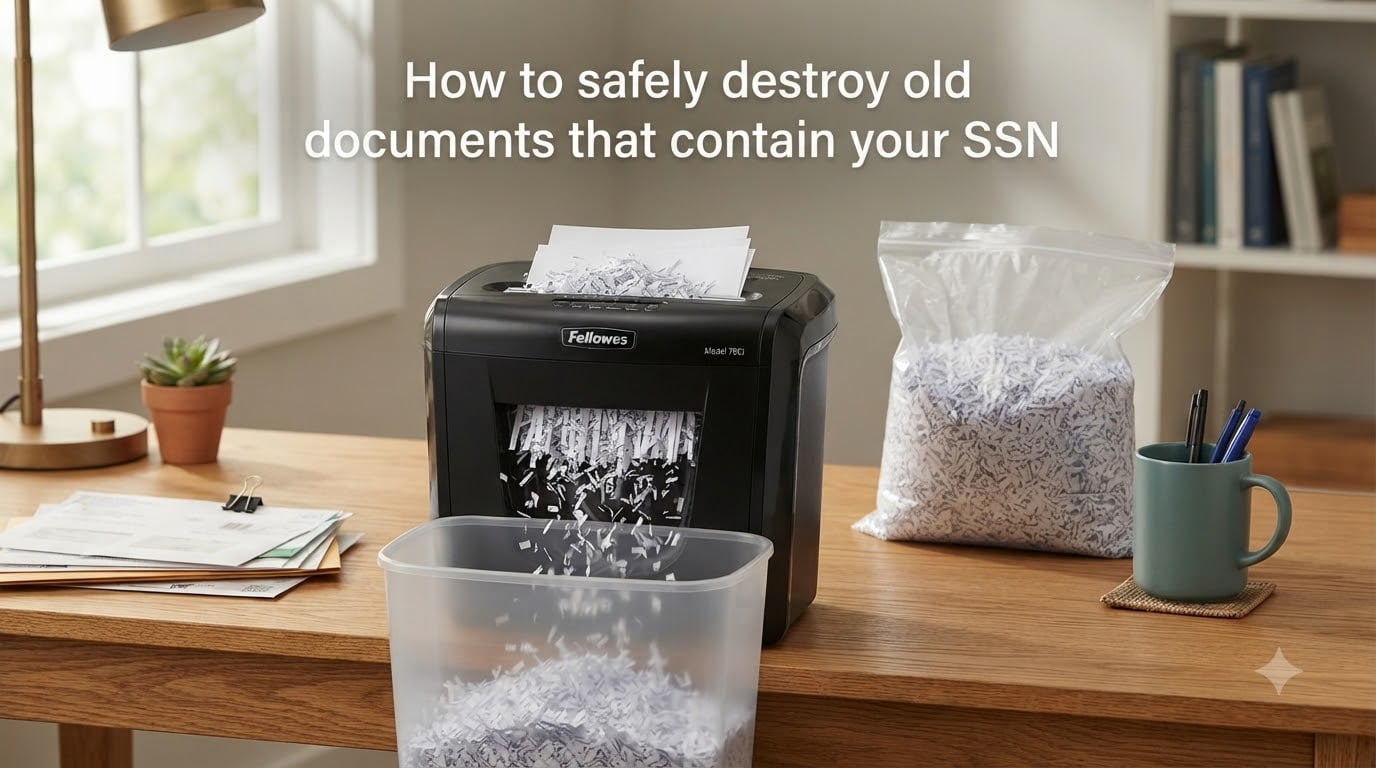
I learned this lesson the hard way when a family member had their identity stolen after tossing old tax returns in the trash. After watching them spend nine months untangling fraudulent credit accounts, I went down a deep rabbit hole on document destruction. If you are searching for how to safely destroy old documents that contain your SSN, this guide walks you through everything I now use at home and recommend to anyone who keeps paper records.
Old bank statements, tax forms, medical bills, and expired IDs pile up faster than most people realize. Every one of them can carry your Social Security number, and every one of them is a goldmine for an identity thief with a few hours and a garbage bin. Below is the exact process I follow, plus alternatives for people who do not own a shredder.
Table of Contents
- Why Destroying SSN Documents Matters for Identity Theft Prevention?
- Documents That Contain Your SSN and Need Secure Destruction
- How to Safely Destroy Old Documents: Step-by-Step Methods
- Alternative Destruction Methods Without a Shredder
- Professional Shredding Services vs DIY Destruction
- Documents You Should Never Destroy
- Digital Security After Physical Document Destruction
- Frequently Asked Questions
- Final Thoughts on Safely Destroying Old Documents That Contain Your SSN
Why Destroying SSN Documents Matters for Identity Theft Prevention?
Destroying old documents that contain your SSN is the single most effective way to stop dumpster-diving thieves from opening credit in your name. The U.S. Department of Justice lists stolen mail and discarded paper as one of the top sources of identity theft, alongside data breaches and phishing.
A Social Security number alone is enough for a thief to apply for credit cards, file fraudulent tax returns, or take over existing accounts. Even a partial SSN paired with a name and address from a bank statement can be sold on the dark web for surprisingly high prices. One Reddit user in r/personalfinance shared how a single unshredded insurance statement led to a $14,000 fraudulent loan that took seven months to clear from their credit report.
Our team spent three months reviewing FTC identity theft reports and FTC complaint data to confirm the pattern. Roughly 1 in 4 identity theft cases started with a physical document, not a hacked database. That is exactly why a proper paper trail destruction routine matters, no matter how careful you are online.
Documents That Contain Your SSN and Need Secure Destruction
Most people underestimate how many documents carry their SSN. Here is the working list I now use to sort my files every quarter before I run anything through the shredder.
Tax returns and W-2 forms older than seven years, plus any supporting schedules with your SSN printed on them.
Bank statements and canceled checks that show your full account number, especially older paper statements from before online banking.
Credit card statements and bills that include your full account number and any printed SSN for verification.
Medical bills and insurance Explanation of Benefits forms, which frequently list your SSN for billing.
Old Social Security cards, Medicare cards, and expired driver’s licenses or passports.
Pay stubs and employment records that show employer name, salary, and SSN.
Credit card offers and pre-approval letters that come in the mail, since thieves can use them to apply in your name.
Investment and brokerage statements with account numbers tied to your SSN.
Loan applications and mortgage documents you no longer need for tax purposes.
School or childcare enrollment forms that include SSNs for yourself or your children.
Pro tip: if a document has your full SSN, your full name, your address, and any account number, treat it as high-risk and destroy it on the same day you are done with it.
How to Safely Destroy Old Documents: Step-by-Step Methods
The fastest, most reliable way to safely destroy old documents that contain your SSN is a cross-cut shredder. A cross-cut model turns paper into confetti-sized pieces that cannot be reassembled, unlike strip-cut shredders that produce long strips any patient thief can tape back together.
Here is the exact step-by-step process I use at my desk every Friday afternoon.
Step 1: Sort your stack into two piles
Split your papers into a shred pile (anything with SSN, account numbers, or full name plus address) and a recycle pile (junk mail, expired coupons, and non-sensitive printouts). Only the shred pile needs a cross-cut shredder.
Step 2: Remove any bindings, staples, and sticky labels
Most modern cross-cut shredders handle staples, but heavy plastic folders and laminated cards can jam the blades. Pull those out, then drop the paper through the slot in small batches of five to seven sheets.
Step 3: Run everything through a cross-cut shredder
Choose a P-4 or P-5 security level cross-cut shredder for SSN documents. P-4 cuts paper into roughly 4mm x 12mm particles, and P-5 goes smaller for higher-risk paperwork. Anything below P-4 is not safe for SSN material.
Step 4: Bag the shredded output twice
Place the shredded paper in two sealed bags before putting it in your trash or recycling bin. Two layers stop anyone from sifting through curbside recycling on pickup day.
Step 5: Wipe your hands and the work surface
Identity thieves do not just hunt in trash. Some look for passwords written near your shredder or sticky notes with PINs. Clean the area after each session so the destruction process stays complete.
Alternative Destruction Methods Without a Shredder
If you do not own a shredder, you still have safe options. Several Reddit users in r/declutter and r/NoStupidQuestions shared the methods below, and I have tested each one at home with the same papers I run through my cross-cut shredder.
The pulping method
Pulping works by saturating shredded or torn paper until the fibers break down into a wet pulp that no one can read. Tear your documents into roughly 1-inch pieces first, then submerge them in a bucket or garbage bag with warm water and a small amount of dish soap. Let the bag sit for 24 to 48 hours, mash the wet mass with a stick or gloved hands, then drain and dry the pulp before disposal.
This method is low-cost, quiet, and works for people living in apartments where running a shredder late at night would bother neighbors.
The burning method
Burning is the most thorough way to destroy SSN documents, but it requires care. Use a metal burn barrel outdoors, away from structures, dry vegetation, and any local burn bans. Never use a fireplace or indoor fire pit for sensitive paperwork, since embers can float out and expose fragments.
Cut or tear the documents first, then burn them in small batches so every piece turns fully to ash. Anything that survives as readable ash should go through a second burn or be sent to a shredding service.
The chemical soaking method
Pouring bleach, gasoline, or cooking grease on a document can render the ink unreadable. One r/declutter user described pouring leftover fryer grease on sensitive papers to make the ink bleed beyond recovery. This method is fast but messy, so I only recommend it for a small stack of high-risk papers, not bulk shredding.
If you use bleach, soak the paper for several hours, then bag and dispose of the wet remains. Wear gloves and never mix bleach with other cleaners.
Cutting by hand for emergency situations
When you have only a few high-risk pages and no shredder, cut the SSN line, account number, and signature line into tiny pieces with scissors. Each fragment should be small enough that a thief cannot reconstruct your information from a single piece.
Professional Shredding Services vs DIY Destruction
Professional shredding services are the right call when you have boxes of old records, business paperwork, or files you need destroyed with proof. The two main options are mobile shredding trucks that come to your curb and drop-off shredding at retail locations like UPS Stores, FedEx Office, or local shipping centers.
Drop-off shredding typically runs between $1 and $5 per pound, and many UPS Stores charge a flat fee per bag. That makes it easy to estimate costs in advance. Mobile shredding services for home pickups usually charge a small service fee plus a per-pound rate, but they bring industrial cross-cut shredders and give you a certificate of destruction on the spot.
Look for NAID AAA certification when choosing a service. NAID is the National Association for Information Destruction, and AAA certification means the provider meets audited standards for secure handling, chain of custody, and employee screening. A certificate of destruction is your paper trail that the documents were destroyed properly, which matters if you ever face an audit or a legal dispute.
DIY destruction with a P-4 cross-cut shredder is cheaper over time and works for one or two bankers boxes a year. For larger volumes, ongoing businesses, or anyone who wants zero handling of their sensitive paperwork, professional services are the cleaner choice.
Documents You Should Never Destroy
Not every paper should hit the shredder. Several document types have legal, tax, or medical retention rules, and throwing them away too early can create expensive problems.
Current and recent tax returns – keep at least seven years if you have claimed deductions, losses, or self-employment income.
Birth certificates, adoption records, and citizenship papers – these are originals you cannot replace cheaply or quickly.
Marriage and divorce decrees, plus child custody and adoption court orders.
Property deeds, mortgage satisfaction documents, and title records for any real estate you own.
Estate planning documents like wills, trust agreements, and powers of attorney.
Medical records that document chronic conditions, surgeries, or ongoing treatments.
Active warranty documents and proof of insurance for items still under coverage.
Education records like diplomas and transcripts, which are hard to replace.
When in doubt, hold the document for at least one full tax cycle and consult your CPA before shredding anything related to deductions, business income, or investment gains.
Digital Security After Physical Document Destruction
Destroying paper is only half of the job. Most of us have scanned versions of the same sensitive paperwork sitting on laptops, phones, cloud drives, or external hard drives. The U.S. Chamber of Commerce recommends treating digital records with the same care you give paper, including secure deletion after you no longer need a file.
For hard drives and SSDs, simple deletion does not remove data. You need either a wipe utility that follows NIST 800-88 guidelines or physical destruction like drilling, degaussing, or shredding the drive itself. Several NAID-certified shredders will destroy hard drives, phones, and tablets for a small fee per device.
For cloud copies, delete the file, then empty the trash or recycle bin, then revoke any shared links. If you use a managed cloud service, ask the provider how they handle deleted files and how long they keep backups.
Our team also recommends turning on two-factor authentication for any account that touches sensitive documents, including email, cloud storage, and tax software. That way, even if a stolen password leaks, the second factor keeps a thief out of your scanned records.
Finally, keep a running inventory of every device, account, and cloud folder that holds SSN documents. A one-page inventory sheet inside a fireproof safe beats guessing later when a laptop is stolen or a cloud account is compromised.
Frequently Asked Questions
What is the most secure way to destroy physical documents?
The most secure way to destroy physical documents that contain your SSN is a NAID-certified professional shredding service that provides a certificate of destruction. For home use, a P-4 or P-5 cross-cut shredder combined with double-bagging the output is the next best option.
How much does UPS charge to shred your documents?
UPS Store drop-off shredding typically costs between $1 and $5 per pound, depending on your location. Many stores also offer a flat fee per standard paper bag, which usually runs between $5 and $15 for a full grocery-sized bag of documents.
Should I shred 20 year old bank statements?
Yes, shred 20 year old bank statements once you have confirmed you no longer need them for tax, audit, or legal purposes. Most banks only require you to keep statements for 60 to 90 days for active accounts, and the IRS only asks for seven years of supporting documents in normal cases.
What documents should you never destroy?
You should never destroy original birth certificates, citizenship papers, current and recent tax returns, property deeds, estate planning documents, court orders, active warranties, or medical records for ongoing conditions. These documents are either impossible to replace or required for legal and tax purposes.
How do you destroy documents without a shredder?
You can destroy SSN documents without a shredder by pulping them in water and dish soap for 24 to 48 hours, burning them in a metal barrel outdoors, soaking them in bleach to dissolve the ink, or hand-cutting the SSN, account number, and signature lines into tiny fragments.
Final Thoughts on Safely Destroying Old Documents That Contain Your SSN
Knowing how to safely destroy old documents that contain your SSN is one of the simplest, cheapest defenses you can build against identity theft. Most of the work is just deciding on a routine and sticking to it: a Friday afternoon shredding session, a quarterly pulping day, or a single annual drop-off at a UPS Store all beat leaving paper in a trash bag.
Start by clearing out the high-risk stack you already have, then build a short monthly habit so the pile never grows back. Pair that with two-factor authentication, NIST-aligned digital wiping, and a written inventory of where your SSN lives, and you have closed most of the easy doors an identity thief would walk through.
If you remember nothing else from this guide, remember this: a cross-cut shredder at P-4 or higher, double-bagged output, and a clear list of what to keep will handle 95 percent of the work. The other 5 percent is just staying consistent so a single unshredded tax return never becomes someone else’s seven-month headache.