
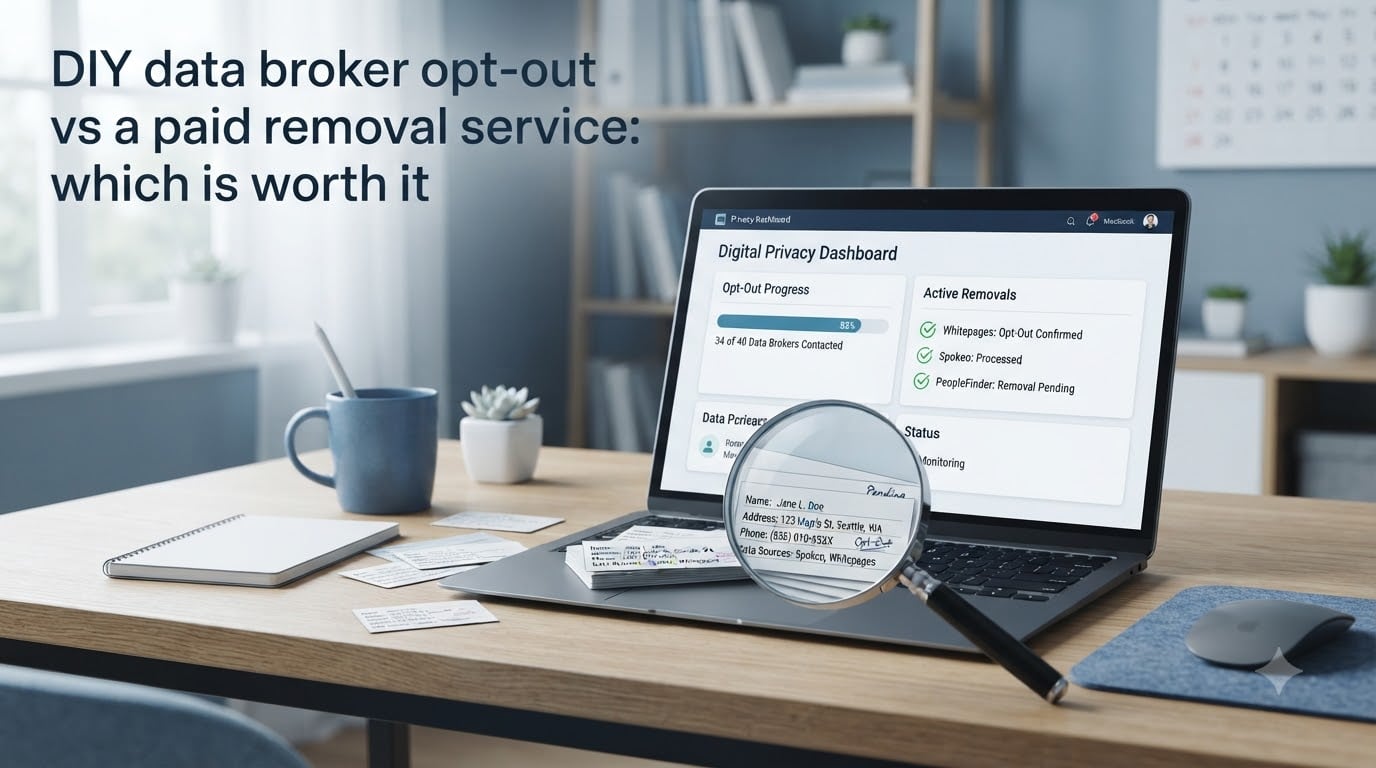
Your home address, phone number, relatives’ names, and court records are probably sitting on dozens of websites right now, free for anyone to look up. Data brokers collect this information from public records, purchase histories, and app data, then sell it to marketers, investigators, and anyone willing to pay. Removing yourself is possible, but the question almost everyone asks is whether to grind through it manually or pay someone to handle it.
The DIY data broker opt-out vs paid removal service debate comes down to three factors: how much your time is worth, how thorough you need the removal to be, and whether you can stay on top of ongoing maintenance. Our team dug through forum discussions, tested both approaches, and compared the top-rated services to give you a straight answer.
We found that both paths work, but they serve different people. If you have spare time and want zero recurring costs, the manual route gets results. If you want set-and-forget convenience across hundreds of broker sites, a paid service earns its keep. Let’s break down exactly what each option involves so you can decide which is worth it for your situation.
Table of Contents
- What Data Brokers Actually Do With Your Information?
- DIY Data Broker Opt-Out vs Paid Removal Service: How Each Approach Works?
- How to Do a DIY Data Broker Opt-Out (Step by Step)
- How Paid Removal Services Work?
- Time and Cost Breakdown: DIY vs Paid
- The Whack-a-Mole Problem: Why Data Keeps Coming Back?
- What Real Users Say: Forum Experiences?
- Privacy Laws That Support Your Opt-Out Rights
- Who Should DIY and Who Should Pay?
- Warning Signs of Unreliable Removal Services
- FAQs
- Conclusion
What Data Brokers Actually Do With Your Information?
Data brokers are companies that gather personal information from multiple sources, compile it into detailed profiles, and sell those profiles or access to them. They pull from public records like property deeds, court filings, and voter registrations. They also buy data from retailers, loyalty programs, mobile apps, and even other data brokers.
People-finder sites like Whitepages, Spokeo, and BeenVerified represent the most visible layer of this industry. Type a name into any of them and you can often find an address, age, relatives, past addresses, and sometimes criminal records within seconds. These sites get millions of visitors per month.
Beyond people-finders, there are hundreds of lesser-known data brokers operating behind the scenes. Companies like Acxiom, Experian, and Epsilon build profiles for marketing, credit, and risk assessment. You will never see their websites, but they hold some of the most detailed personal data in existence.
The risk is real. Identity thieves use broker data to piece together convincing phishing attempts and loan fraud. Stalkers and harassers use people-finder sites to locate targets. Marketers use your profile to flood you with targeted ads, spam calls, and junk mail. In one Reddit thread from r/privacy, a user described discovering 47 different sites listing their home address and family members after a stalker found them through a single people-finder search.
DIY Data Broker Opt-Out vs Paid Removal Service: How Each Approach Works?
The core difference between a DIY data broker opt-out and a paid removal service comes down to who does the work. With the DIY route, you personally visit each broker’s opt-out page, submit removal requests, verify your identity, and track follow-ups. With a paid service, a company automates or manages this process on your behalf across dozens or hundreds of sites.
DIY opt-out costs nothing in money but demands significant time. You have to find the brokers holding your data first, which often means using free scan tools or manually searching people-finder sites. Then you submit individual requests, each with its own process. Some require email confirmation, others want a copy of your ID, and a few make you mail a physical letter.
Paid services like DeleteMe, Incogni, Optery, and EasyOptOuts scan broker databases for your information automatically. They identify which sites have your data, submit opt-out requests in bulk, and continue monitoring for reappearances on a recurring schedule. Most operate on a subscription model ranging from roughly $20 to $130 per year depending on the service and plan.
Neither approach is instant. Even paid services take weeks to months to clear your data from all the brokers they cover. And neither can guarantee permanent removal, because data has a habit of reappearing. The real question is whether the time you save with a paid service justifies the cost for your specific situation.
How to Do a DIY Data Broker Opt-Out (Step by Step)
If you decide to handle removals yourself, here is the process that actually works based on our research and user reports from privacy forums.
Step 1: Find out where your data lives. Start by searching your name on major people-finder sites: Whitepages, Spokeo, BeenVerified, Intelius, Radaris, and PeopleFinder. Use a free scan tool like the one from Optery or Incogni’s free check to see how many brokers have your profile. Most people find their data on 30 to 80 different sites.
Step 2: Start with the biggest people-finder sites. These sites get the most traffic and are usually the easiest to opt out of. Whitepages, Spokeo, and BeenVerified all have online opt-out forms that take 5 to 10 minutes each. You will typically need to find your listing, copy the URL, paste it into the opt-out form, and confirm via email.
Step 3: Work through the mid-tier broker list. Sites like Intelius, Radaris, PeopleFinder, USSearch, and Truthfinder have similar processes but vary in how responsive they are. Some remove your listing within 48 hours. Others take weeks or require follow-up requests. Keep a spreadsheet tracking each site, the date you submitted, and the status.
Step 4: Handle the stubborn brokers. Some data brokers do not have simple online forms. Acxiom requires you to fill out a detailed form and may ask for additional documentation. Epsilon and LexisNexis have their own processes. A few smaller brokers require you to send an email or even a physical letter. This is where DIY gets time-consuming.
Step 5: Verify removals and document everything. After submitting requests, search for yourself again on each site two to four weeks later. If your listing is still there, resubmit. Take screenshots of your opt-out confirmations in case you need to prove you submitted a request under privacy laws like CCPA.
Step 6: Set up recurring checks. Data reappears. New brokers emerge. Existing brokers refresh their databases from public records. Plan to repeat this process every three to six months to stay on top of it. One Reddit user in r/cybersecurity described the DIY approach as “a constant game of whack-a-mole” that never truly ends.
The realistic time investment for a thorough first pass is 20 to 40 hours spread over several weeks. That includes research, form submissions, identity verification, and follow-up. After the initial sweep, expect to spend 3 to 5 hours per quarter on maintenance.
How Paid Removal Services Work?
Paid removal services streamline the entire opt-out process by handling the identification, submission, and follow-up steps for you. When you sign up, you provide your personal details, and the service scans its network of data brokers to find your profiles.
Once the scan identifies which brokers hold your data, the service submits opt-out requests on your behalf. Some services use automated systems that send requests in bulk. Others use human agents for brokers that require more nuanced handling. The best services combine both approaches for maximum coverage.
Continuous monitoring is what separates paid services from a one-time DIY sweep. After the initial removals, the service keeps scanning for your data on an ongoing basis. When a broker re-adds your profile or a new site picks up your information, the service submits another removal request automatically.
Most services also provide a dashboard or privacy report showing which sites had your data, which have been cleared, and which are still in progress. This transparency matters. Users on privacy forums consistently say that seeing exactly what was found and removed builds trust in the service.
DeleteMe, one of the most established services, sends quarterly reports detailing every removal action taken. Incogni, created by the team behind Surfshark VPN, focuses on leveraging privacy laws like GDPR and CCPA to force compliance from brokers. Optery offers tiered plans so you can choose how much coverage you want. EasyOptOuts is a budget option that covers fewer sites but costs significantly less.
Limitations exist even with paid services. None can remove your data from social media platforms, government databases, or news articles. They also cannot guarantee that every broker will comply, though using legal frameworks improves success rates. And you are handing your personal information to yet another company, which is a trust consideration some users find uncomfortable.
Time and Cost Breakdown: DIY vs Paid
This is the section most comparison articles gloss over, so let’s get specific. The DIY data broker opt-out vs paid removal service question ultimately comes down to what your time is worth.
DIY costs: Zero dollars. You can opt out of every data broker for free if you are willing to put in the work. The cost is entirely in time. A thorough initial sweep takes 20 to 40 hours. Quarterly maintenance adds another 12 to 20 hours per year. Over three years, that is roughly 60 to 100 hours of your time.
Paid service costs: Budget options like EasyOptOuts run around $20 per year. Mid-range services like Incogni cost roughly $60 to $100 per year. Premium services like DeleteMe charge about $130 per year for an individual plan, with family discounts available. Over three years, that is $60 to $390 total depending on your choice.
The break-even analysis: If you value your free time at even $10 per hour, the DIY approach costs $600 to $1,000 worth of your time over three years. A mid-range paid service costs $180 to $300 over the same period. The paid service is cheaper in that scenario, even at a low hourly rate.
Effectiveness differences: Paid services typically cover 100 to 200+ broker sites, including many obscure ones you would never find on your own. A DIY approach realistically covers 30 to 60 sites, which captures the major people-finders but misses the long tail of smaller brokers. More coverage means fewer places for your data to hide.
Convenience factor: This is where paid services dominate. You sign up once, provide your information, and the service handles everything going forward. No spreadsheets, no tracking which sites you have already contacted, no weekend spent filling out forms. For busy professionals, parents, or anyone who values free time, this convenience is the deciding factor.
The Whack-a-Mole Problem: Why Data Keeps Coming Back?
Here is the reality that catches every first-time opt-out attempt off guard. Data brokers refresh their databases regularly from public records sources. When your county updates property records or a new court filing hits the system, brokers scoop up that data and add it right back to their profiles.
This means removal is never truly permanent. A site that removed your listing in January might have it back by July. New data brokers launch constantly, and they seed their databases by scraping existing people-finder sites. Even if you clear every known broker today, a new one could appear tomorrow with your information.
Forum users describe this cycle vividly. One r/privacy contributor said they spent an entire weekend removing themselves from 50 sites, only to find 20 of them repopulated within four months. Another user reported that their data reappeared on three sites just two weeks after removal because the brokers pulled fresh records from a recent voter registration update.
Paid services address this through continuous monitoring. They rescan broker databases on a set schedule and automatically submit new removal requests when your data pops back up. This ongoing protection is one of the strongest arguments for paying, because the maintenance burden of doing it yourself never goes away.
If you go the DIY route, accept that this is a lifestyle change, not a one-time project. Block out time every few months to rescan and resubmit. Set calendar reminders. Keep your tracking spreadsheet updated. The alternative is spending 20 hours on an initial sweep only to have most of it undone within a year.
What Real Users Say: Forum Experiences?
We combed through hundreds of discussions on Reddit’s r/privacy, r/cybersecurity, r/IdentityTheft, and other privacy forums to find out what actual users experience with both approaches. The results are more nuanced than most marketing pages suggest.
On the DIY side, users who commit to the process report genuine satisfaction. Several contributors shared detailed guides on how they cleared their data from 40-plus sites and felt empowered doing it. One user noted that the free scan from Optery gave them a complete list of brokers, which made the manual process much more manageable. The common thread is that DIY works if you are organized and persistent.
On the paid side, experiences are mostly positive but not universal. DeleteMe users frequently praise the quarterly reports and the set-and-forget convenience. One user reported that after six months on DeleteMe, their listing disappeared from 42 sites that previously showed their information. Another appreciated not having to think about data brokers ever again.
Spam reduction results are mixed. Some users report a noticeable drop in spam calls and junk mail after using removal services for several months. Others saw little to no change, which makes sense because spammers also source numbers from breaches and app permissions, not just data brokers. Setting expectations here matters.
Trust concerns came up repeatedly. Multiple users hesitated to hand their personal details to yet another company. Third-party audits help, and services that are transparent about what they collect and how they use it earned more trust. Price sensitivity was also common, with many users seeking the cheapest effective option rather than the most comprehensive.
For stalking and harassment victims, the urgency is different. Several users in vulnerable situations reported that paid services gave them peace of mind faster than they could have achieved on their own. When safety is the priority, the speed and breadth of a paid service can be worth every dollar.
Privacy Laws That Support Your Opt-Out Rights
You have more legal power to demand data removal than you might realize, and understanding these laws strengthens both DIY and paid approaches.
The California Consumer Privacy Act (CCPA), updated by the California Privacy Rights Act (CPRA), gives California residents the right to request deletion of their personal information from businesses. Data brokers operating in California must honor these requests or face penalties. This law has effectively become a national standard because most major brokers do business in California.
The General Data Protection Regulation (GDPR) provides even stronger protections for EU residents, including the right to erasure. Under GDPR, companies must delete your data upon request unless they have a compelling legal reason to retain it. Services like Incogni specifically leverage GDPR to force compliance from European and internationally operating brokers.
Other states have followed suit. Virginia, Colorado, Connecticut, and Utah have all passed consumer privacy laws with data deletion provisions. More states are adding similar protections each year. These laws create real consequences for brokers that ignore opt-out requests, which is why citing the relevant statute in your removal request can improve response rates.
For DIY opt-outs, mentioning CCPA or your state’s equivalent in your removal email adds legal weight. Brokers know they face fines for noncompliance, so referencing the law signals that you know your rights. Paid services use these same laws at scale, submitting legally grounded requests that are harder for brokers to dismiss.
Keep in mind that these laws primarily cover commercial data brokers. Government records, court filings, and news articles are generally exempt. No law forces a county clerk to remove your property records from public access, which is one reason data keeps flowing back into broker databases.
Who Should DIY and Who Should Pay?
After comparing both approaches across time, cost, effectiveness, and user experiences, here is how to decide which path fits you.
DIY is worth it if: You have flexible free time and enjoy research-heavy projects. You are on a tight budget and cannot justify a recurring subscription. You only need to remove yourself from the major people-finder sites that bother you most. You are comfortable with the ongoing maintenance and will stick with it every few months. You have strong privacy concerns about sharing your data with yet another company.
A paid service is worth it if: Your time is valuable and you would rather spend weekends doing something besides filling out opt-out forms. You want the broadest possible coverage including obscure brokers you would never find on your own. You are in a vulnerable situation involving stalking, harassment, or doxxing where speed and thoroughness matter. You want set-and-forget convenience with continuous monitoring. You can comfortably afford $20 to $130 per year.
Consider a hybrid approach: Many users start with a free scan to see how exposed they are, then DIY the top 10 to 15 major people-finder sites themselves. For the long tail of smaller brokers and ongoing maintenance, they either continue manually or sign up for a budget service. This gives you the satisfaction of immediate action on the biggest offenders while offloading the tedious ongoing work.
For stalking victims and high-risk individuals: Do not hesitate. Use a paid service immediately. The speed of automated removals across hundreds of sites is something you simply cannot replicate manually, and safety should not wait on your free time. Services like DeleteMe and Incogni have experience handling sensitive cases.
Warning Signs of Unreliable Removal Services
Not every company offering data removal is trustworthy. Watch for these red flags before handing over your information and payment.
A legitimate service should clearly list which data brokers it covers. If a service is vague about its coverage or claims to remove you from “all” brokers without specifics, be skeptical. There is no service that covers literally every data broker in existence, and honest companies publish their broker lists or at least the count.
Be cautious of services that ask for more personal information than necessary. A removal service needs your name, address, and possibly birth date to find and remove your profiles. It should not need your Social Security number, bank account details, or full ID scans unless dealing with a specific broker that requires identity verification.
Avoid lifetime payment deals that sound too good to be true. Data removal requires ongoing work, so a one-time payment for permanent removal is a promise no company can realistically keep. Subscription models that fund continuous monitoring are more honest about the reality of data reappearance.
Look for third-party audits, independent testing, and genuine user reviews. Wirecutter tested nine services over a year with real staffers. Security.org verified Incogni claims through Deloitte. These external validations separate reputable services from those making empty promises. If you cannot find any independent coverage of a service, proceed with caution.
Finally, check whether the service itself has a clear privacy policy and does not sell your data. The irony of a data removal service mishandling your information is real. Stick with established companies that have been independently reviewed and have transparent data handling practices.
FAQs
Are data broker removal services worth it?
For most people, yes. Paid removal services save 20 to 40 hours of manual work on the initial sweep and handle ongoing maintenance that DIY opt-outs require every few months. If your time is worth more than a few dollars per hour, a service costing $20 to $130 per year pays for itself quickly. They are especially worth it for stalking victims, public figures, and anyone who wants broad coverage across hundreds of broker sites.
What is the best data broker deletion service?
DeleteMe is widely rated as the best overall option for its proven track record, quarterly reports, and broad broker coverage. Incogni is a strong alternative that leverages privacy laws like GDPR for faster compliance. EasyOptOuts is the best budget pick at roughly $20 per year, while Optery offers flexible tiered plans. Wirecutter named DeleteMe its top pick after a year of testing.
Which is better, Cloaked or DeleteMe?
DeleteMe is the stronger choice for data broker removal because it focuses specifically on removing your personal information from hundreds of broker sites with detailed quarterly reports. Cloaked is more of an identity management tool that provides masked emails, phone numbers, and cards. If your goal is removing existing data from brokers, DeleteMe is the better fit. If you want to prevent future data collection through masked identities, Cloaked serves a different purpose.
What is the best app to remove personal information from the internet?
The best apps for removing personal information include DeleteMe, Incogni, Optery, and Kanary. DeleteMe offers the most established service with detailed reporting. Incogni provides a clean mobile experience and leverages privacy laws for enforcement. Optery lets you see your data exposure for free before committing. All four offer mobile-friendly dashboards to track removal progress.
How long does data broker removal take?
Initial removals typically take two to eight weeks depending on the broker. Some sites remove listings within 48 hours, while others take a month or longer. A full sweep across all major brokers usually takes three to six months to complete. Data can reappear after removal, so ongoing monitoring is necessary regardless of whether you use a paid service or DIY approach.
Can I remove my information from data brokers for free?
Yes, you can remove your information from data brokers for free by submitting opt-out requests manually. Every major data broker is legally required to provide an opt-out mechanism. Start by searching your name on people-finder sites, then use each site’s opt-out form. The process costs nothing but requires 20 to 40 hours for a thorough initial sweep plus ongoing maintenance every few months.
Conclusion
So which is worth it: a DIY data broker opt-out or a paid removal service? The honest answer is that both work, but they serve different needs. DIY is free and effective if you have the time and discipline for ongoing maintenance. A paid service costs $20 to $130 per year but saves you dozens of hours and covers more brokers than you could ever find on your own.
For most people in 2026, a paid service is the better value when you factor in the true cost of your time. The whack-a-mole nature of data reappearance means removal is never a one-time project, and continuous monitoring is where paid services earn their keep. But if budget is tight or you have privacy concerns about sharing data with another company, the DIY route absolutely gets results.
Our recommendation: start with a free scan to see how exposed you are. If your data appears on a manageable number of major sites, tackle those yourself. If you find your information spread across 50-plus brokers, sign up for a service and let them handle the heavy lifting. Either way, taking action is far better than leaving your personal information freely available to anyone with a search engine.