
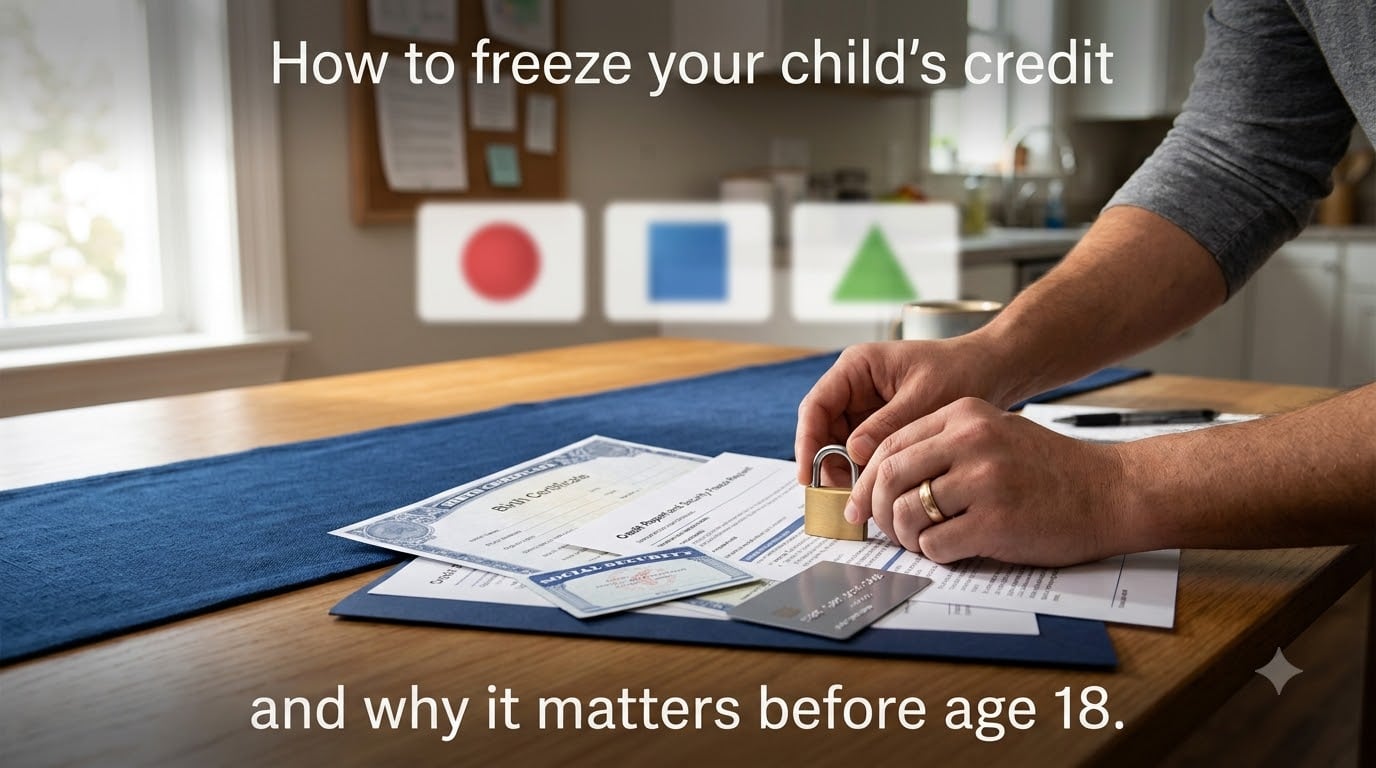
Over 1.3 million children in the United States had their identities stolen in a single year, costing families roughly $1 billion in losses. The average victim was just 8 years old when the fraud began, and most parents did not discover the damage for years.
If you have ever wondered whether you should freeze your child’s credit, the short answer is yes. A security freeze locks your child’s credit file so that no one, not even a scammer with their full Social Security number, can open accounts in their name.
In this guide, I walk you through exactly how to freeze your child’s credit with all three major credit bureaus. I cover the documents you need, the step-by-step process for each bureau, how to mail sensitive paperwork safely, and what happens when your child turns 18.
By the end, you will have a clear action plan to protect your child’s financial future before they ever apply for their first credit card, student loan, or apartment lease.
Table of Contents
- What Is a Child Credit Freeze?
- Why You Should Freeze Your Child’s Credit Before Age 18?
- Required Documents: What You Need Before Starting?
- How to Freeze Your Child’s Credit: Step-by-Step for Each Bureau
- How to Safely Mail Sensitive Documents?
- Age-Specific Rules: Under 16, Ages 16-17, and Turning 18
- How to Unfreeze Your Child’s Credit?
- Warning Signs Your Child’s Identity May Already Be Compromised
- Beyond the Freeze: Additional Ways to Protect Your Child
- FAQs
- Conclusion
What Is a Child Credit Freeze?
A child credit freeze, officially called a security freeze for a minor dependent, is a free tool that locks your child’s credit file at each of the three major credit bureaus: Equifax, Experian, and TransUnion.
When you place a freeze, the bureau creates a credit file for your child if one does not already exist. Then it restricts access to that file so lenders cannot pull it. Since lenders check credit files before approving loans or credit cards, a freeze effectively blocks anyone from opening new credit in your child’s name.
Only you, as the parent or legal guardian, can lift the freeze when your child legitimately needs credit. The freeze stays in place until you or your child removes it.
It is important to understand the difference between a credit freeze and a credit lock. A freeze is free, mandated by federal law, and offers the strongest legal protection. A lock is a product offered by credit bureaus that may carry monthly fees and weaker consumer protections.
Why You Should Freeze Your Child’s Credit Before Age 18?
Children are prime targets for identity thieves because their Social Security numbers are clean. A child’s SSN has no credit history attached to it, so a fraudster can pair that number with a fake name and birth date to build an entirely new credit profile.
This type of fraud, called synthetic identity theft, often goes undetected for years. Most parents never think to check their 7-year-old’s credit report, and the theft only surfaces when the child applies for a first job, student loan, or apartment at 18.
By then, the damage can be extensive. I have read stories on Reddit from parents who discovered thousands of dollars in fraudulent utility bills, credit cards, and even auto loans tied to their teenager’s Social Security number. Cleaning up that mess can take months of paperwork and phone calls.
According to the Federal Trade Commission, children whose identities are stolen typically face more severe consequences than adult victims. The fraud lasts longer, costs more to resolve, and can interfere with college financial aid applications.
A credit freeze eliminates this risk almost entirely. With a freeze in place at all three bureaus, even a scammer who steals your child’s complete identity cannot open a single account.
Some parents ask whether freezing is necessary if their child’s information was never exposed in a data breach. The answer is still yes. School records, medical offices, sports registrations, and insurance databases all store your child’s SSN. Any one of them could be breached at any time.
Required Documents: What You Need Before Starting?
Before you contact any credit bureau, gather your documentation. Having everything ready saves you from repeated submissions and delays.
You will need copies, not originals, of the following items for yourself and your child:
Your government-issued photo ID (driver’s license or state ID card)
Your Social Security card or a document showing your SSN
Proof of your current address (utility bill, bank statement, or insurance card)
Your child’s birth certificate showing you as the parent
Your child’s Social Security card or a document showing their SSN
If you are a legal guardian rather than a biological parent, you must also include a copy of the court order, foster care certification, or power of attorney that proves your authority over the child.
Some parents on Reddit have expressed worry about mailing copies of these sensitive documents. I address how to do that safely in a later section, including tips like using tracked, certified mail.
How to Freeze Your Child’s Credit: Step-by-Step for Each Bureau
You must place a separate freeze with each of the three credit bureaus. A freeze at Equifax does not protect your child at Experian or TransUnion.
Here is the exact process for each one, based on current bureau requirements.
Step 1: Freeze With Equifax
Equifax allows you to request a minor child freeze online or by mail. Most parents find the online process faster.
To start online, go to the Equifax security freeze page and look for the option to place a freeze for a minor child. You will create an account, then upload digital copies of your identification documents and your child’s documents.
To submit by mail, send copies of your required documents along with a written request stating your child’s full name, date of birth, and Social Security number. Mail everything to: Equifax Information Services LLC, P.O. Box 105788, Atlanta, GA 30348.
Equifax typically processes minor freeze requests within 3 business days of receiving all required documents.
Step 2: Freeze With Experian
Experian requires parents to submit minor child freeze requests by mail. There is currently no fully online option for creating a brand-new minor freeze, which is a common frustration among parents I have seen discuss this process.
Download the Minor Child Security Freeze Request form from Experian’s website. Fill it out completely, include copies of all required documents, and mail it to: Experian, P.O. Box 9554, Allen, TX 75013.
Experian states that processing takes approximately 3 to 5 business days after they receive your complete request. If any documents are missing or unclear, they will send a letter requesting additional information, which adds time.
Once the freeze is placed, Experian will mail you a confirmation letter with a unique PIN. Store this PIN in a secure location, because you will need it to lift or remove the freeze later.
Step 3: Freeze With TransUnion
TransUnion offers an online portal for submitting minor child freeze requests, though many parents still choose to mail their documents.
To submit online, visit the TransUnion child identity theft page and select the option to place a protected consumer freeze. You will upload your documents electronically and answer verification questions.
To submit by mail, send copies of your documents and a written request to: TransUnion LLC, P.O. Box 2000, Chester, PA 19016. Include a cover letter with your child’s information and your request to place a security freeze.
TransUnion generally processes requests within 3 business days of receiving all documents. You will receive a confirmation letter with instructions for managing the freeze.
How to Safely Mail Sensitive Documents?
This is the number one concern I see from parents on Reddit and personal finance forums. Nobody wants to put their child’s birth certificate and Social Security card in an envelope and hope for the best.
Here are practical steps to reduce the risk. First, never mail original documents. Make clear photocopies or scans and keep your originals in a locked file at home.
Second, use USPS Priority Mail with tracking and signature confirmation. This costs a few dollars more than regular mail but gives you proof of delivery and a chain of custody.
Third, send your mail from a post office counter rather than dropping it in a street mailbox. This reduces the window of time your envelope sits unattended.
Finally, if you are especially concerned, some parents on Reddit recommend using a private overnight service like FedEx or UPS for the most sensitive submissions. The credit bureaus accept deliveries from these carriers at their physical addresses.
Age-Specific Rules: Under 16, Ages 16-17, and Turning 18
The rules for freezing credit change depending on your child’s age, and getting this right matters.
Children Under 16
If your child is under 16, you as the parent or legal guardian have the right to place and manage a security freeze on their behalf. You must contact all three bureaus individually. This is the simplest scenario because you control the entire process.
Federal law, specifically the Economic Growth, Regulatory Relief, and Consumer Protection Act, requires credit bureaus to provide free security freezes for children under 16. You should never pay a fee for this service.
Children Ages 16 and 17
Once your child turns 16, they gain the right to manage their own credit freeze. They can request, lift, or remove the freeze by phone or mail without your involvement.
If you placed a freeze when they were younger, it remains in effect. Your child simply takes over management of the freeze when they turn 16, though they will need the PIN or account credentials you received.
Turning 18
When your child turns 18, the freeze does not automatically lift. It stays in place until your child, now a legal adult, decides to remove or temporarily lift it.
This is actually a good thing. Your child can keep the freeze active and simply lift it when they need to apply for credit, such as a student loan or first credit card. Then they can refreeze it immediately afterward.
Make sure you hand over all PINs, passwords, and account information to your child before they turn 18 so they can manage their own credit going forward.
How to Unfreeze Your Child’s Credit?
There are two ways to lift a freeze, and understanding the difference matters when timing is important.
A temporary lift, also called a thaw, removes the freeze for a specific period or for a specific creditor. This is what your child will use when applying for a student loan, credit card, or apartment lease. The freeze automatically goes back into place after the period you specify.
A permanent removal takes the freeze off entirely. You or your child would only choose this option if you no longer want the protection, which is rarely advisable.
To lift a freeze, contact the specific bureau where you need access and provide the PIN or account credentials you received when the freeze was placed. Online requests are typically processed within one hour. Phone and mail requests may take up to 3 business days.
If your child is applying for financial aid or a loan, ask the lender which bureau they will check. You may only need to lift the freeze at one bureau rather than all three.
Warning Signs Your Child’s Identity May Already Be Compromised
Sometimes parents discover that their child already has a credit file when they try to place a freeze. This can be a sign of existing identity theft.
Here are the most common warning signs to watch for:
Your child receives pre-approved credit card offers in the mail
You get a notice from the IRS stating your child failed to pay taxes on income
A collection agency calls about debts in your child’s name
Your child is denied a driver’s license because someone else already has one under their SSN
You receive medical bills for services your child never received
If you notice any of these signs, do not wait. Contact each credit bureau immediately to check whether a credit file exists for your child. You can also file a report with the FTC at IdentityTheft.gov and place a fraud alert on your child’s file.
If fraudulent accounts already exist, you will need to dispute them individually with each creditor and credit bureau. This process can take several months, so starting early is critical.
Beyond the Freeze: Additional Ways to Protect Your Child
A credit freeze is the strongest single protection available, but it works best as part of a broader strategy.
Keep your child’s Social Security number private. When schools, doctors’ offices, or sports leagues ask for an SSN, ask whether they truly need it. Often they will accept an alternative identifier or only the last four digits.
Shred any documents containing your child’s personal information before throwing them away. Old school records, medical statements, and insurance forms are goldmines for identity thieves.
Be cautious about oversharing on social media. Posting your child’s full name, birthday, and school information gives fraudsters the building blocks for synthetic identity theft.
Talk to your teenager about phishing scams and online safety. Many teen identity theft cases begin with a compromised social media account or a fake scholarship email asking for personal details.
Consider checking your child’s credit report annually once they turn 14. This gives you a few years to address any issues before they turn 18 and need their credit for real-world applications.
FAQs
Should I freeze credit for my kids?
Yes. Freezing your child’s credit is the single most effective way to prevent child identity theft. Children are attractive targets because their Social Security numbers have no credit history attached, and fraud can go undetected for years. The freeze is free and stays in place until you or your child removes it.
How do I put a credit freeze on my child’s Social Security number?
You must contact all three major credit bureaus individually: Equifax, Experian, and TransUnion. For each one, submit copies of your ID, proof of address, your child’s birth certificate, and your child’s Social Security card. Equifax and TransUnion offer online submission, while Experian requires mail submission for new minor freezes.
What is the downside of freezing your credit report?
The main downside is that a freeze blocks all access to your credit file, including legitimate applications for loans, credit cards, or apartment rentals. You must temporarily lift the freeze before applying for credit, which takes a few minutes online but can take up to 3 business days by mail or phone. A freeze does not affect your credit score.
How do I build my child’s credit before 18?
You cannot build a traditional credit score for a minor by adding them as an authorized user on your credit card. If you choose to do this, make sure you pay the card on time. The more important step before 18 is protecting their credit with a freeze so they start adulthood with a clean record. Once they turn 18, they can begin building credit independently.
Is a child credit freeze free?
Yes. Federal law requires all three credit bureaus to provide security freezes for free, including those for minor children. You should never pay a fee to place, lift, or remove a security freeze. Be careful not to confuse a free freeze with paid credit lock products that bureaus may try to upsell.
Conclusion
Knowing how to freeze your child’s credit is one of the most practical steps a parent can take to safeguard their family’s financial future. The process takes about an afternoon, costs nothing, and provides protection that lasts until your child is ready to manage their own credit.
Start by gathering your documents, then submit freeze requests to Equifax, Experian, and TransUnion. Use tracked mail for sensitive paperwork, store your PINs securely, and check periodically for warning signs of identity theft.
Your child will thank you when they apply for their first student loan or apartment and discover a clean, fraud-free credit history waiting for them. Take action this week, not after a data breach forces your hand.