
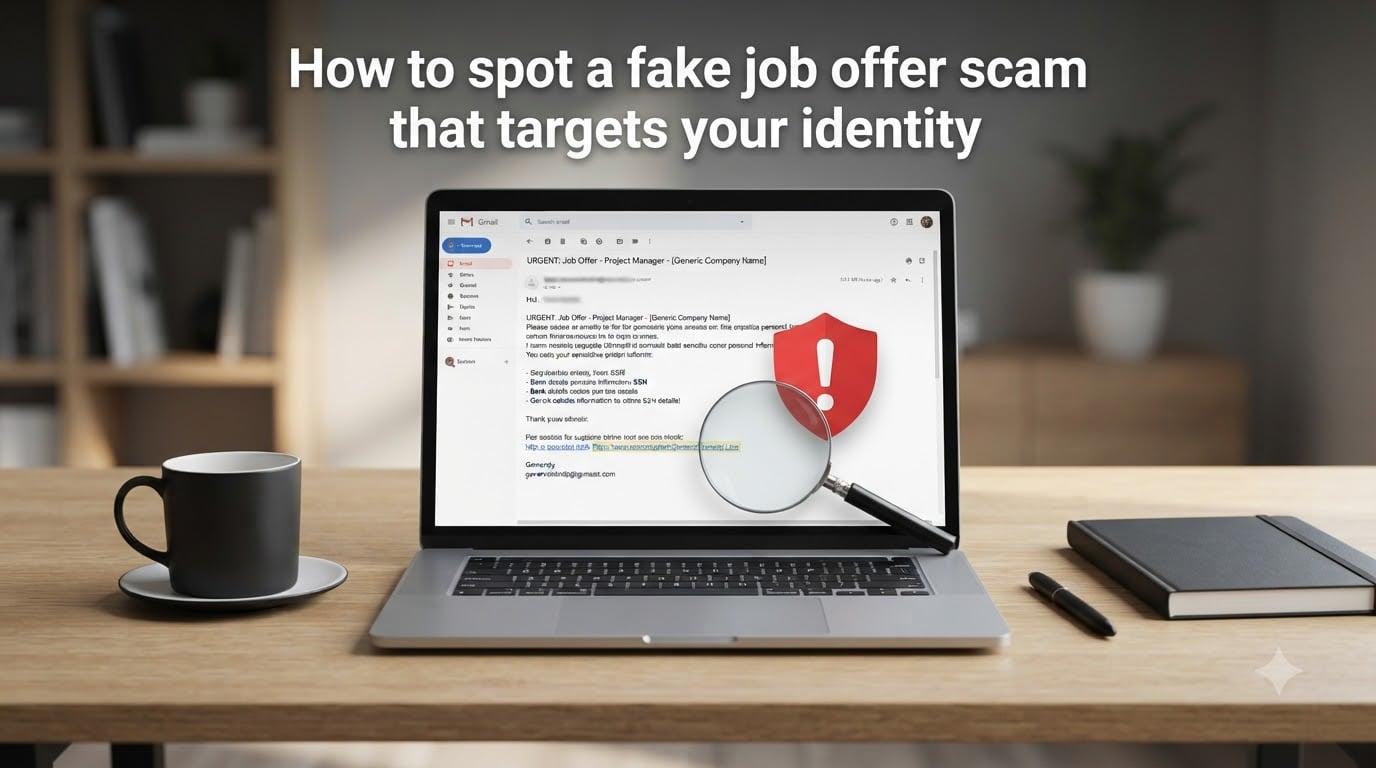
Every time you apply for a job online, you hand over pieces of yourself. Your full name, address, phone number, work history, and often your Social Security number. Now imagine all of that landing in the hands of someone who never planned to hire you in the first place. That is exactly what happens in a fake job offer scam that targets your identity.
I have spent the last several months digging through forum threads on r/Scams and r/IdentityTheft, reading hundreds of victim stories, and studying FTC complaint data. The pattern is chilling and consistent. People are losing money, tanking their credit, and spending months untangling damage from job offers that looked completely legitimate at first glance.
In this guide, I will walk you through how to spot a fake job offer scam that targets your identity before it harms you. You will learn the specific red flags scammers use, how identity theft actually happens through fake jobs, how to verify any offer in minutes, and exactly what to do if you already shared your information.
The stakes are higher than most people realize. The FTC reported record losses from job scams in recent years, and identity-focused variants are growing fast. By the end of this article, you will have a checklist you can run on any job offer in under a minute.
Table of Contents
- What Is a Fake Job Offer Scam?
- How Job Scams Target Your Identity?
- Red Flags: How to Spot a Fake Job Offer Scam That Targets Your Identity
- Common Types of Job Scams in 2026
- SMS and Text Message Job Scams
- Social Media Job Scams on LinkedIn, Facebook, and Instagram
- How to Verify a Job Offer Is Legitimate?
- Quick Checklist: Spot a Scam Job Offer in 60 Seconds
- What to Do If You Already Gave Your Information to a Scammer?
- Frequently Asked Questions
- What are some warning signs that might be a fake job scam?
- How do I verify a job offer’s legitimacy?
- How to check if a job offer letter is real or fake?
- What are five warning signs of a scam?
- How does the identity theft scam work?
- Why am I getting fake job offer texts?
- Can someone steal your identity without your SSN?
- What information do job scams actually need to steal identity?
- Stay Alert and Protect Your Identity
What Is a Fake Job Offer Scam?
A fake job offer scam is a fraudulent job posting or recruitment message designed to steal your personal information or money by impersonating a legitimate employer. The scammer creates a convincing job listing, conducts fake interviews, sends offer letters on stolen company letterhead, and then asks for exactly the kind of sensitive data a real employer would request during onboarding.
The trick is that this data collection feels normal. Every legitimate employer asks for your Social Security number, bank account details for direct deposit, and a government-issued ID to complete an I-9 form. Scammers exploit that expectation. By the time you realize something is wrong, they already have everything they need to open credit accounts, file fake tax returns, or sell your identity on the dark web.
Some scammers skip identity theft entirely and go straight for cash. They send you a fake check, ask you to deposit it, and instruct you to forward a portion of the money elsewhere. The check bounces days later. You are left repaying the bank while the scammer keeps what you sent.
How Job Scams Target Your Identity?
Understanding how to spot a fake job offer scam that targets your identity starts with knowing what data scammers actually want. They are not guessing. They follow a checklist, and each piece of information unlocks a different type of fraud.
The first target is your Social Security number. With just your SSN and full name, a scammer can open credit cards, take out loans, file a fraudulent tax return to claim your refund, and even apply for government benefits in your name. This is why fake job scams almost always include a W-4 or I-9 form request early in the process.
Next comes your bank account information. Scammers request direct deposit forms not to pay you but to set up fraudulent transfers or link your account to money laundering operations. Some victims discover unauthorized withdrawals weeks after the fake job disappears.
Your government-issued ID is another prize. A driver’s license or passport photo gives scammers enough to bypass many identity verification systems. Forum users on r/IdentityTheft have described sending photos of both sides of their license to fake recruiters, only to find accounts opened in their name days later.
Even seemingly harmless details matter. Your date of birth, mother’s maiden name, prior addresses, and employment history are all answers to common security questions. Scammers piece these together to defeat bank and credit account protections.
The most sophisticated scammers do not just steal your identity outright. They use your real work history and personal details to build a synthetic identity, combining real and fabricated information to create a new persona that passes credit checks. This type of fraud is harder to detect and can damage your credit for years before you notice.
Red Flags: How to Spot a Fake Job Offer Scam That Targets Your Identity
Scammers follow predictable playbooks, and that makes them detectable if you know what to look for. Here are the warning signs that a job offer is fake and may be targeting your identity:
Unsolicited contact with an offer that sounds too good to be true. If a recruiter messages you out of nowhere offering high pay for minimal work, treat it as suspicious until verified.
No real interview. A legitimate employer will interview you by phone or video. If you get hired after a text-only chat or a quick messaging app conversation, that is a scam signal.
Requests for upfront payment or fees. No real job asks you to pay for training, equipment, software, or background checks before you start working.
Pressure to act immediately. Scammers create false urgency, claiming the offer expires in hours or insisting you send documents right now.
Personal email addresses. Communication from Gmail, Yahoo, WhatsApp, Telegram, or text messages instead of a company domain is a major red flag.
Vague or copy-pasted job descriptions. If the responsibilities are generic, the company name is missing, or the salary seems disconnected from the role, dig deeper.
Requests for sensitive information before a formal offer. No employer needs your SSN, bank details, or ID photos during the application or interview stage.
Check forwarding schemes. If you are asked to deposit a check and send money or gift cards elsewhere, it is a fake check scam, full stop.
Mismatched or spoofed domains. The email looks like it comes from a real company but the reply-to address or links point elsewhere.
Unrealistic pay for easy work. Offers of $30 per hour for data entry, package sorting, or mystery shopping with no experience required are almost always fraudulent.
Poor grammar and generic greetings. Many scam messages originate overseas and contain awkward phrasing, spelling errors, or address you as “Dear Applicant.”
Requests to communicate only on encrypted apps. Being pushed to move conversations to Telegram, Signal, or WhatsApp is a tactic to avoid detection.
If you see even one of these signs, slow down and verify before sharing anything. If you see three or more, walk away immediately.
Common Types of Job Scams in 2026
Scammers rotate through different job categories depending on what is trending and what attracts the most applicants. Here are the most common fake job offer scams circulating right now.
Work-From-Home and Remote Job Scams
Remote work is popular, and scammers know it. They post fake listings for data entry, virtual assistant, customer service, and administrative roles on job boards. The pay looks excellent, the hours are flexible, and the requirements are minimal. Once you are “hired,” they request your banking information for direct deposit or send equipment that you must pay a deposit to receive.
Reshipping Scams
You are hired to receive packages at your home and forward them to another address, often international. The packages were purchased with stolen credit cards. You become an unwitting link in a fraud chain, and when law enforcement traces the shipments, your address is on the label.
Mystery Shopper Scams
Scammers send you a check to evaluate a store or service. You deposit the check, keep a portion as payment, and send the rest back through wire transfer, gift cards, or cryptocurrency. The check bounces, and you owe the bank the full amount.
Nanny, Caregiver, and Virtual Assistant Scams
These scams target people looking for caregiving or personal assistant roles. The employer sends a large check upfront for supplies or equipment, then asks you to return the difference. Sometimes the scam focuses on identity theft, requesting copies of your ID and personal documents under the guise of a background check.
Job Placement Service Scams
Someone promises to find you a guaranteed job in exchange for a fee. Real staffing agencies are paid by employers, not job seekers. If you are asked to pay for access to exclusive listings, training materials, or placement services, it is a scam.
Government and Postal Job Scams
Scammers charge money for information about federal or postal jobs that is available for free on official government sites like USAJobs.gov. They may also ask for personal information to process your application.
SMS and Text Message Job Scams
One of the fastest-growing threats is the SMS job scam. You receive a text message from an unknown number offering a work-from-home opportunity with excellent pay. The message references a real-sounding company, often a major brand, and asks you to reply or click a link to continue.
I have seen dozens of these messages shared on r/Scams. They typically follow a script. The sender claims to be a recruiter from a well-known company, offers an hourly rate that seems generous, and asks you to move the conversation to a messaging app like Telegram. From there, the scam unfolds with fake interviews, document requests, and sometimes check schemes.
Why are you getting fake job offer texts in the first place? Scammers buy or scrape phone numbers from data breaches, public directories, job board leaks, and resume databases. If your phone number appears anywhere online connected to job hunting, you are on someone’s list. Replying to even one message confirms your number is active and marks you for more attempts.
The text format is dangerous because it feels casual and immediate. People respond to texts faster than emails, and the informality lowers your guard. Never click links in unsolicited job texts. Never share personal information through SMS. If a real recruiter wants to reach you, they will use professional channels with verifiable contact details.
Social Media Job Scams on LinkedIn, Facebook, and Instagram
Social media platforms have become prime hunting grounds for scammers because they can impersonate recruiters with alarming accuracy.
On LinkedIn, scammers create detailed recruiter profiles. They list impressive job titles, steal photos of real professionals, and even build fake connection histories. They send InMail messages offering roles that match your profile, which makes the approach feel targeted and legitimate. Once you engage, they move you to an external chat platform and begin collecting personal data or running check schemes.
Facebook job scams often appear in local community groups or marketplace listings. Someone posts about urgent hiring for warehouse, delivery, or administrative positions. They ask you to message them directly rather than applying through a company page. The conversation moves quickly to requests for your SSN, ID, or bank information.
Instagram scams typically target younger users with offers for brand ambassador, influencer, or content creation roles. The compensation sounds incredible, and the requirements are minimal. Victims are asked to pay for starter kits, promotional materials, or verification fees.
Across all platforms, the common thread is moving you off the official channel. A real recruiter will keep communication within the platform or move you to a verified company email address. Anyone pushing you to Telegram, WhatsApp, or a personal phone number should be treated with suspicion.
How to Verify a Job Offer Is Legitimate?
Verification takes minutes and can save you months of identity theft recovery. Here is a step-by-step process to confirm any job offer is real before you share sensitive information.
Step 1: Check the company independently. Search for the company name and visit their official website directly. Do not click links from the offer email. Look for the job posting on the company’s careers page. If it is not listed there, that is a warning sign.
Step 2: Verify the recruiter. Look up the recruiter on LinkedIn. A legitimate recruiter will have a complete profile, history with the company, and real connections. Cross-reference their email domain against the company website. Scammers frequently spoof domains with subtle misspellings.
Step 3: Confirm a real interview happened. A genuine job offer follows at least one phone or video interview with someone you can identify. If you were hired through text messages alone, with no spoken conversation, the offer is almost certainly fake.
Step 4: Examine the email address closely. Hover over sender addresses to reveal the actual domain. Look for extra characters, hyphens, or country code extensions that do not match the real company. A message from [email protected] is not from Amazon.
Step 5: Research the phone number. If a recruiter calls or texts from a number you do not recognize, search the number online. Scam numbers often appear in complaint databases and fraud reports.
Step 6: Never pay to work. A legitimate employer never charges you for training, background checks, equipment, or software. If money flows from you to the employer before your first paycheck, stop immediately.
Step 7: Trust your instincts. If something feels off, it probably is. Job seekers often override their own intuition because they want the opportunity badly. Pause and investigate before proceeding.
Quick Checklist: Spot a Scam Job Offer in 60 Seconds
Run through this checklist on every job offer you receive. If you answer yes to any of these questions, investigate further before responding.
Did they contact me out of the blue with no application from my side?
Is the pay unusually high for the described work?
Was there no phone or video interview?
Are they using a personal email or messaging app instead of a company domain?
Are they asking for my SSN, bank details, or ID before a formal written offer?
Am I being pressured to respond immediately?
Did they send me a check and ask me to forward money elsewhere?
Am I being asked to pay any fee to start the job?
Can I find this exact posting on the company’s official website?
Does the recruiter’s LinkedIn profile look complete and established?
Print this list, screenshot it, or bookmark this page. Sixty seconds of checking can prevent months of identity theft recovery.
What to Do If You Already Gave Your Information to a Scammer?
If you have already shared personal information with a fake employer, act quickly. The faster you respond, the more damage you can prevent. Here is exactly what to do, in order.
Freeze your credit immediately. Contact all three major credit bureaus, Equifax, Experian, and TransUnion, and place a freeze on your credit file. This prevents anyone from opening new accounts in your name. Freezing is free and takes minutes online. This is the single most effective step you can take.
Place a fraud alert. A fraud alert tells lenders to verify your identity before extending credit. You only need to contact one bureau, and they will notify the other two. A fraud alert lasts one year and is free.
File a report with the FTC. Visit IdentityTheft.gov to file an official report. The site walks you through a personalized recovery plan and generates documentation you can share with banks and credit bureaus.
File a police report. Contact your local police department and file an identity theft report. This creates an official record that strengthens your case with creditors and credit bureaus.
Get an IP PIN from the IRS. If your SSN was compromised, request an Identity Protection PIN from the IRS. This six-digit number prevents anyone else from filing a tax return using your Social Security number.
Contact your bank. If you shared bank account details, notify your financial institution immediately. They can monitor for unauthorized activity, issue new account numbers, and reverse fraudulent transactions if caught early.
Change your passwords. Update passwords on your email, bank, and any accounts where you used the same credentials. Enable two-factor authentication everywhere it is available.
Monitor your accounts. Check your credit reports at AnnualCreditReport.com regularly. Watch for new accounts, hard inquiries, or address changes you did not authorize. Many victims do not discover identity theft for months.
Report the scam. File complaints with the FTC at ReportFraud.ftc.gov and the Internet Crime Complaint Center at IC3.gov. Include the scammer’s phone numbers, email addresses, and any other details that could help track them.
Frequently Asked Questions
What are some warning signs that might be a fake job scam?
Warning signs include unsolicited contact with too-good-to-be-true pay, no real interview, requests for upfront payment, pressure to act immediately, communication from personal email or messaging apps, vague job descriptions, and requests for your Social Security number or bank details before a formal offer.
How do I verify a job offer’s legitimacy?
Check the company website directly for the posting, verify the recruiter on LinkedIn, confirm a phone or video interview occurred, examine the sender email domain for spoofing, research the phone number, and never pay fees to start working. If you cannot find the job on the official company site, treat it as suspicious.
How to check if a job offer letter is real or fake?
Compare the letter against the company’s official communication format, verify the sender email domain matches the company website exactly, call the company using the phone number from their official site to confirm the offer, and check whether a formal interview preceded the offer. Fake letters often contain formatting errors, generic greetings, and requests for sensitive data.
What are five warning signs of a scam?
The top five warning signs are: the pay is unrealistically high for the work, there is no phone or video interview, you are asked to pay money upfront, you are pressured to respond immediately, and communication happens through personal email or messaging apps instead of a company domain.
How does the identity theft scam work?
Scammers create fake job listings to collect your Social Security number, bank details, and government ID under the guise of onboarding. They use this data to open credit accounts, file fraudulent tax returns, or sell your identity. Some use your real work history to build synthetic identities that pass credit checks.
Why am I getting fake job offer texts?
Scammers obtain phone numbers from data breaches, public directories, job board leaks, and resume databases. If your number appears anywhere online connected to job hunting, you are a target. Replying to even one fake text confirms your number is active and leads to more attempts. Never click links or share information through unsolicited texts.
Can someone steal your identity without your SSN?
Yes. With your full name, date of birth, address, government-issued ID, and employment history, scammers can open accounts, bypass some identity verification systems, and build synthetic identities. Your SSN makes identity theft easier and more damaging, but it is not the only piece of data scammers can exploit.
What information do job scams actually need to steal identity?
Scammers target your Social Security number, government-issued ID photos, bank account details, date of birth, full address, and employment history. This combination allows them to open credit accounts, file fake tax returns, set up fraudulent direct deposits, and defeat security questions on existing accounts.
Stay Alert and Protect Your Identity
Knowing how to spot a fake job offer scam that targets your identity is one of the most valuable skills you can develop as a job seeker. The warning signs are consistent, the verification steps take minutes, and the recovery plan is clear if the worst happens.
Run the 60-second checklist on every offer. Trust your instincts when something feels wrong. And if you have already shared information, freeze your credit and file an FTC report the same day. Your identity is worth far more than any job offer, and a legitimate employer will never pressure you to compromise it.