
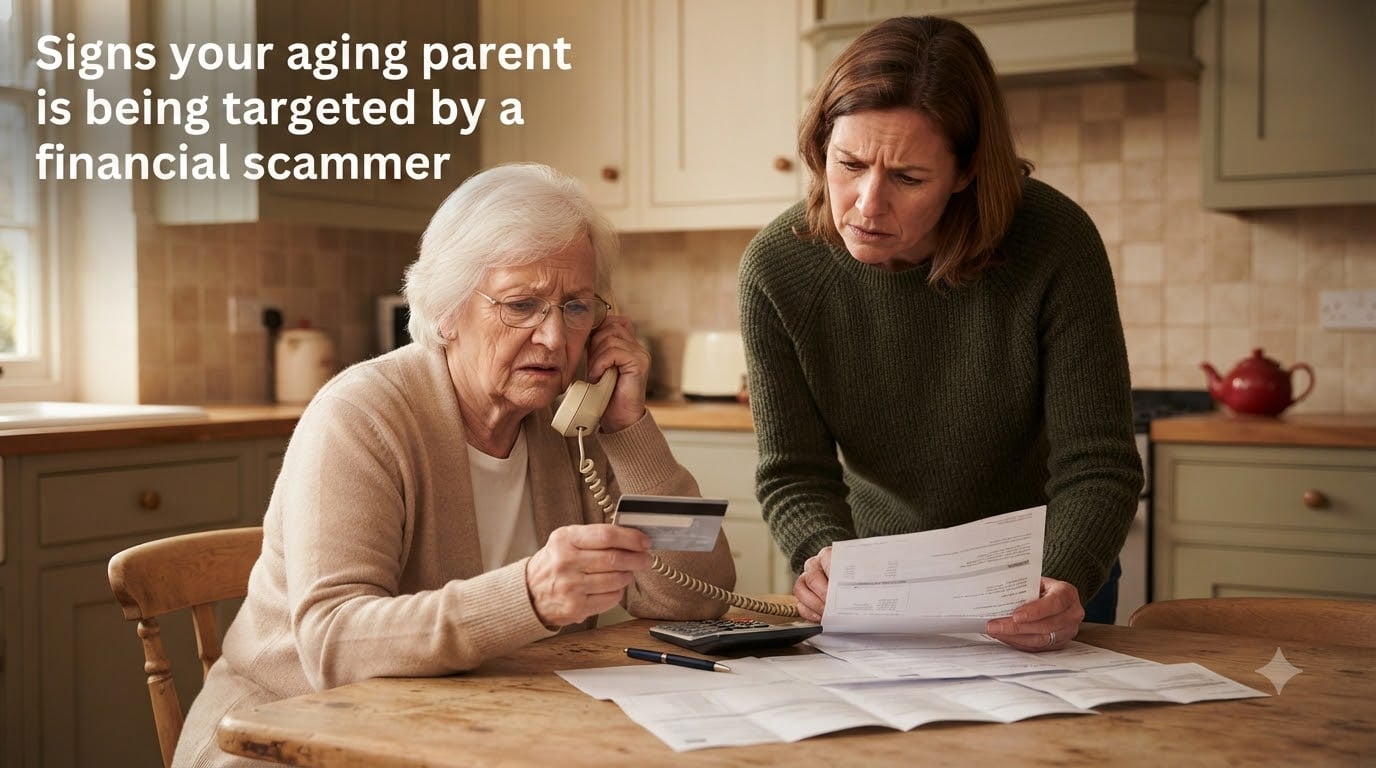
I never expected my father’s phone to ring at 2 a.m. with someone claiming to be his grandson in jail. But that is exactly how a scammer tried to drain his savings last year. The voice sounded panicked, the story felt real, and the “bail money” demand came within minutes.
Unfortunately, stories like my father’s are happening to families across America every single day. According to the FBI’s Internet Crime Complaint Center (IC3), older adults lost more than $3.4 billion to cybercrime in 2026 alone, and the average victim loses over $33,000 before anyone notices (FBI IC3, 2026). The FTC reports that adults aged 60 and over filed more than 380,000 fraud reports last year, with median losses climbing sharply with age (FTC, 2026).
This is not a small problem. It is a quiet epidemic that preys on trust, isolation, and the very human desire to help family. If you are reading this, you probably already sense something is off with your own parent. Maybe you noticed strange packages, secretive phone calls, or sudden transfers of money. Maybe you just want to be ready before something happens.
This guide covers the warning signs your aging parent is being targeted by a financial scammer, the most common scam types circulating right now, the new threat of AI voice cloning, the exact steps to take if your parent has already been scammed, how to talk to a parent who refuses to listen, and where to report elder financial fraud. I have gathered data from the FTC, FBI, NCOA, Adult Protective Services, and the Elder Fraud Hotline to give you clear, actionable answers.
Table of Contents
- Why Financial Scammers Target Aging Adults?
- Warning Signs Your Aging Parent Is Being Targeted by a Financial Scammer
- Common Scam Types That Target Older Adults
- The New Threat of AI Voice Cloning Scams
- Immediate Actions If Your Parent Has Been Scammed
- How to Talk to a Parent Who Won’t Listen?
- Protective Measures to Prevent Future Scams
- Where to Report Elder Financial Scams?
- FAQs
- Final Thoughts on Protecting Your Aging Parent
Why Financial Scammers Target Aging Adults?
Scammers do not pick victims at random. Aging adults sit at the center of a perfect storm of vulnerability that makes them uniquely profitable targets. Understanding the “why” helps you approach the conversation with empathy instead of frustration.
Three factors make seniors especially attractive. First, there is the wealth factor. People aged 50 and older in the United States hold more than 70% of all household wealth, which means scammers see a bigger payoff per attack. Second, there is the trust factor. Many older adults grew up in an era when businesses, banks, and government agencies operated in good faith, and they extend that trust to callers and emails by default. Third, there is the isolation factor. When a spouse passes away or friends move on, scammers become the friendly voices on the other end of the line.
There are also cognitive and digital factors at play. Age-related changes in memory, judgment, and processing speed can make complex scams harder to spot. At the same time, the people who never had to learn email or smartphone security are now managing online banking, social media, and digital subscriptions. Scammers know this. They build emails that look like Microsoft or Amazon alerts, knowing many seniors will click before thinking.
The numbers back this up. The NCOA reports that one in five older Americans has experienced some form of financial exploitation, and only a fraction of cases are ever reported (NCOA, 2026). The FBI points out that older victims are less likely to report fraud out of embarrassment, which lets the same scammer come back again and again. That combination of higher wealth, lower digital literacy, and lower reporting makes aging adults a target-rich environment for organized fraud rings.
Warning Signs Your Aging Parent Is Being Targeted by a Financial Scammer
These are the most common warning signs your aging parent is being targeted by a financial scammer. I have compiled this list from FTC, FBI, and NCOA resources, plus real-world case reports from family caregivers. If you notice three or more of these signs, it is time to take action.
Unsolicited calls about prizes, sweepstakes, or “winnings” that require payment of taxes or fees before the prize is released.
Urgent demands for secrecy, especially phone calls telling your parent not to discuss the situation with family or bank staff.
Requests to pay with gift cards, wire transfers, or cryptocurrency, which are nearly impossible to trace or reverse.
Sudden unexplained withdrawals from bank accounts, retirement funds, or savings.
New “best friends” or romantic interests your parent met online that they have never met in person.
Mail piling up with unfamiliar credit card statements or new accounts your parent did not open.
Fear or anxiety when the phone rings, especially from unknown numbers.
Talk of tech support or virus removal after a routine phone call or pop-up message.
Repeated charitable donations to organizations your parent cannot clearly name or describe.
Confusion about recent financial decisions, with stories that do not quite add up.
Cash being mailed or handed to couriers at the door, sometimes daily.
New “authorized users” or “helpers” added to bank accounts who are not family members.
Pay particular attention to behavior changes. A parent who was once open about finances becoming secretive, or a parent who was confident becoming anxious when discussing money, is often the earliest red flag.
Common Scam Types That Target Older Adults
Knowing the actual scams in circulation makes it easier to spot them when they show up in your parent’s life. The FBI, FTC, and NCOA consistently track the same handful of high-impact schemes, and these are the ones most often used to target older adults.
Government Impersonation Scams. A caller pretends to be from the IRS, Social Security Administration, or Medicare. They claim your parent owes back taxes, has a suspended Social Security number, or has committed Medicare fraud. They demand immediate payment, often through gift cards, to avoid arrest or benefit suspension. The FTC reports that government impersonation remains one of the top three scams targeting seniors.
Grandparent Scams. Someone calls pretending to be a grandchild in trouble, often in another country, needing bail money, hospital bills, or emergency travel funds. The classic version includes the line “Don’t tell mom and dad” to keep victims from verifying. With AI voice cloning now in play, these calls can sound exactly like your parent’s actual grandchild.
Tech Support Scams. A pop-up on the computer claims a virus has been detected. The “support technician” then asks for remote access to the computer and payment for unnecessary repairs. One caregiver on Reddit shared that her 76-year-old father lost $145,000 to a fake Microsoft 365 support scam he found through a Google search. The bank could not stop the wire transfers because he was authorizing them himself.
Romance Scams. A “sweetheart” connects on a dating site or social media, builds a relationship over weeks or months, and then asks for money. They often claim to be overseas, deployed, or in a business emergency. The FTC reports median losses from romance scams are among the highest of any fraud category, often exceeding $10,000 per victim.
Medicare and Health Insurance Scams. Scammers pose as Medicare representatives offering free medical equipment, COVID-19 tests, or updated insurance cards. They collect Social Security numbers and personal data that can be used for identity theft.
Sweepstakes and Lottery Scams. A letter, email, or call says your parent has won a major prize, but they must pay taxes or shipping fees first. Real lotteries never ask for upfront payment. Once a victim pays, the demands usually continue with new “fees” and “taxes.”
Investment and Cryptocurrency Scams. Older adults are increasingly targeted by fake investment opportunities, especially ones pitching guaranteed returns through cryptocurrency or gold. The FBI IC3 reported that crypto investment fraud led to more than $3.9 billion in losses across all age groups in 2026, with the median age of victims climbing steadily.
Fake Charity Scams. After major disasters, scammers set up lookalike charities and pressure seniors into donating. Real charities will never demand immediate payment by gift card or wire transfer.
The New Threat of AI Voice Cloning Scams
Here is the threat that keeps me up at night. AI voice cloning technology now lets scammers create realistic copies of a person’s voice using just a few seconds of audio. That audio can come from a TikTok video, a YouTube interview, a voicemail greeting, or a Facebook post. The FBI issued a formal warning in 2026 about criminals using AI-generated voices in grandparent scams and emergency impersonations (FBI IC3, 2026).
Imagine your phone rings and you hear your daughter’s voice, crying, saying she has been in a car accident and needs money wired right away. It sounds just like her. It has her speech patterns, her tone, even her laugh. The scammer asks you not to call her back because she is “in surgery.” By the time you realize it was a recording, the money is gone.
This is no longer science fiction. The NCOA has reported cases where AI-cloned voices were used to defraud families out of tens of thousands of dollars in a single call. The defense is to establish a family “safe word” and to always hang up and call the person directly on a number you already have saved. If your parent receives a call like this, encourage them to do the same.
Immediate Actions If Your Parent Has Been Scammed
If you suspect your parent has already lost money to a scammer, time is critical. The first 24 to 48 hours often determine whether any money can be recovered and whether further damage can be prevented. Walk through these steps with your parent immediately.
Stop all communication with the scammer. Block phone numbers, emails, and social media accounts. Do not respond to any further messages, even ones claiming to “refund” the money. Refund scams are a common follow-up trick.
Contact the bank or financial institution right away. Ask the fraud department to freeze accounts, reverse pending transactions if possible, and place a fraud alert on the account. Most banks have a dedicated fraud hotline open 24/7.
Place a fraud alert or credit freeze with all three credit bureaus (Equifax, Experian, TransUnion). A credit freeze is free and prevents new accounts from being opened in your parent’s name.
Document everything. Save emails, texts, voicemails, bank statements, and screenshots. Write down the timeline of events while it is fresh, including dates, amounts, and names used by the scammer.
File a report with the FTC at ReportFraud.gov or by calling 1-877-FTC-HELP. The FTC uses these reports to track scam patterns and coordinate with law enforcement.
File a report with the FBI’s Internet Crime Complaint Center (IC3) at ic3.gov. The IC3 tracks internet-facilitated fraud and works with local law enforcement on cases involving significant losses.
Contact local Adult Protective Services (APS) if you believe your parent is still being targeted or financially exploited. APS can conduct wellness checks and connect families with protective services.
Call the Elder Fraud Hotline at 1-833-FRAUD-11 (1-833-372-8311) for personalized case support, especially if the loss is large or has cross-border elements.
Notify the Social Security Administration, IRS, or Medicare if the scammer claimed to represent these agencies. Replace any compromised Medicare card or report a stolen Social Security number at identitytheft.gov.
Consider consulting an elder law attorney if the loss is significant. An attorney can advise on recovery options, conservatorship concerns, and protective legal tools.
Try to act gently with your parent during this process. Shame keeps many seniors from reporting fraud, and your calm presence now is what allows them to keep talking to you later.
How to Talk to a Parent Who Won’t Listen?
This is the hardest part of the entire situation, and no checklist fully prepares you for it. You can have all the evidence in the world, and a parent who refuses to believe they are being scammed will still hang up on you. The psychologies at play are trust, dignity, and fear. A scammer exploits all three, and confronting them head-on often makes them dig in deeper.
Start by validating, not correcting. Saying “you got scammed” almost guarantees an argument. Instead, try “this kind of scam is so common that even bank executives have fallen for it.” Framing helps remove the shame. Many adults who refuse to listen are not in denial because they are gullible. They are in denial because admitting the truth means accepting they have lost control or, worse, their judgment.
Here are some scripts that have worked for caregivers. Adapt them to your family’s tone. Script one for the call demanding gift cards: “I read that these gift card scams are happening to thousands of people every week. Can we check with the bank together, just to be safe?” Script two for the new online friend: “It sounds like you really care about this person. Can we video call them together so I can say hello?” Script three for the “secret” investment: “The bank requires a second signature on transactions over $10,000 in our family. It’s just what we do.”
Recruit trusted allies. A parent’s own attorney, doctor, clergy, or long-time friend can sometimes deliver the message more effectively than a child. Frame the conversation as a family precaution, not a critique of their judgment. Many scam victims truly believe the person they are sending money to is a real friend. That belief was built slowly, and undoing it takes time.
Finally, watch for signs of repeat victimization. If your parent has been scammed once, the FBI notes the risk of being targeted again is high since the names get sold on the dark web. Engage your parent’s bank, set up transaction alerts, and consider adding a trusted contact person to the bank account so the bank can flag suspicious activity.
Protective Measures to Prevent Future Scams
Prevention is always easier than recovery. Once you have addressed the immediate crisis, work with your parent to put long-term safeguards in place. The goal is to add friction without taking away dignity or autonomy.
Set up transaction alerts on bank and credit card accounts so any withdrawal or charge over a set amount triggers a text or email.
Add a trusted contact person to bank accounts. Most banks allow seniors to name a family member who can be called if suspicious activity is detected.
Place a credit freeze with all three credit bureaus. A freeze is free, lasts until you lift it, and prevents new accounts from being opened in your parent’s name.
Use call-blocking tools on the phone to filter robocalls and known scam numbers. Major carriers offer free scam-blocking services.
Register phone numbers on the National Do Not Call Registry at donotcall.gov. Legitimate telemarketers will stop calling within 31 days.
Establish a family password for any emergency request involving money. Any real grandchild or family member will understand and use it.
Schedule regular money check-ins where you review statements together, not to take over but to stay informed.
Update privacy settings on social media accounts so scammer cannot pull voice samples or family details easily.
Consider a password manager to help your parent use unique, strong passwords for email and banking without having to memorize them.
Educate without lecturing. Share news articles about scams targeting seniors and praise your parent for being aware. This builds a habit of scrutiny without creating shame.
If your parent is open to it, consider working with a Daily Money Manager or financial advisor who specializes in elder care. These professionals can review statements, pay bills, and flag suspicious activity for a reasonable fee.
Where to Report Elder Financial Scams?
Reporting matters. Even if you do not recover the money, the report becomes part of a national database that helps investigators shut down fraud rings and warn other families. The FTC, FBI, NCOA, APS, and the Elder Fraud Hotline all play different roles in the response system.
FTC (Federal Trade Commission) – File at ReportFraud.gov or call 1-877-FTC-HELP. The FTC collects reports from every consumer and uses them to identify trends, pursue enforcement, and publish scam alerts.
FBI IC3 (Internet Crime Complaint Center) – File at ic3.gov. The FBI handles internet-facilitated crimes, including tech support scams, romance scams, investment fraud, and AI voice cloning cases. The IC3 issues the annual Elder Fraud Report that you will see cited in the news.
Adult Protective Services (APS) – Every state has an APS agency. They investigate reports of elder financial exploitation, abuse, and neglect. Find your local APS office through the Eldercare Locator at eldercare.acl.gov or by calling 1-800-677-1116.
Elder Fraud Hotline – Call 1-833-FRAUD-11 (1-833-372-8311). Operated by the U.S. Department of Justice, this hotline provides case support, connects families to resources, and helps victims aged 60 and over.
NCOA (National Council on Aging) – Visit ncoa.org for scam awareness resources, educational materials, and tools for older adults and caregivers. The NCOA also funds programs that directly support seniors in avoiding fraud.
Local Police and State Attorney General – For immediate threats or in-person harassment, contact local law enforcement. Your state attorney general’s office also has a consumer protection division that handles fraud complaints.
FAQs
What to do when your elderly parent keeps getting scammed?
If your elderly parent keeps getting scammed, treat it as both a financial and emotional issue. First, secure the accounts by contacting the bank, placing a credit freeze, and adding a trusted contact. Then report the incident to the FTC at ReportFraud.gov and the FBI IC3. Most importantly, do not shame your parent. Repeat victimization is common, and a non-judgmental approach makes them more likely to tell you about the next attempt quickly.
How to convince an elderly person they are being scammed?
Avoid saying they got scammed. Frame it as a widespread problem: these scams are happening to thousands of people every week. Use real news stories, involve a trusted third party like a doctor or attorney, and ask to verify together rather than confront. Scammers build trust over time, so undoing it takes patience. A family safe word and direct callback to known numbers help close the loop.
What are the red flags for elderly financial exploitation?
Red flags include sudden unexplained withdrawals, secretiveness about finances, requests for gift cards or wire transfers, urgent callers demanding secrecy, new online romantic interests, missing mail, fear when the phone rings, and confusion about new accounts or financial decisions. Multiple red flags together signal it is time to talk to the bank and consider protective measures like a credit freeze.
How to stop an elderly parent from giving money away?
You cannot take away their autonomy, but you can add friction. Set up bank transaction alerts, place a credit freeze, add a trusted contact to the account, and require a second signature for large transactions. Have a calm conversation about family protocols for any emergency money request. If necessary, consult an elder law attorney about protective legal tools such as a financial power of attorney or limited conservatorship.
Final Thoughts on Protecting Your Aging Parent
Recognizing the signs your aging parent is being targeted by a financial scammer is the first step in protecting their savings and their dignity. Watch for the warning signs, know the common scam types, and act quickly if something has already happened. Most importantly, keep the conversation open, gentle, and ongoing. The families who catch fraud early are the ones who talk about money as a normal, shame-free topic long before a scammer ever calls.
Use the FTC, FBI IC3, NCOA, Adult Protective Services, and the Elder Fraud Hotline. Share this guide with siblings, friends, and neighbors. The more people who know what to look for, the harder it becomes for scammers to win.