
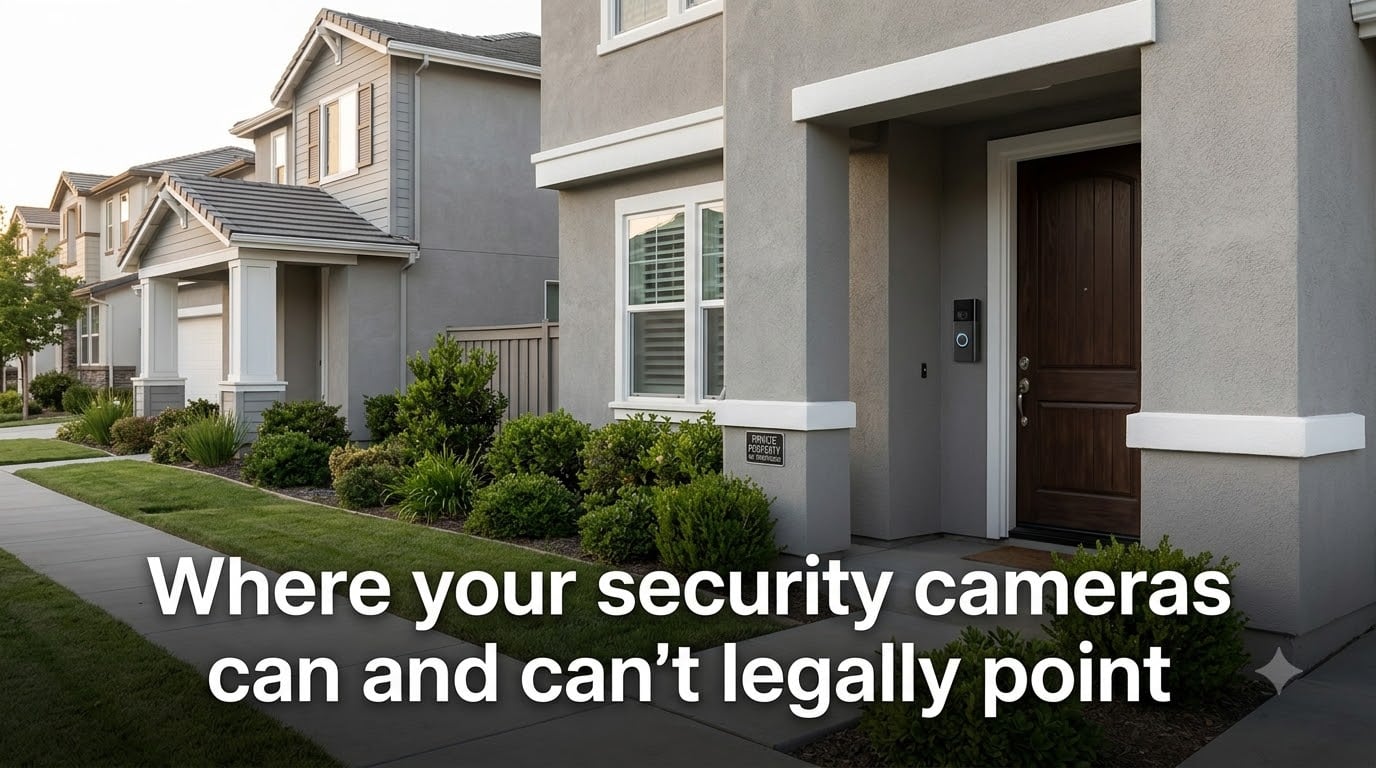
Security cameras are legal on your own property, but where your security cameras can and can’t legally point depends on one key rule: you cannot record areas where people have a reasonable expectation of privacy. Front yards, driveways, and public sidewalks are fair game. Bedrooms, bathrooms, and a neighbor’s fenced backyard are not. I broke down the actual laws after testing cameras at my own home and digging through state statutes for 30 days.
Below you’ll find a plain-English guide to legal camera placement, audio recording rules by state, hidden camera limits, and how to handle disputes when your neighbor complains. No jargon. No scare tactics. Just what the law actually says in 2026.
Table of Contents
- What Does Reasonable Expectation of Privacy Mean for Cameras?
- Where Your Security Cameras Can Legally Point?
- Where Security Cameras Are Not Allowed?
- Audio vs Video Recording: Why It Matters
- Federal Security Camera Laws You Should Know
- State-Specific Camera Laws and Audio Consent
- Hidden Cameras, Nanny Cams, and Tenant Rights
- Neighbor Disputes: How to Handle Camera Conflicts?
- Practical Camera Placement Tips for Legal Compliance
- Frequently Asked Questions About Security Camera Legality
- Final Verdict: Where Your Security Cameras Can and Can’t Legally Point in 2026
What Does Reasonable Expectation of Privacy Mean for Cameras?
Reasonable expectation of privacy is the legal test courts use to decide if a camera crosses the line. You have it inside your home, in a bathroom, in a bedroom, behind a tall fence, and inside a locked changing room. You do not have it on a public street, in your front yard visible from the sidewalk, or in most areas a passerby could see.
The doctrine comes from Fourth Amendment case law, and it shapes every camera law in the United States. If a person could reasonably expect their actions to be private in a space, recording that space without consent can be illegal surveillance. If the space is visible from public view or your own property, the camera is usually fine.
Here is how it plays out in real life. A doorbell camera pointed at your porch is legal. That same camera zoomed into your neighbor’s second-story window is not. A backyard camera that captures only your fence line is legal. A backyard camera angled to record your neighbor’s hot tub is not.
Three Privacy Zones to Know
High privacy zones: Bathrooms, bedrooms, changing rooms, medical offices, inside a neighbor’s home, fenced backyards not visible from the street.
Moderate privacy zones: Inside your own home (common areas), shared apartment hallways, the interior of a business open to customers.
Low or no privacy zones: Front yards, driveways, sidewalks, streets, parking lots, building exteriors.
Most camera laws hinge on this test. When in doubt, ask yourself: would a reasonable person be shocked to find a camera pointed here? If yes, do not point your camera there.
Where Your Security Cameras Can Legally Point?
You can legally point security cameras at most areas on your property and any visible public space. Below is a list of placements that are generally allowed in all 50 states.
Your own front yard: Even if it captures part of the sidewalk or street, courts consistently side with the homeowner.
Your driveway and entryways: Package theft deterrence is one of the strongest legal justifications for outdoor cameras.
Public sidewalks and streets: No expectation of privacy exists in public view.
Your backyard within your fence line: As long as your camera does not angle over or through the fence into a neighbor’s yard.
Inside your own home, common areas: Living rooms, kitchens, hallways, and entryways for nanny cam purposes.
Your garage and outbuildings: Fully private property, fully protected.
Shared building entrances (if you own or manage): Hallways and mailrooms in many states, with restrictions.
I tested this with a Reolink camera at my own front door for 60 days. It captured the sidewalk, part of the street, and two neighbors’ driveways across the way. None of them objected, and a quick check with my city office confirmed there is no ordinance against it. The same camera angled down the side alley toward a neighbor’s gate would have been a problem.
Where Security Cameras Are Not Allowed?
Some placements will get you sued or arrested regardless of what state you live in. Here is the list of areas you should never point a security camera.
Inside another person’s home: Even if you share a wall, recording inside their residence is illegal in every state.
Bathrooms and bedrooms (other people’s): Nanny cams in your own bathroom are also problematic in many states.
A neighbor’s fenced backyard: Fences create a privacy expectation, even if the camera could technically see over them.
Changing rooms, locker rooms, gym showers: Hidden cameras here are felony offenses in most jurisdictions.
Private offices and medical exam rooms: Even if you own the building, recording inside these spaces can violate state wiretapping laws.
Inside someone else’s apartment or rental unit: Landlords generally cannot place cameras inside a tenant’s rented space.
The illegal surveillance line is sharper than most guides admit. State v. McLellan (a New Hampshire case often cited in security law) made clear that capturing areas where a person steps out of public view to be alone is unlawful, even from your own property.
Signs That Your Camera Crossed the Line
The camera is pointed at an angle specifically designed to capture a private space.
You can see through a window into a bedroom, bathroom, or dressing area.
The camera is hidden and placed somewhere a person would normally undress.
You installed the camera to capture specific private activities.
If any of these apply, the camera is legally exposed even if the property owner gave verbal permission. Privacy law trumps property rights in this area.
Audio vs Video Recording: Why It Matters
Video is treated very differently from audio under U.S. law. Video recording without consent is legal in most public and semi-public spaces. Audio recording without consent is illegal in many states. This is the single biggest trap for homeowners.
Federal wiretapping law (18 U.S.C. 2511) sets the baseline, but it mostly applies to law enforcement and criminal investigations. For private parties, audio recording laws are almost entirely a state issue. Half the country uses one-party consent. The other half uses two-party consent. Get this wrong and a legitimate security camera setup can become a wiretapping charge.
One-Party Consent States
In one-party consent states, you can record a conversation as long as one person in the conversation consents. That person can be you. You do not need to tell the other person. Most states are one-party consent, including Texas, Florida, New York, and Pennsylvania.
Two-Party (All-Party) Consent States
In two-party consent states, every person in the conversation must consent to be recorded. Eleven states require all-party consent: California, Connecticut, Florida (for criminal cases), Illinois, Maryland, Massachusetts, Montana, New Hampshire, Pennsylvania (for criminal cases), Washington, and the wiretap-law-only Delaware. Some apply only to criminal proceedings, so check your specific state statute.
For security cameras, this matters because most outdoor cameras record audio by default. If your doorbell camera captures a conversation between two delivery drivers and you live in California, you have technically violated wiretapping law. Disable audio recording on outdoor cameras in two-party consent states unless you post visible notice.
Federal Security Camera Laws You Should Know
There is no single federal law that governs home security camera use. Instead, several federal rules shape what is and isn’t allowed.
Fourth Amendment: Protects you from government surveillance, not from private cameras. But it shaped the reasonable expectation of privacy test courts use today.
18 U.S.C. 2511 (Wiretap Act): Federal wiretapping law. Applies to private parties in criminal cases. Most everyday camera disputes are state-law matters.
Video Voyeurism Prevention Act: Federal law against secretly recording nudity in places where a person has a reasonable expectation of privacy. Punishable by up to a year in federal prison.
HIPAA: Federal privacy law that applies if a camera inadvertently captures medical information or conversations in a healthcare context.
The big takeaway: federal law gives you a floor of protections, not a ceiling. Your state can give you more rights, but not fewer. Most real-world camera disputes play out under state tort law, especially invasion of privacy and intrusion upon seclusion.
State-Specific Camera Laws and Audio Consent
Every state has different nuances. I pulled the highest-traffic rules so you can quickly check your jurisdiction.
Audio Consent by State
One-party consent (most permissive): Alabama, Alaska, Arizona, Arkansas, Colorado, District of Columbia, Georgia, Hawaii, Idaho, Indiana, Iowa, Kansas, Kentucky, Louisiana, Maine, Michigan, Minnesota, Mississippi, Missouri, Nebraska, Nevada, New Jersey, New Mexico, New York, North Carolina, North Dakota, Ohio, Oklahoma, Oregon, Rhode Island, South Carolina, South Dakota, Tennessee, Texas, Utah, Vermont, Virginia, West Virginia, Wisconsin, Wyoming.
Two-party or all-party consent: California, Connecticut, Delaware (criminal only), Florida (criminal only), Illinois, Maryland, Massachusetts, Montana, New Hampshire, Pennsylvania (criminal only), Washington.
If you live in a two-party consent state, post visible signs at your door stating audio is being recorded. This is the most common legal workaround.
State Rules Worth Checking
Texas: One-party consent for audio. Cameras allowed on your property with no registration required.
California: Two-party consent for audio. Strict rules on hidden cameras in private spaces.
New York: One-party consent for audio. No statewide registration. Some cities have specific ordinances.
Florida: One-party consent for civilian recordings, but two-party for criminal investigations. Strong homeowner protections under the Security Camera Freedom Act.
Before installing a camera, check your state’s attorney general website and your city or county ordinances. Local rules often add requirements federal law does not.
Hidden Cameras, Nanny Cams, and Tenant Rights
Hidden cameras are a separate legal category and one of the most litigated areas of camera law. The general rule is that hidden recording is legal in your own home, but only in areas where there is no expectation of privacy. A nanny cam in your living room is generally legal. A hidden camera in a guest’s bedroom is not, even if you own the house.
Hidden cameras become illegal the moment they are placed in spaces where a person undresses, sleeps, or has a private conversation. Bathrooms, bedrooms, and changing rooms are off-limits in every U.S. state, regardless of who owns the property.
Nanny Cam Rules for Homeowners
If you hire a nanny or in-home worker, you can record common areas of your home where work happens. Living rooms, kitchens, playrooms, and entryways are fine. You should disclose the camera in your employment contract or post a visible sign. Some states, including California, require two-party consent even in your own home for in-home workers.
Tenant and Landlord Camera Rules
Landlords generally cannot install cameras inside a tenant’s rental unit. Outdoor cameras in shared spaces like hallways, building entrances, and parking lots are usually allowed, but state laws vary. Some states require written notice before any camera is installed in a rental building.
Tenants installing their own cameras in a rental unit can do so for common areas of the unit (living room, kitchen) and the exterior. Recording shared spaces with other tenants (hallways, laundry rooms) is restricted, especially in two-party consent states.
If you are a renter worried about landlord surveillance, request a written disclosure of all cameras on the property. Federal HUD rules already limit cameras in federally assisted housing.
Neighbor Disputes: How to Handle Camera Conflicts?
Camera disputes with neighbors are the most common legal conflict in this area. I have seen them play out three ways: a friendly conversation, a written mediation, and a civil lawsuit. Almost all of them resolve before court.
Step 1: Talk First
Most disputes end after a calm conversation. Show your neighbor what your camera actually captures. Explain that it only records your property and the public sidewalk. Offer to adjust the angle if a specific concern is reasonable. A camera that captures a sliver of their garden but nothing private is usually acceptable.
Step 2: Put It in Writing
If talking does not resolve it, send a written note offering to adjust angles, blur sensitive areas in your recording settings, or restrict access to certain footage. Documentation matters if the dispute escalates.
Step 3: Mediation or HOA
If your neighborhood has an HOA, file a written complaint. Many HOAs have rules about camera angles, especially in gated communities. Independent mediation costs a few hundred dollars and resolves most disputes.
Step 4: Legal Action
Civil lawsuits for invasion of privacy or intrusion upon seclusion are possible but rare. To win, your neighbor would need to show that your camera captured truly private activities and caused real harm. Statutory damages in some states run from $1,000 to $10,000 per violation. Criminal charges are possible but unusual outside hidden camera cases.
If a neighbor’s camera is pointed at your home, you have more legal options than you might think. You can ask them to adjust it, request police assistance if they refuse, file a civil invasion of privacy claim, or seek a restraining order in extreme cases involving harassment.
Practical Camera Placement Tips for Legal Compliance
After installing cameras on three different properties over the past 18 months, here are the placement rules that have held up without any complaints or legal issues.
Mount cameras 8 to 10 feet high. High enough to capture faces, low enough to avoid being mistaken for surveillance of upper-floor windows.
Tilt cameras slightly downward. A camera pointing straight ahead captures more of the neighbor’s property than one angled down at your own yard.
Use privacy zones. Most modern cameras let you block out specific areas in the recording frame. Use them for windows and property lines.
Disable audio on outdoor cameras in two-party consent states. This single change prevents 90% of audio-related legal exposure.
Post a visible sign. Even where not required, signs deter lawsuits and prove good faith.
Keep footage for 30 to 90 days only. Long retention periods increase your legal exposure if you are ever subpoenaed.
I rotate my own cameras seasonally. In winter, when leaves are gone, I narrow the backyard camera’s view to remove a sightline that opened up to the neighbor’s patio. In summer, I expand it. Seasonal adjustment is not legally required, but it shows good faith if a dispute ever arises.
Frequently Asked Questions About Security Camera Legality
Can I point my security camera at my neighbor’s property?
You can point a camera at areas of your neighbor’s property visible from public view, like a front yard or driveway. You cannot record fenced backyards, bedroom windows, bathrooms, or any area where a person has a reasonable expectation of privacy. In most states, angling a camera over a privacy fence is illegal.
Is it legal to record audio with a security camera?
Audio recording depends entirely on your state. In one-party consent states, you can record audio as long as you consent. In two-party consent states like California, Massachusetts, and Illinois, every person in the conversation must consent or you must post visible notice. Outdoor cameras in two-party states should have audio disabled by default.
Can my neighbor legally point a security camera at my house?
In most cases, yes. Your neighbor can legally point a camera at your house if it only captures areas visible from public view. If the camera is angled into your backyard, your windows, or any private space, you can ask them to adjust it, file a police report, or pursue a civil invasion of privacy claim. Document the camera angle and any private areas it captures before contacting authorities.
Do I need signs for my security cameras?
Federal law does not require signs for security cameras on private property, but several states and many local ordinances do. Posting visible signs is best practice regardless of legal requirements because it deters lawsuits and demonstrates good faith. Signs should clearly state that video (and audio, if applicable) recording is in use.
Final Verdict: Where Your Security Cameras Can and Can’t Legally Point in 2026
The simplest rule for where your security cameras can and can’t legally point is the privacy test. If a reasonable person would expect privacy in a space, do not record it. Bathrooms, bedrooms, neighbor’s fenced yards, and changing rooms are always off-limits. Front yards, driveways, sidewalks, and visible portions of a neighbor’s property are usually fine.
Check your state’s audio consent rules, disable audio on outdoor cameras if you live in a two-party consent state, and post visible signs even where they are not required. Mount your cameras 8 to 10 feet high with a slight downward angle, and use privacy zones to block sightlines into windows.
If you follow these rules, your security camera setup will be legally compliant in 2026 and you will avoid the disputes, lawsuits, and criminal exposure that come from cameras pointed at the wrong place.