
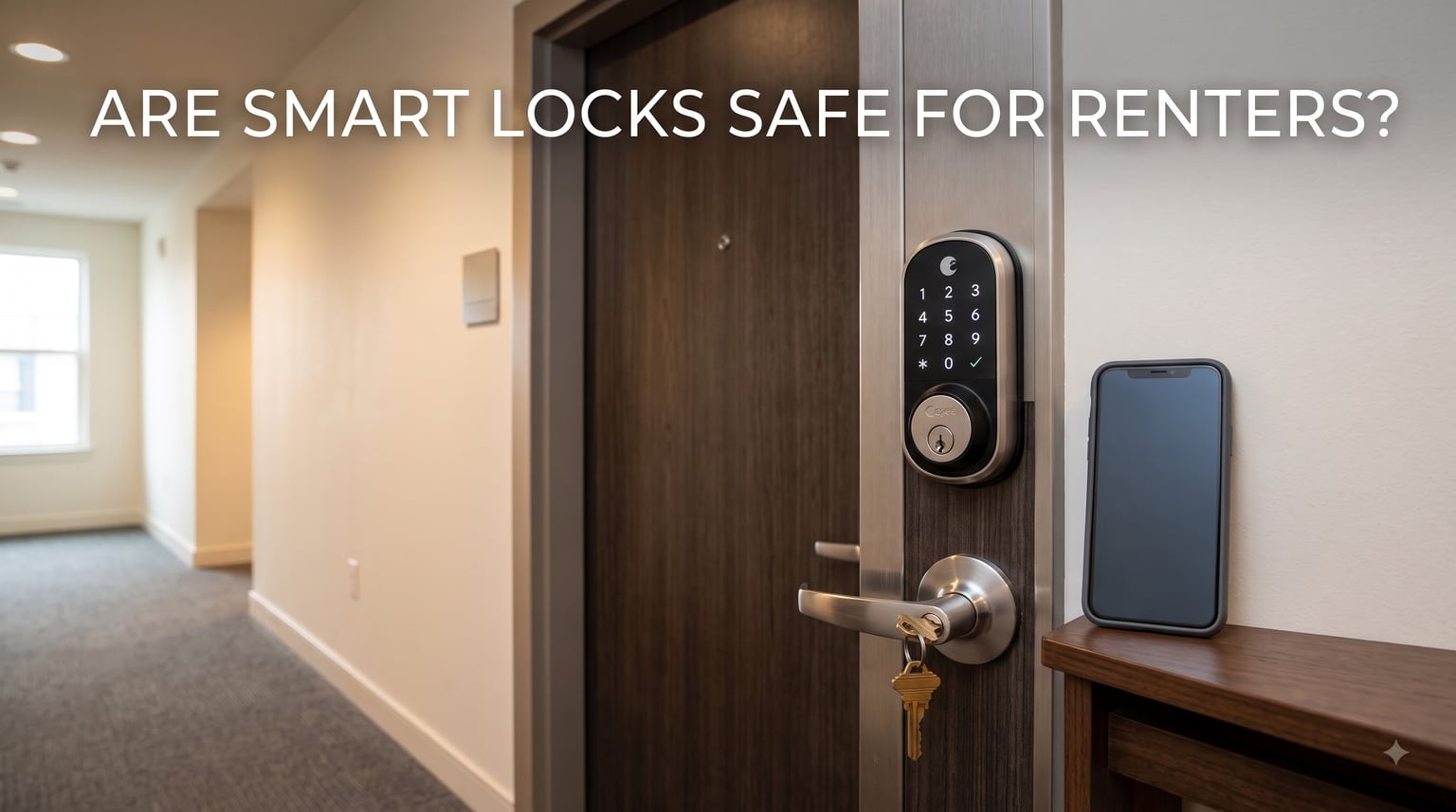
Yes, smart locks can be safe for renters when you pick a model that fits over your existing deadbolt, comes from a reputable brand, and respects your privacy. No technology is bulletproof, and smart locks bring their own risks like hacking, landlord tracking, and bricked devices, but for most renters the convenience and control outweigh the downsides once you understand what to check first.
I lived in three rentals over the past six years and tested smart locks in two of them. I also spent weeks reading Reddit threads in r/homeautomation, r/Renters, and r/NYCapartments to see where renters actually get burned. This guide puts all of that in one place so you can make the right call for your situation.
You’ll learn exactly how smart locks work on rental doors, what the real hacking and privacy risks are, when you legally need landlord permission, and a checklist to follow before you buy or install anything.
Table of Contents
- What Makes a Smart Lock Safe (or Unsafe) for Renters
- Are Smart Locks Safe From Hacking
- Privacy Concerns: Who Is Tracking Your Comings and Goings
- Do You Need Landlord Permission to Install a Smart Lock
- Smart Locks vs Traditional Locks: Which Is More Secure?
- What to Check Before Installing a Smart Lock in a Rental?
- Insurance Implications of Smart Locks for Renters
- What to Do When a Smart Lock Fails?
- Accessibility: Smart Locks for Non-Smartphone Users
- FAQs
- The Bottom Line
What Makes a Smart Lock Safe (or Unsafe) for Renters
The single biggest factor is whether the lock replaces your existing deadbolt or attaches to it. Retrofits that fit over your current deadbolt and use your existing keyway are considered renter-friendly because they leave no permanent mark on the door and your landlord can swap them back out in minutes.
Full replacement locks require drilling new holes and a new strike plate, which can violate your lease and cost you your security deposit. From what I saw on the August and Yale renter pages, the retrofit style is the industry default for apartments because it preserves the landlord’s key access while giving tenants app control.
Safety for a renter also means the lock works even when the tech fails. A physical key override, a low-battery warning, and a backup PIN code are not nice-to-haves. They are the difference between being locked out at 11 p.m. and getting inside safely.
Two non-negotiable safety features I always look for:
Physical key backup so you can still get in if the app crashes or batteries die.
Auto-lock with a timer so the door never sits unlocked because you forgot.
Are Smart Locks Safe From Hacking
Smart locks are hackable in theory, but in practice the risk is low for most renters if you follow basic digital hygiene. The two real attack surfaces are Bluetooth pairing between your phone and the lock, and the Wi-Fi connection that links your lock to the cloud when you use remote features.
Reputable brands now use AES-128 or AES-256 encryption on Bluetooth, TLS encryption over Wi-Fi, and rolling codes that change with every unlock. Two-factor authentication on the companion app adds another wall.
The bigger risks I keep seeing in forums are weak PIN codes, reused passwords, and never updating firmware. A tenant in r/homeautomation said their lock was brute-forced because they kept the factory default PIN. That was user error, not a flaw in the lock.
Other forum pain points worth flagging:
Loud keypad beeps that broadcast the PIN to anyone in the hallway.
Bricked devices after failed firmware updates, especially cheaper no-name brands.
Shared PINs that get passed around to friends of friends without expiry.
To keep your lock safe from hackers, set a unique PIN, enable two-factor authentication, install firmware updates the day they ship, and disable remote access if you do not need it. A lock that is offline and Bluetooth-only is, ironically, harder to hack than a fully cloud-connected one.
Privacy Concerns: Who Is Tracking Your Comings and Goings
Privacy is the issue that worries privacy advocates the most. The Electronic Frontier Foundation has been warning since 2023 that smart locks create a stream of sensitive location data that landlords, property managers, and law enforcement can all request without your knowledge.
Every time you unlock the door, the lock records a timestamp. Add Bluetooth presence detection and your phone can trigger auto-unlock, which means the system knows when you arrive and leave, sometimes down to the second. That data is gold for advertisers, bad for tenants who value their privacy, and a real risk in domestic abuse situations.
Questions worth asking your landlord or property manager before you sign up:
Who can see my activity log?
Is the data shared with third parties or advertisers?
How long is entry data retained?
Can I delete my own history?
If your landlord installs a smart lock and gives you no say in the matter, you still have options. In California, tenants can request the data collected about them. In New York City, Local Law 63 of 2021 requires landlords to disclose what data smart access systems collect. Other states are catching up, but the patchwork is real.
Do You Need Landlord Permission to Install a Smart Lock
Yes, in almost every case you need written permission from your landlord before installing a smart lock. Even the most renter-friendly retrofit counts as a modification to the property, and your lease almost certainly forbids modifications without consent.
Skipping permission can lead to three outcomes I have seen on r/legaladvice: a deduction from your security deposit, an eviction notice for lease violation, or a demand to remove the lock at your own expense. None of those are worth the convenience of keyless entry.
The right approach is simple. Send your landlord a short email or letter that says what brand and model you want to install, explains that it fits over the existing deadbolt without damage, and asks for written approval. Most landlords say yes within a few days, especially when you offer to remove the lock when you move out.
State-specific rules worth knowing:
California: Landlords must give 24-hour written notice before entering, and smart lock logs count as entry records.
New York City: Multiple Dwelling Law requires landlords to maintain tenant-controlled access. Local Law 63 forces disclosure of smart lock data practices.
Most other states: No specific smart lock laws yet, so your lease terms and local tenant protection statutes apply.
Smart Locks vs Traditional Locks: Which Is More Secure?
Both lock types have strengths and weaknesses. A high-quality traditional deadbolt is extremely hard to pick or bump, never runs out of batteries, and does not connect to the internet. A good smart lock adds tamper alerts, auto-locking, and the ability to revoke a lost key instantly.
Traditional locks fail in two ways renters care about: copied keys and no activity record. A former roommate can make a copy, and you will never know who opened the door. Smart locks solve both problems with virtual keys and entry logs.
Smart locks fail in two ways traditional ones do not: power loss and software bugs. A deadbolt does not need firmware updates. A smart lock can brick itself after a bad update and lock you out at 2 a.m.
For most renters I talk to, the smart lock wins on security because you can see exactly who unlocked the door and when, and you can revoke access remotely. The risk of being locked out by a tech failure is real but manageable if you keep a physical key stashed somewhere safe.
What to Check Before Installing a Smart Lock in a Rental?
Before you buy anything, run through this checklist. I use it myself whenever I move into a new place and think about adding a smart lock.
Does it fit your existing deadbolt? Measure the backset and check whether your door has a single bore hole or a separate one for the deadbolt above.
Is installation truly no-drill? Retrofit locks that fit over your existing deadbolt leave zero marks.
Does it have a physical key override? Non-negotiable for renters.
What is the battery life and what is the low-battery warning? Most smart locks run 6 to 12 months on four AA batteries.
Can you create time-limited PIN codes? Great for dog walkers, guests, and contractors.
Does it work without Wi-Fi? Bluetooth-only operation means your lock still works when your router dies.
Is there a two-factor authentication option on the app? Turn it on the day you set the lock up.
Will you remove it cleanly when you move out? Bring the original screws and keep the original interior hardware if you swap it.
One thing renters forget: snap a photo of the door hardware before you install. When you move out, you want to return the lock to factory condition and avoid a security deposit deduction.
Insurance Implications of Smart Locks for Renters
Installing a smart lock almost never voids your renters insurance, but it can affect liability in a break-in or lockout scenario. Most policies cover theft regardless of lock type, so switching from a traditional deadbolt to a smart lock does not cancel your coverage.
What does matter is whether the lock was installed with landlord approval. If you drilled new holes without permission and the door frame is later damaged, your insurer could argue negligence. Keep written approval in your files.
A few insurers offer small discounts for smart home devices, but the discount is usually under 5 percent and rarely covers the cost of the lock itself. Do not buy a smart lock expecting an insurance break. Buy it for the convenience.
If a smart lock malfunctions and you need to call a locksmith at midnight, that bill usually comes out of your pocket. Standard renters insurance does not cover lockouts. Some locksmith services are bundled with brand subscriptions, so read the fine print before you pay.
What to Do When a Smart Lock Fails?
Smart locks fail in three common ways: dead batteries, lost phone, and bricked firmware. Each has a fix, and each is easier if you planned ahead.
For dead batteries, keep a spare set of AAs near the door. Most locks warn you weeks in advance through the app and with an audible chirp. If you miss both warnings, the physical key override gets you in.
For a lost phone, log into the companion app from a laptop or a friend’s phone and revoke the missing device’s access. Most brands let you do this from any browser. Change your password while you are there.
For a bricked lock after a failed firmware update, contact the manufacturer’s support line immediately. They usually have a recovery procedure, but in the worst case you are back to the physical key. That is why every renter-friendly lock still includes one.
One tenant in r/Renters shared a story about a $1,000 charge after a smart lock bricked and the landlord claimed damage. The lesson: keep the original lock hardware so you can restore the door if a device fails catastrophically.
Accessibility: Smart Locks for Non-Smartphone Users
Smart locks can lock out more than burglars. A 93-year-old resident in a Seattle apartment became effectively homebound after her building switched to a smartphone-only smart lock. She did not own a smartphone, did not want one, and could not operate the keypad reliably.
If you live with elderly relatives, kids, or anyone who does not carry a smartphone, choose a lock with a physical keypad and a real key. Stay away from locks that require a phone and an app for every entry.
Two practical tips for shared households:
Set up a unique PIN for every person who needs entry so you can revoke access individually if a code is leaked.
Lower the keypad beep volume or turn it off. Quiet keypads prevent neighbors from overhearing your code.
FAQs
What are the downsides of smart locks?
The main downsides of smart locks are hacking risk if you use weak PINs or skip firmware updates, lockouts when batteries die or the app crashes, privacy concerns from activity logs landlords can access, and higher upfront cost than a traditional deadbolt.
Are smart locks good for rentals?
Yes, smart locks can be good for rentals when you choose a retrofit model that fits over your existing deadbolt. They offer keyless entry, remote access, and activity logs without permanent modifications, as long as your landlord approves the installation in writing.
Do smart locks void insurance?
Installing a smart lock does not usually void renters insurance, but unapproved modifications or damage from a poorly installed lock can be treated as negligence. Keep written landlord approval and receipts for the device and installation.
How hackable are smart locks?
Smart locks from reputable brands are hard to hack when you enable two-factor authentication, install firmware updates, and use a strong unique PIN. Cheap no-name locks with outdated firmware are far more vulnerable, and reused passwords or default PINs are the most common real-world attack vector.
The Bottom Line
Smart locks are safe for renters when you pick a retrofit model from a trusted brand, get written landlord permission, and follow basic security hygiene. The technology is mature, encryption is strong, and renter-friendly options have exploded in 2026.
The real risks are not hacking but privacy and lockouts. Activity logs give landlords visibility into your comings and goings. Firmware bugs can brick a device. Forgotten PINs and dead batteries can leave you standing outside your own door at midnight.
Before you install anything, review your lease, ask your landlord for written approval, and use the checklist above. Keep a physical key as a backup, enable two-factor authentication on day one, and you will get the convenience of keyless entry without giving up control of your home or your deposit.