
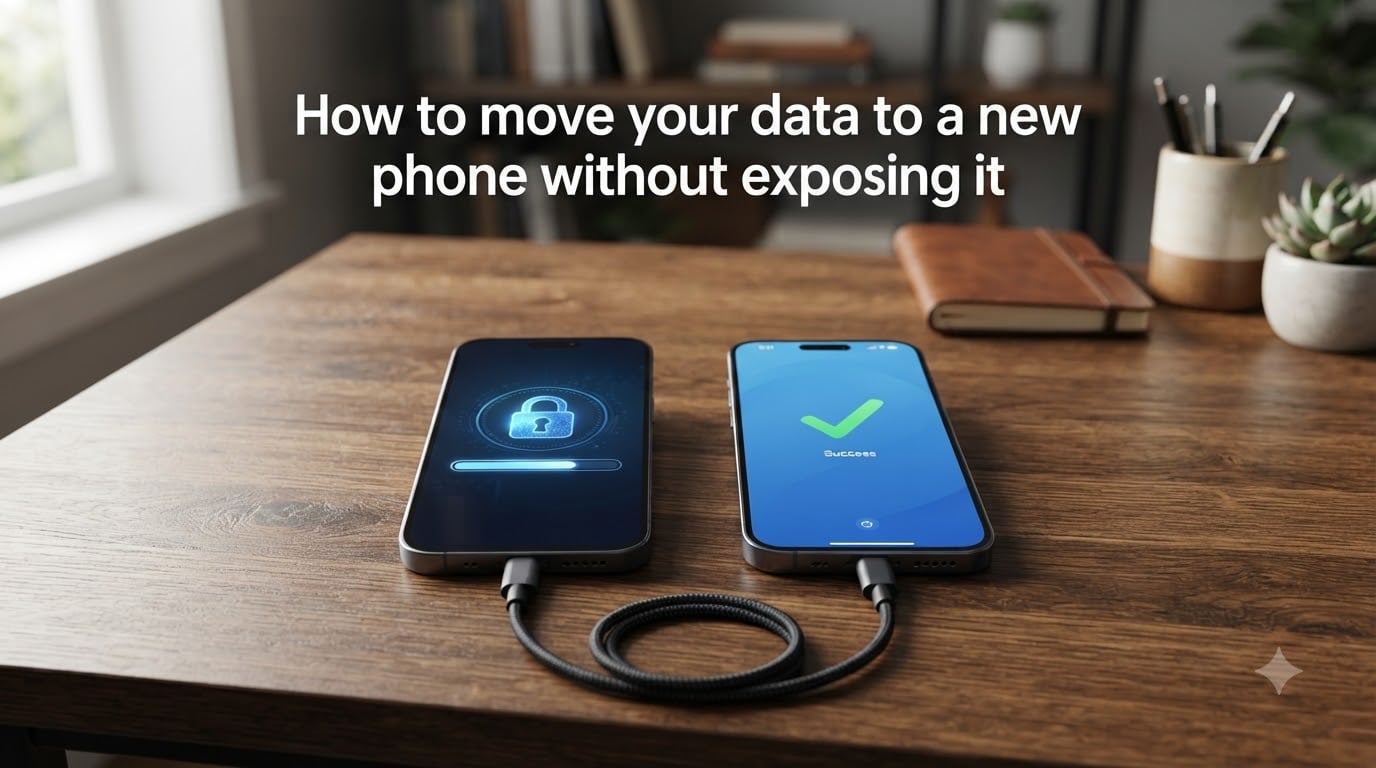
Getting a new phone feels great. What does not feel great is wondering whether your contacts, photos, messages, and passwords are floating around somewhere during the switch. I have helped friends and family upgrade phones dozens of times, and every single time someone asks the same question: is this transfer safe?
The answer is yes, if you do it right. Learning how to move your data to a new phone without exposing it comes down to choosing the right transfer method, backing up first, moving only what you need, and wiping the old device properly when you are done.
Most guides skip the security angle entirely. They tell you to connect two phones wirelessly and tap a few buttons, but they never mention what data is actually at risk or what happens to your old phone after the transfer finishes. This guide covers all of it, step by step.
Table of Contents
- What Data Is at Risk During a Phone Transfer?
- Step 1: Back Up Everything Before You Start
- Step 2: Choose a Secure Transfer Method
- How to Move Your Data to a New Phone Without Exposing It (Wireless Method)
- Cable Transfer: The Most Private Method
- Selective Data Transfer: Move Only What You Need
- Special Cases: WhatsApp, DRM Content, and Broken Screens
- Post-Transfer Security Checklist
- How to Securely Wipe Your Old Phone After Transfer?
- Common Transfer Problems and How to Fix Them
- FAQs
- Conclusion
What Data Is at Risk During a Phone Transfer?
Your phone holds more personal information than your wallet. When you transfer data between devices, several categories of sensitive information are in motion simultaneously.
Contacts, call logs, text messages, photos, and videos are the obvious ones. But your phone also stores saved passwords, banking app tokens, biometric data references, browsing history, location data, and cached login sessions. All of this moves during a full transfer.
The main risks come from two places. First, wireless transfers that use open or unencrypted connections can theoretically be intercepted if someone is on the same network. Second, your old phone retains a full copy of everything even after the transfer completes, which means anyone who gets hold of it can access your data unless you wipe it properly.
There is also a less obvious risk. Some transfer methods move app data and cached login tokens to the new phone. If a malicious app intercepted that data in transit, it could potentially access your accounts. This is why using official, encrypted transfer tools matters.
The good news is that modern phone transfer tools from Google, Samsung, and Apple all use encrypted local connections. As long as you use these official methods and take the right precautions, your data stays private.
Step 1: Back Up Everything Before You Start
Before touching either phone, create a complete backup. This is your safety net in case anything goes wrong during the transfer. I have seen transfers fail halfway through, and without a backup, that means lost data.
Google Account Backup (Android)
Open Settings on your old phone, tap your Google account name at the top, then select Backup. Tap Back up now and wait for the process to finish. This saves your contacts, app data, call history, device settings, and SMS messages to your Google account.
Google Photos Backup
Open the Google Photos app, tap your profile picture, then Photos settings, then Backup. Turn it on and wait until every photo and video shows the cloud icon confirming upload. For large photo libraries over 50 GB, this can take an hour or more on Wi-Fi.
Samsung Cloud Backup (Samsung Devices)
Go to Settings, tap your Samsung account name, then Samsung Cloud, then Back up data. Select all categories and tap Back up now. Samsung Cloud covers calls, contacts, messages, settings, and home screen layout.
Local Backup as a Second Copy
Connect your old phone to a computer with a USB-C cable, select File Transfer mode, and copy your DCIM, Downloads, and Documents folders to your computer. This gives you an offline copy that no cloud service can touch.
Once your backup is complete, verify it. Check that your Google One backup timestamp is current and that Google Photos shows the correct number of items. A backup you cannot verify is not a backup.
Step 2: Choose a Secure Transfer Method
Three main methods exist for moving data to a new phone, and each has different security characteristics. Picking the right one depends on your priorities.
USB Cable Transfer
This is the most private method. A direct cable connection between two phones creates a closed, physical link. No wireless signal is broadcast, so there is nothing to intercept. Google and Samsung both support cable transfers using a USB-C to USB-C cable or a USB-C to Lightning cable for cross-platform moves.
Wireless Direct Transfer
Wireless transfer uses Wi-Fi Direct, a peer-to-peer connection that creates a temporary encrypted link between two phones. This does not go through your router or the internet. It is secure for practical purposes, though technically a wireless signal is still broadcast in your immediate area.
Cloud Restore
Cloud restore pulls data from your Google or Samsung backup over the internet. This is convenient but means your data passes through cloud servers. Your backup is encrypted at rest, but if you want the absolute minimum data exposure, stick with cable or wireless direct methods.
For maximum privacy, I recommend cable transfer. For maximum convenience, wireless direct transfer is excellent. Use cloud restore only if you no longer have the old phone.
How to Move Your Data to a New Phone Without Exposing It (Wireless Method)
The wireless method is the most popular because it requires no cables and works on almost every modern phone. Here is how to do it securely, step by step.
Step 1: Charge both phones to at least 80 percent. A transfer can take 30 minutes to 2 hours depending on how much data you have. A dead battery mid-transfer can corrupt the process.
Step 2: Turn on your new phone but do not insert a SIM card yet. Follow the on-screen setup until you reach the Copy apps and data screen. Tap Next.
Step 3: When prompted, choose the wireless transfer option. Your new phone will search for nearby devices using a combination of Bluetooth and Wi-Fi Direct.
Step 4: On your old phone, open the Google app or Settings and look for the transfer prompt. A notification will appear asking if you want to copy data to your new device. Tap it and confirm.
Step 5: Both phones will display a verification code or pattern of dots. Make sure they match on both screens. This confirms the two phones are talking to each other and not a third device. If the codes do not match, cancel immediately and start over.
Step 6: Select the data types you want to transfer. You can choose apps, contacts, messages, photos, videos, files, and settings. Be selective here. If privacy is your priority, uncheck anything you do not strictly need on the new device.
Step 7: Confirm and wait. Keep both phones on the same flat surface and do not use either one during the transfer. The phones will show a progress bar and estimated time remaining.
Step 8: Once complete, the new phone will finish its setup process. Sign in to your Google account, set up biometrics, and verify that your data is present before doing anything else.
One important security note: keep both phones close together during the wireless transfer. Wi-Fi Direct has a range of about 200 meters in theory, but in practice the connection is strongest within 1 meter. Moving the phones apart can cause connection drops and incomplete transfers.
Cable Transfer: The Most Private Method
If you want zero wireless broadcasting during your transfer, use a USB cable. This method creates a direct physical connection between two phones with no signal to intercept.
Step 1: Get the right cable. For Android to Android, you need a USB-C to USB-C cable. For iPhone to Android, you need a Lightning to USB-C cable. Use the cable that came with your new phone or a high-quality replacement.
Step 2: Charge both phones above 80 percent. Even though cable transfers are faster than wireless, a large photo library can still take 20 to 40 minutes.
Step 3: Start setup on your new phone and select Cable when asked how you want to copy data. Connect the cable between both phones.
Step 4: Your old phone will show a permission prompt asking to allow data access from the connected device. Tap Allow or Trust and confirm the connection.
Step 5: On the new phone, select which data types to transfer. The same categories appear as in the wireless method: apps, contacts, messages, photos, videos, files, and settings.
Step 6: Start the transfer. You will see a progress bar on both screens. Do not disconnect the cable until both phones confirm the transfer is complete.
Step 7: Once finished, disconnect the cable and complete the new phone setup. Sign in, set up your lock screen, and verify your data.
Samsung users have an additional option: Samsung Smart Switch. This tool works over cable or wirelessly and handles Samsung-specific data like home screen layouts, Edge panels, and call logs. Smart Switch also works fully offline, which means no internet connection is needed at any point. For Samsung owners who prioritize privacy, Smart Switch over a cable is the most secure option.
Selective Data Transfer: Move Only What You Need
One of the best ways to protect your privacy during a phone transfer is to move less data. Every item you do not transfer is one less thing that could be exposed.
Most people accept the default transfer settings, which copies everything. But you can be selective. During the transfer setup on your new phone, you will see a list of data categories with checkboxes. Go through each one and decide what you actually need.
What to Transfer
Contacts, messages, and photos are the big three. Most people want these. App data can be useful but takes up the most space and transfer time. Settings and preferences are convenient but not critical.
What to Skip
Consider skipping cached files, downloaded documents, and old app data for apps you rarely use. These take up storage and add transfer time without much value. You can always re-download them later.
For maximum privacy, transfer only contacts and messages. Reinstall apps fresh from the Play Store, sign in individually, and let Google Photos sync your pictures over the next few hours. This approach takes longer but gives you complete control over what lands on your new device.
Security-conscious users on Reddit frequently recommend starting fresh instead of transferring everything. One user in r/AndroidQuestions put it well: setting up a new phone from scratch takes an extra hour but means no leftover cache, no stale tokens, and no data you forgot about sitting on your device.
Special Cases: WhatsApp, DRM Content, and Broken Screens
Some data types need special handling. These are the three situations that cause the most headaches during phone transfers.
WhatsApp Chat History
WhatsApp does not transfer automatically during a standard phone transfer. You need to back up your chats to Google Drive on the old phone first. Open WhatsApp, tap the three dots, go to Settings, then Chats, then Chat backup, and tap Back up. On your new phone, install WhatsApp, verify your number, and tap Restore when prompted. This pulls your chat history from Google Drive. Without this step, your WhatsApp conversations will not appear on the new phone.
DRM-Protected Content
Music and movies purchased with DRM protection often will not transfer. This includes content from Google Play Movies, some audiobooks, and certain streaming app downloads. The licenses are tied to the original device hardware. You can usually re-download this content on the new phone by signing in to the same account, but the files themselves do not move.
Broken Screen Transfer
If your old phone screen is cracked or unresponsive, direct transfer may not work because you cannot tap the on-screen prompts. In this case, use cloud restore. As long as your old phone had Google backup enabled, you can set up the new phone and restore from your Google account without touching the old device. If you never enabled backup and the screen is dead, you may need a USB-C hub with HDMI output to mirror the screen on a monitor and navigate with a mouse.
Post-Transfer Security Checklist
Once your data is on the new phone, the job is not finished. Run through this checklist to make sure everything is secure.
First, verify your data. Open your contacts app and scroll through. Check that photos loaded correctly. Open Messages and confirm your text history is there. This takes five minutes and catches incomplete transfers early.
Second, sign in to your Google or Samsung account on the new phone and confirm it is set as your primary device. Go to your Google account security page (myaccount.google.com/security) and review which devices have access. Remove the old phone from the trusted devices list if you plan to stop using it.
Third, re-pair your Bluetooth devices. Headphones, smartwatches, fitness trackers, and car Bluetooth systems need to be paired fresh with the new phone. Bluetooth pairings do not transfer. Go to Settings, Bluetooth, and pair each device one at a time.
Fourth, check your banking and payment apps. Google Pay, Samsung Pay, and banking apps typically require re-authentication on a new device for security. Open each one and follow the setup prompts. If an app shows an error, it usually means it detected a device change and needs you to verify your identity again.
Fifth, handle your SIM or eSIM. If using a physical SIM, power off both phones, swap the SIM card, and power on the new phone. If using eSIM, contact your carrier or use their app to transfer the eSIM to the new device. Some carriers let you do this through a self-service portal without calling.
Sixth, set up two-factor authentication on the new phone. If you use an authenticator app like Google Authenticator or Authy, transfer your 2FA codes to the new device before wiping the old one. Google Authenticator lets you transfer accounts between phones through its settings menu.
How to Securely Wipe Your Old Phone After Transfer?
This is the step most guides skip entirely. After your data is safely on the new phone and verified, your old phone still contains a complete copy of everything. You need to wipe it before selling, recycling, or storing it.
Before You Wipe
Wait at least 48 hours after the transfer before wiping the old phone. Use the new phone normally for two days. If you discover missing data or a problem, you still have the old phone as a reference. Once you wipe it, that data is gone for good.
Remove Your Google Account First
Before factory resetting, remove your Google account from the old phone. Go to Settings, Accounts, tap your Google account, and select Remove account. This prevents Factory Reset Protection from locking the phone, which matters if you plan to sell it.
Factory Reset Steps (Android)
Go to Settings, System, Reset options, then Erase all data (factory reset). Tap Erase all data and confirm with your PIN or password. The phone will restart and wipe everything. This process takes about 5 minutes and securely erases all user data.
Factory Reset Steps (Samsung)
Go to Settings, General management, Reset, then Factory data reset. Tap Reset and enter your password. Samsung devices will remove all accounts, apps, data, and settings during the reset.
Verify the Wipe
After the reset, the phone should show the initial setup screen, just like it did when it was new. Try to set it up without signing in to any account. If it asks for a previous owner’s Google credentials, Factory Reset Protection is still active. Sign in with your account, remove it again in Settings, and factory reset one more time.
If Selling or Recycling
For extra security, you can encrypt the phone before the factory reset. Go to Settings, Security, Encryption and credentials, then Encrypt phone. This step is optional on modern phones because they encrypt data by default, but it does not hurt. After encryption, perform the factory reset as described above.
Common Transfer Problems and How to Fix Them
Transfers sometimes fail or stall. Here are the most common issues and how to resolve them.
If the transfer freezes at a certain percentage, restart both phones and start over. This usually happens with corrupted files in the photo library. Before retrying, clear your old phone’s cache in Settings, Storage, Cached data.
If Bluetooth devices will not pair with the new phone, make sure the old phone has Bluetooth turned off. Devices can only pair with one phone at a time for most use cases.
If fingerprint or face recognition fails on the new phone, delete the old biometric data and set it up fresh. Biometric data is hardware-specific and does not transfer between devices for security reasons.
If certain apps are missing after transfer, they may not have been compatible with the new phone’s Android version. Open the Play Store, go to My apps, and reinstall them manually.
If the old phone screen is too damaged to navigate, use a USB-C to HDMI adapter to connect it to a TV or monitor. You can then use a USB mouse to navigate and start the transfer or backup process.
FAQs
How to safely transfer data to a new phone?
Use a USB-C cable for a direct, private connection between both phones. Alternatively, use the built-in wireless transfer tool (Google Quick Share or Samsung Smart Switch) which creates an encrypted Wi-Fi Direct link. Back up to Google Drive first, verify the backup, then transfer only the data types you need.
How to transfer data from a phone without a display?
If the old phone screen is broken but the phone still turns on, connect it to a monitor using a USB-C to HDMI adapter and use a USB mouse to navigate. If that is not possible and you had Google backup enabled, set up the new phone and restore from your cloud backup instead of doing a direct transfer.
What will not transfer to a new phone?
DRM-protected music and movies, Bluetooth device pairings, biometric data (fingerprints and face unlock), banking app tokens, and some app-specific data will not transfer. WhatsApp chats require a separate Google Drive backup. You will need to re-pair Bluetooth devices and re-enroll biometrics on the new phone.
How do I swap phones without losing everything?
Back up your old phone completely first using Google One backup and Google Photos sync. Verify the backup timestamp is current. Then use cable or wireless transfer to move data to the new phone. Wait 48 hours to confirm everything is working before factory resetting the old phone.
Can someone access my data during a phone transfer?
When using official transfer tools like Google Quick Share or Samsung Smart Switch, the connection is encrypted and goes directly between the two phones. No one on your Wi-Fi network can intercept it. For maximum privacy, use a USB cable instead of wireless transfer to eliminate any wireless signal entirely.
What happens to data on my old phone after transfer?
Your old phone keeps a complete copy of all data even after a successful transfer. The transfer copies data rather than moving it. You must factory reset the old phone to remove your data permanently. Remove your Google account first to disable Factory Reset Protection, then erase all data through Settings.
Conclusion
Knowing how to move your data to a new phone without exposing it comes down to four steps: back up first, choose cable or wireless direct transfer, move only what you need, and factory reset the old phone once you have verified everything works.
The security angle matters because your phone contains your entire digital life. Take the extra time to do it right. Charge both phones fully, use official tools, verify the transfer code matches, and never skip the factory reset on your old device.
Start with a backup today, even if your new phone has not arrived yet. The backup is the one step that saves you if anything else goes wrong.