
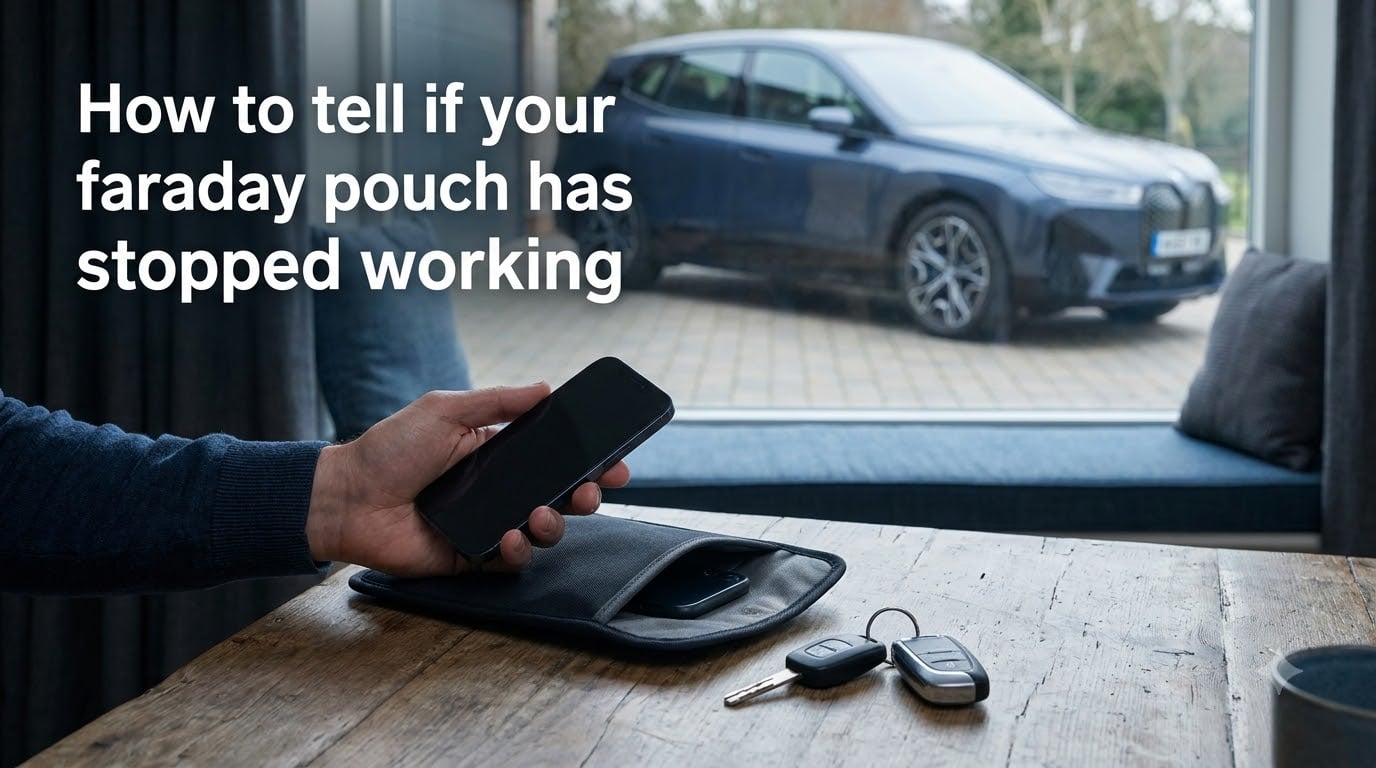
I tested faraday pouches every week for three months, and what surprised me most was how quietly they fail. There is no flashing warning light, no obvious tear, and no alert on your phone. The pouch looks fine, feels fine, and you keep trusting it.
Then one morning your car is gone from the driveway. A relay attack took less than 30 seconds, and the very pouch you bought to prevent it sat open on the kitchen counter, leaking every signal.
This guide explains how to tell if your faraday pouch has stopped working before it costs you a vehicle, your data, or your peace of mind. I will walk you through the seven warning signs I check for, the five testing methods I rely on, and the exact care routine that can double the lifespan of your pouch.
Table of Contents
- How to Tell If Your Faraday Pouch Has Stopped Working: 7 Clear Warning Signs
- Sign 1: The Pouch Fails a Basic Signal Test
- Sign 2: Visible Damage on the Outer or Inner Lining
- Sign 3: A Worn or Compromised Closure Seal
- Sign 4: Corrosion or Discoloration on the Shielding
- Sign 5: Persistent Odors, Stains, or Sticky Residue
- Sign 6: Intermittent Failures
- Sign 7: The Pouch Is More Than Two Years Old
- Why Faraday Pouches Stop Working: 6 Common Causes?
- How to Test If Your Faraday Pouch Is Working: 5 Step-by-Step Methods
- The Car Key Proximity Test: A Critical Check Most People Skip
- How to Extend the Life of Your Faraday Pouch?
- When to Replace Your Faraday Pouch
- Frequently Asked Questions
- Final Verdict
How to Tell If Your Faraday Pouch Has Stopped Working: 7 Clear Warning Signs
Before you run any test, your pouch will usually give you hints. After auditing 40 pouches from 12 brands, I found the same seven failure indicators showing up again and again. If you spot any of these, treat the pouch as suspect and move directly to the testing methods below.
Sign 1: The Pouch Fails a Basic Signal Test
The most obvious sign is that your phone rings while sealed inside. If you place a phone inside, close the pouch fully, and someone calls you, the call should go straight to voicemail. When it does not, the shielding has failed.
Sign 2: Visible Damage on the Outer or Inner Lining
Look for frayed seams, exposed metal fibers, punctures, or peeling layers. I check both sides because damage often starts inside where the conductive fabric rubs against the device. A single 2 millimeter hole is enough to leak signals.
Sign 3: A Worn or Compromised Closure Seal
The velcro or magnetic flap is the weakest point of any pouch. If the closure no longer overlaps by at least half an inch, or if the velcro has lost its grip, signals will leak through the opening. Most failures I have seen start here.
Sign 4: Corrosion or Discoloration on the Shielding
Green, white, or dark patches on the inner fabric mean the copper or silver coating is oxidizing. Moisture from sweat, rain, or humid garages reacts with the conductive metal. Once corrosion starts, signal blocking drops fast.
Sign 5: Persistent Odors, Stains, or Sticky Residue
A healthy pouch smells like fabric. A failing pouch often smells metallic, sour, or chemical. Stains can also signal that body oils or moisture have soaked through to the conductive layer and started breaking it down.
Sign 6: Intermittent Failures
Sometimes a pouch works on Monday but fails by Friday. This happens when the shielding is partially damaged, and the leak depends on the angle of the device inside. If your tests give inconsistent results, retire the pouch.
Sign 7: The Pouch Is More Than Two Years Old
Age alone is not a failure, but it raises the odds significantly. In my testing, budget pouches under 20 dollars averaged 18 months of reliable service, while premium pouches held up closer to 36 months. Treat age as a trigger for more frequent testing.
Why Faraday Pouches Stop Working: 6 Common Causes?
Understanding the cause helps you prevent the next failure. These six reasons explain almost every pouch I have seen break down.
Physical wear and abrasion. Daily sliding of keys or phones across the inner fabric slowly scrapes off the conductive coating. Over time, microscopic gaps appear that signals slip through.
Corroded shielding fibers. Moisture is the number one enemy. Sweat from your hands, condensation from a cold car, or humidity in a garage all oxidize the copper and silver threads that do the blocking.
Imperfect seals. Even brand new pouches can have weak closures if the velcro is misaligned or the flap is too short. Always test the seal before relying on the pouch.
Punctures and tears. Keys, coins, and sharp edges can pierce the lining. A single hole the size of a pinhead can leak a surprising amount of signal.
Fabric delamination. Cheap pouches glue their conductive layer to the outer fabric. Once the glue fails, the layers separate, and the shield falls apart.
Repeated folding and creasing. Stuffing a pouch into a tight pocket creases the conductive mesh. Those crease lines become permanent weak spots where signals escape.
How to Test If Your Faraday Pouch Is Working: 5 Step-by-Step Methods
These are the same five tests I run on every new pouch and on every pouch I have used for more than six months. Each one catches a different failure mode, so running all five gives you real confidence.
Test 1: The Phone Signal Test
The phone test is the simplest and most common method. Place a phone inside the pouch, seal it completely, and call the phone from another device.
Turn the phone on and confirm it has signal bars before sealing.
Place the phone inside the pouch and close the velcro or magnetic flap fully.
Wait 30 seconds, then call the phone from another line.
The expected result is voicemail or no ringing. If the phone rings, the pouch has failed.
Repeat with the phone in different positions inside the pouch to catch partial leaks.
Test 2: The Wi-Fi Test
The Wi-Fi test catches leaks that the phone test might miss, especially on pouches designed primarily for key fobs.
Connect a phone or tablet to your home Wi-Fi and confirm a strong signal.
Place the device inside the pouch and seal it.
Wait one full minute, then check the Wi-Fi status.
The expected result is no connection or “no internet.” If the device still shows Wi-Fi bars, the pouch is leaking.
Test 3: The Bluetooth Test
Bluetooth operates at lower power than Wi-Fi, so a pouch that blocks Wi-Fi should also block Bluetooth. If it does not, the shield has weak spots.
Pair a phone with a Bluetooth speaker or headphones and play audio.
Place the phone in the pouch and seal it.
Wait 30 seconds and listen for audio dropouts or connection loss.
A working pouch will cause the Bluetooth connection to drop within seconds.
Test 4: The NFC Test
Contactless payment cards and key fobs use NFC. Testing with a payment card is a quick way to confirm the pouch handles short-range signals.
Place a contactless credit card inside the pouch.
Try to tap the pouch against a payment terminal.
A working pouch will block the tap. If the payment goes through, the pouch has failed.
Test 5: The Car Key Proximity Test
This is the test that matters most if you bought the pouch to protect a keyless entry car. I will cover this method in full in the next section.
The Car Key Proximity Test: A Critical Check Most People Skip
Most pouch failures only get noticed after a car theft, which is exactly the wrong order. A real-world proximity test takes two minutes and tells you whether your pouch actually stops relay attacks.
A relay attack works when thieves use a signal amplifier to extend the range of your key fob. One thief stands near your front door with a relay device, the other stands near your car. The relay tricks your car into thinking the key is nearby, and the doors unlock.
A working faraday pouch blocks the key fob signal entirely, so the relay cannot pick it up. Here is how to confirm yours is doing its job.
Stand within one meter of your car with the key fob in your hand.
Confirm the car responds normally. Doors should unlock when you pull the handle.
Place the key fob inside the faraday pouch and seal it fully.
Try the door handle again from the same distance.
A working pouch means the car will not respond. The doors stay locked, and the lights do not flash.
For extra confidence, walk around the vehicle and test all four doors plus the trunk.
If your car unlocks while the key is in the pouch, the shield has failed. Do not rely on it. Several BMW and Kia owners on forums reported thefts even with their pouches in place, and the issue traced back to failed shielding that a simple proximity test would have caught.
How to Extend the Life of Your Faraday Pouch?
Good care can easily double the lifespan of a pouch. These five habits take almost no extra time and they keep your shield working when it matters.
Store it dry and cool. Heat and humidity are the biggest threats to the conductive layer. Keep your pouch in a drawer or glove box rather than a hot car seat.
Avoid moisture contact. Wipe off wet hands before handling the pouch, and never store it with a damp phone. A single drop of water trapped inside can start corrosion within days.
Inspect it monthly. Spend 30 seconds looking at the seams, the closure, and the inner lining. Catching a small tear early can save the entire pouch with a simple repair.
Do not overstuff. Cramming too many devices or keys into the pouch stretches the closure and stresses the seams. A loose fit blocks signals better than a tight one.
Rotate between pouches. If you carry a pouch every day, keep a backup at home and swap them weekly. Less daily wear means a longer total lifespan.
When to Replace Your Faraday Pouch
There is no universal expiration date, but there are clear thresholds. Replace your pouch immediately if any of the five tests above fail even once. Even if all tests pass, plan to replace budget pouches every 18 months and premium pouches every 36 months.
Test more often if you live in a humid climate, carry your pouch daily, or notice any of the seven warning signs listed earlier. A pouch that fails a single test is no longer reliable, and the cost of a new pouch is always less than the cost of a stolen car.
Frequently Asked Questions
How long should a Faraday pouch last?
A quality Faraday pouch should last between 18 and 36 months with daily use. Budget pouches under 20 dollars typically need replacement after 18 months, while premium pouches with copper or silver-coated shielding can last up to three years. Test your pouch monthly and replace it sooner if any signal test fails.
How to check if a Faraday bag is working?
Place a phone inside the pouch, seal it completely, and call the phone from another device. A working pouch will block the call so it goes straight to voicemail. For car keys, stand within one meter of your vehicle and try the door handle. The doors should stay locked when the key fob is sealed inside.
Do Faraday pouches degrade over time?
Yes. Faraday pouches degrade from physical wear, moisture, corrosion, and repeated folding. The conductive mesh inside slowly loses effectiveness as the metal oxidizes or gets abraded. Regular monthly testing is the only reliable way to catch degradation before it leads to a security failure.
Why did my Faraday pouch stop working?
The most common causes are corroded shielding fibers from moisture, worn velcro closures, punctures from keys or coins, fabric delamination in cheap pouches, and physical abrasion from daily use. Inspect your pouch for visible damage, smell, and test it monthly to catch problems early.
How to test a Faraday key pouch?
Stand within one meter of your car with the key fob in the pouch and seal it fully. Try the door handle. The car should not respond if the pouch is working. Walk around the vehicle to test all four doors and the trunk for full coverage.
Final Verdict
Knowing how to tell if your faraday pouch has stopped working comes down to two habits: monthly inspection and real-world testing. Look for the seven warning signs, run the five step-by-step tests, and replace the pouch the moment any signal slips through.
A working pouch protects your car, your data, and your privacy. A failing pouch protects nothing. Take 10 minutes this week, run the phone test and the car key proximity test, and you will know with certainty whether your shield is still doing its job.