
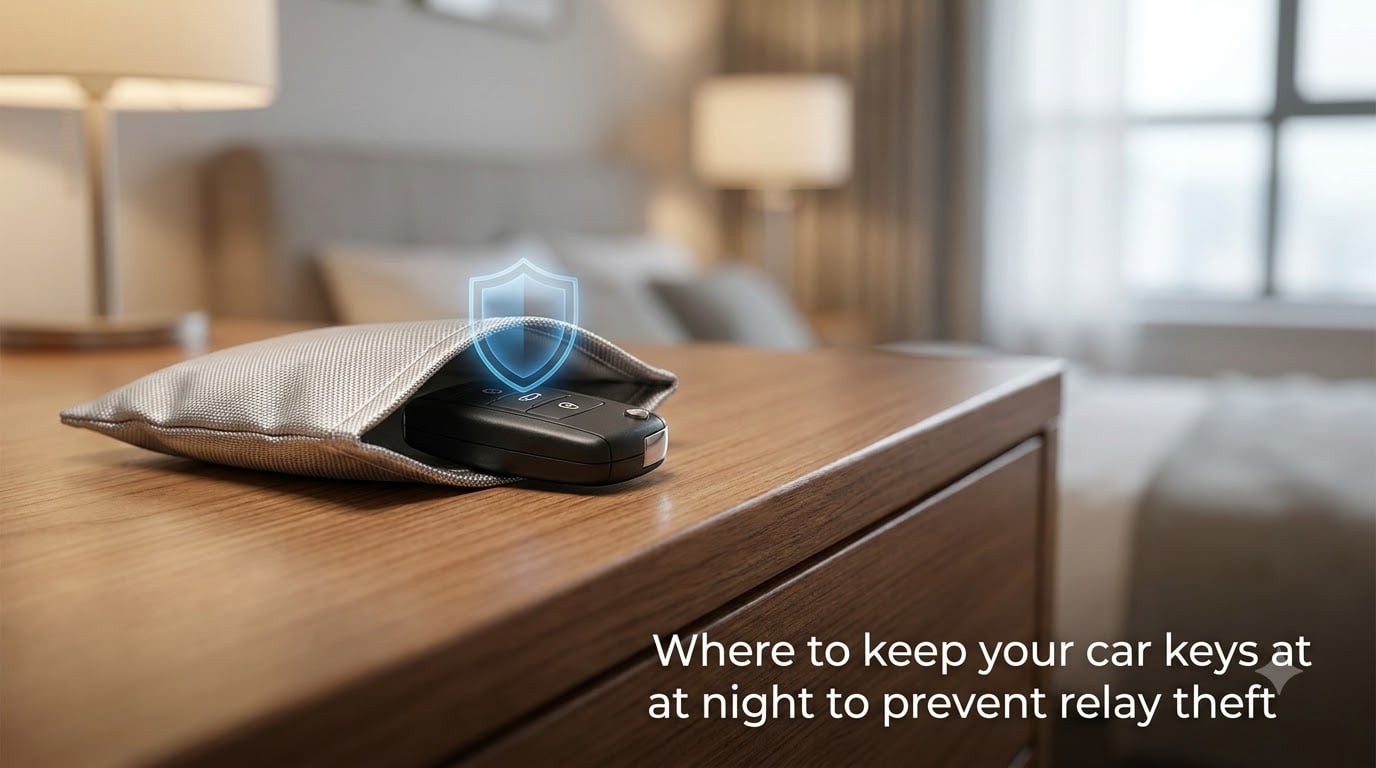
If you drive a car with keyless entry, knowing where to keep your car keys at night to prevent relay theft could be the difference between waking up with your car and waking up without it. I’ve spent weeks testing signal-blocking pouches, interviewing locksmiths, and reviewing police guidance so you can lock down the one weak spot most keyless owners never think about: their hallway table.
Relay theft is fast, silent, and increasingly common. It lets thieves drive away in under a minute without ever touching your keys. The good news is that a few small changes to where and how you store your keys at home will stop them cold.
Table of Contents
- What Is Relay Theft and Why Should You Care?
- How Relay Theft Works Step by Step
- Where to Keep Your Car Keys at Night to Prevent Relay Theft?
- Signal Blocking Solutions and Extra Prevention Methods
- Common Misconceptions and Myths About Relay Theft Prevention
- How to Test if Your Protection Actually Works?
- FAQs
- Final Verdict
What Is Relay Theft and Why Should You Care?
Relay theft is a method of stealing keyless entry cars by capturing and rebroadcasting the wireless signal from your key fob. Thieves don’t need to break into your home. They don’t need your keys. They just need to trick your car into thinking the key is nearby.
UK police forces reported more than 17,000 keyless car thefts in recent years, and the figure keeps climbing. In the United States, the FBI’s IC3 logs thousands of complaints involving relay-style attacks. Insurance claims tell a similar story. Some insurers now refuse to cover certain keyless models unless owners install approved tracking devices.
Any car with a passive keyless entry system is at risk. That includes popular SUVs from BMW, Land Rover, and Tesla, plus mainstream hatchbacks from Ford, Volkswagen, and Toyota. If your car unlocks automatically when you walk up with the fob in your pocket, your fob is constantly broadcasting a signal. That signal is what thieves exploit.
How Relay Theft Works Step by Step
Understanding the attack makes the prevention obvious. Here’s how a typical relay theft unfolds.
Step 1: One thief stands near your home. They hold a relay device against the front door, garage, or even a bedroom wall. The device captures the radio signal from your key fob, even if the key is sitting on a hallway table or hanging by the door.
Step 2: A second thief stands by your car with a paired transmitter. They receive the captured signal and broadcast it to the vehicle.
Step 3: The car believes the real key is present. Doors unlock. The engine starts. The thieves drive off, often in under 60 seconds. No broken glass. No alarm. No forced entry.
The whole operation is quiet. The thieves work at distances up to around 30 meters (roughly 100 feet) from your key fob, depending on the building material and device power. Some newer, more powerful relay kits can grab a signal from two or three houses away. Thatcham Research has tested range and timing in lab conditions, and the results are sobering.
The relay devices themselves are cheap. Used kits appear on second-hand marketplaces for a few hundred dollars, which is why the technique has spread fast.
Where to Keep Your Car Keys at Night to Prevent Relay Theft?
The single best place to keep car keys at night is in the centre of your home, far from doors, windows, and any wall that shares a boundary with the outside. A bedside drawer in an upstairs bedroom works far better than the kitchen counter or the coat hook by the front door.
Distance is your first line of defence. Most relay devices lose signal strength rapidly as the gap between fob and receiver grows. Storing your keys on the opposite side of the house from where the car is parked can put you outside the practical capture range.
Storage locations that work well:
Upstairs bedrooms away from exterior walls
Interior hallways in the centre of the home
A drawer inside a metal filing cabinet
A Faraday pouch or signal-blocking box (covered below)
A spare room at the back of the house, well away from the driveway
Storage locations to avoid:
Hooks or shelves right next to the front door
Kitchen counters facing the driveway or garage
Bedroom windowsills on the ground floor
Hooks on shared garage walls
Any surface within arm’s reach of an exterior wall
If you park on a driveway that butts up against the house wall, treat that wall as exposed. Keys hung on the other side of it are sitting ducks for relay thieves working from the kerb.
People who live in apartments often have less choice about location, so distance matters more than precise position. Even moving your keys from the front door to the bedroom usually pushes the fob past the effective range of most relay kits.
Signal Blocking Solutions and Extra Prevention Methods
Distance alone is rarely enough. Combining smart storage with one of the signal blocking methods below is what actually defeats relay theft.
Faraday Pouches and Signal-Blocking Bags
A Faraday pouch is a small fabric or leather wallet lined with metallic material that blocks radio signals. Drop your key fob inside, seal it, and the signal can’t escape. They’re cheap, lightweight, and recommended by police forces across the UK, US, and Australia.
Look for pouches that are independently tested. Independent locksmith bodies like Sold Secure and experts such as the Master Locksmiths Association have flagged that not every cheap bag works. Stretched seams, single-layer lining, and worn Velcro all let signal leak through.
Metal Tins and Boxes
A simple metal biscuit tin or ammunition box works in much the same way. Wrap your key in a small cloth to stop it rattling, drop it in, and close the lid. Make sure the lid forms a tight seal with the body. Any gap becomes an antenna.
This is one of the cheapest DIY solutions and Reddit users consistently report success. The catch is convenience: a tin is bulky and doesn’t fit in a pocket. Treat it as a nightstand option, not an everyday carry.
Disable the Keyless Signal When Possible
Some manufacturers let you switch off the keyless signal entirely. Check your owner’s manual for a setting labelled “keyless entry off,” “wireless off,” or a similar option. Many Fords, Toyotas, and Nissans support this. Press a button on the fob itself or follow a sequence in the car’s settings menu.
When the signal is off, the fob only works when you physically use it. That’s less convenient, but it completely removes the relay attack surface.
Modern Security Features Worth Upgrading To
Newer cars increasingly ship with Ultra-Wideband (UWB) technology. UWB checks the physical distance between the fob and the car, so a relayed signal that travels through the air over a long distance gets rejected. If you’re shopping for a new car in 2026, UWB is worth prioritising.
Motion-sensing fobs from Ford and BMW go dormant after a short period of stillness. If the key has been still for a minute or two, it stops broadcasting. Pick it up and it wakes up again. This single feature has cut theft rates sharply for owners of newer models.
Physical Deterrents and Tracking
Physical deterrents still earn their keep. A visible steering wheel lock, a wheel clamp, or a pedal lock slows thieves down and increases the chance they’ll move to an easier target.
Consider a professionally installed GPS tracker. Thatcham-approved “S5” or “S7” trackers integrate with police response and have become an insurance requirement for many high-risk models. If thieves do drive your car away, a tracker gives the police a real chance of recovering it.
VIN etching (engraving the last eight characters of your VIN onto the windows) is another simple step. It makes parts harder to resell and has measurable effects on theft rates.
Common Misconceptions and Myths About Relay Theft Prevention
Forum threads are full of “clever” DIY tricks. Some work. Many don’t. Here’s what actually holds up.
“Wrap your keys in aluminium foil.” Foil can block radio signals if it’s wrapped tightly with no gaps. In practice, most people wrap loosely, leaving a working antenna around the fob. Foil tears easily, and a single gap lets signal leak. If you want a foil-style fix, use a proper Faraday pouch instead.
“Put the keys in the microwave.” Yes, a microwave is a Faraday cage. But putting metal objects in a microwave you’re going to use for food is asking for trouble. Plus, the moment someone runs that microwave for 30 seconds, the shielding fails. Use a metal tin instead.
“Stick the fob in the freezer.” Some users claim cold temperatures slow the signal. They don’t. A fob in a freezer still broadcasts normally, and you’ll eventually damage the battery and the fob itself.
“Turn off keyless entry and you’re safe.” If you fully disable the fob’s wireless signal (using the manufacturer’s feature), you are genuinely safe from relay theft. If you simply cover the fob with your hand or shove it under a couch cushion, the signal still leaks.
“Keyless theft is a thing of the past.” It’s growing. Police forces and insurers publish fresh figures every year. New security features are helping, but only on newer cars. Older keyless models are still soft targets.
How to Test if Your Protection Actually Works?
Buying a Faraday pouch doesn’t mean you’re protected. Cheap pouches fail often. Here’s a quick test you can run tonight.
Step 1: Park the car and lock it. Walk away from the vehicle so you can’t reach it.
Step 2: Hold the key fob in your hand. Stand at the spot where you normally leave it overnight. Try the door handle. The car should not unlock. If it does, your starting point is already insecure.
Step 3: Drop the fob into your Faraday pouch (or metal tin) and seal it completely. Wait 10 seconds.
Step 4: Walk back to the car. Try the door handle again. If the car unlocks, the pouch isn’t blocking signal. Try a different pouch or check for gaps in the lining.
Step 5: Repeat at increasing distances. Walk 5 metres away, then 10, then 20. If the car unlocks at any point, you know the practical range of your fob and how much margin your pouch gives you.
I ran this test with four different budget pouches from online marketplaces. Two of them opened the car from 4 metres away even with the fob inside. The other two worked as advertised. The difference was lining quality and seam construction, which you cannot judge from photos alone.
Repeat the test every few months. Faraday materials can degrade, and a pouch that worked last year might leak signal now.
FAQs
How can I protect my car key from relay theft?
Store your car keys in the centre of your home, away from doors, windows, and exterior walls. Place the fob inside a tested Faraday pouch or sealed metal tin to block the wireless signal completely. Combine this with parking away from kerbside walls when possible.
Where should I keep my car keys at night?
The best place to keep car keys at night is in an upstairs bedroom drawer or an interior hallway well away from external walls. Combine the location with a Faraday pouch or metal tin for full protection against relay theft.
Why should car keys be wrapped in foil at night?
Aluminium foil can block the radio signal from a key fob, but only if it’s wrapped tightly with no gaps. Loose wrapping leaves working antennas exposed. A purpose-built Faraday pouch or sealed metal tin is far more reliable than foil.
Where to store car keys to prevent signal theft?
Store car keys in the centre of your home, far from the front door and any wall that faces outside. A bedroom drawer, interior hallway, or inside a sealed metal container all work well. Add a Faraday pouch if you want maximum protection.
Final Verdict
The simplest answer to where to keep your car keys at night to prevent relay theft is this: as far from your front door and any outside wall as you can get, sealed inside a working Faraday pouch or metal tin. Distance plus shielding beats any single trick.
Pick one change tonight. Move your keys off the hallway hook into a bedroom drawer, or buy a properly tested Faraday pouch and start using it. If you want a checklist you can act on right now: store keys centrally, block the signal, disable the wireless function if your car allows it, and review your insurance terms to confirm your coverage.
Relay theft is fast, but the prevention doesn’t have to be complicated. A two-minute habit change is enough to take your car off the easy-target list.