
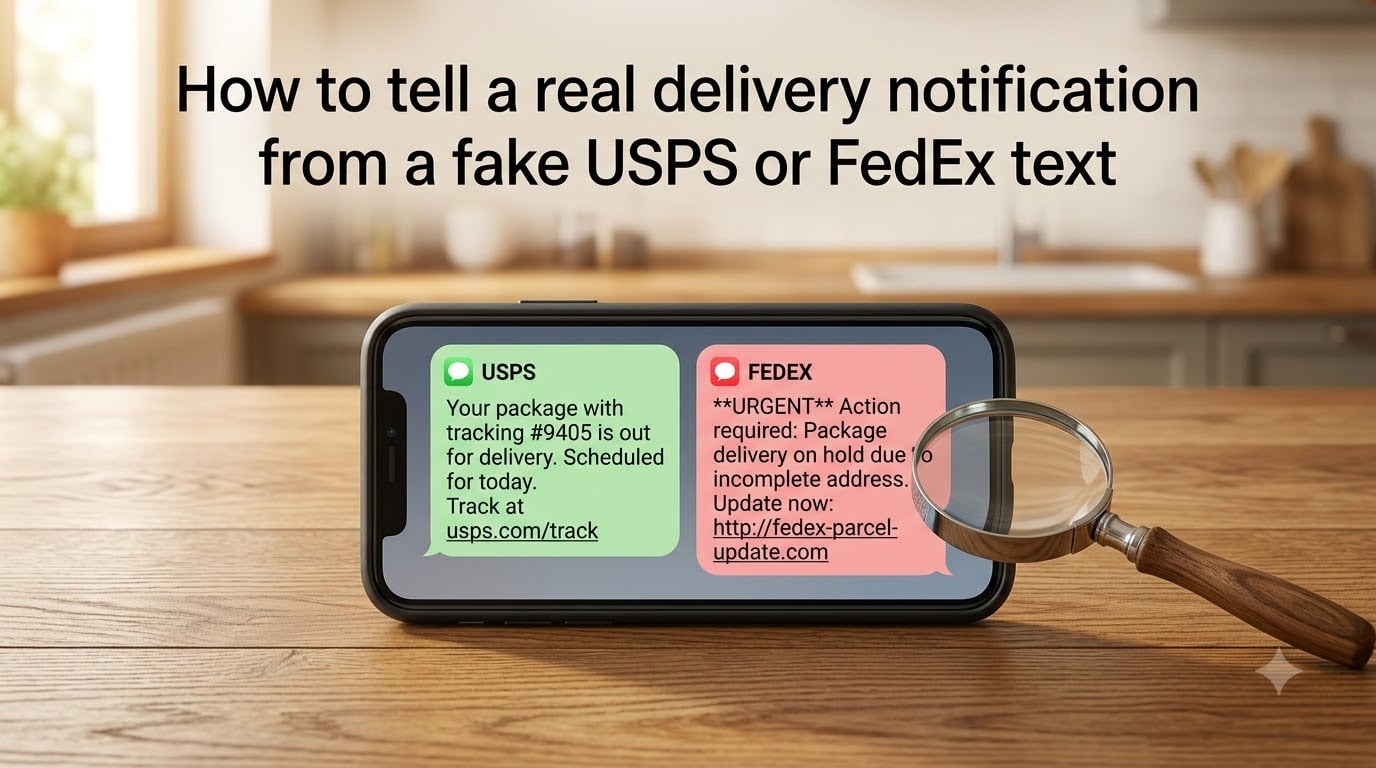
Last Tuesday, I got a text claiming my USPS package couldn’t be delivered. I was not expecting a package. That single mismatch is the simplest test for a fake delivery notification text scam, and it is the one most people forget to run before panicking. If you have ever tapped a tracking link in a rush, felt your stomach drop, and wondered whether you just handed your data to a criminal, this guide is for you. I have spent the past year collecting smishing examples, comparing them to official USPS and FedEx notices, and walking friends through verification. Here is what I learned about how to tell a real delivery notification from a fake USPS or FedEx text.
Table of Contents
- What Is Smishing and Why It Targets Your Phone?
- How Fake Delivery Text Scams Actually Work?
- Red Flags: Signs of a Fake Delivery Notification Text
- What Real USPS Text Messages Look Like?
- What Real FedEx Text Messages Look Like?
- How to Verify a Delivery Text in 5 Steps?
- What to Do If You Already Clicked the Link?
- How to Block and Report Scam Texts?
- Frequently Asked Questions
- How can I tell if a FedEx text message is real or fake?
- How do I know if a USPS text message is real?
- Does USPS send text messages about package delivery?
- What happens if I click a fake delivery notification text link?
- How do I report a fake delivery text scam?
- Why am I suddenly getting so many package delivery scam texts?
- Final Takeaway: Trust the Source, Not the Text
What Is Smishing and Why It Targets Your Phone?
Smishing is phishing carried out through SMS. Criminals send a text that looks like it came from a brand you trust, attach a link or a callback number, and hope you act before you think. The U.S. Postal Inspection Service defines smishing as a fraud scheme where scammers send unsolicited text messages pretending to be from shipping companies to steal personal information, and they confirm that USPS does not send unsolicited text messages about packages (uspis.gov).
Your phone is a prime target because text messages feel personal and urgent. People open 98% of SMS messages, and most are read within three minutes. Scammers know that a missed-delivery alert produces an immediate reflex, especially during the holidays when almost everyone is waiting on something. The fake delivery notification text scam works because it triggers that reflex before the brain engages.
How Fake Delivery Text Scams Actually Work?
The basic mechanics are simple. A scammer buys a list of phone numbers, often leaked from data breaches, and blasts a message that mimics a shipping carrier. The text contains a tracking number, a problem to solve, and a link. That link is the weapon.
Click the link and you land on a fake but convincing site that asks for a redelivery fee, a customs payment, or a quick login to verify your address. Enter anything and the scammer now has your card number, your address, or your username and password. Some links install malware silently, scraping your phone for banking apps and saved credentials. According to the FTC, the goal is to steal personal information by tricking you into clicking a link or calling a number, and the financial losses reported to the FTC in a single year topped $330 million from text-message scams (consumer.ftc.gov).
Red Flags: Signs of a Fake Delivery Notification Text
Before you do anything else, scan the message for these red flags. I have caught every scam in my inbox by applying this checklist first and reading the message second.
Unsolicited contact. USPS and FedEx only text you when you have signed up for alerts. If you never opted in, assume it is fake.
Suspicious link. Real USPS links point to usps.com, and real FedEx links point to fedex.com. Anything with a foreign domain, a string of random letters, or a shortened URL is a scam.
Urgency or threat. “Final notice,” “respond within 24 hours,” or “your package will be returned” are pressure tactics designed to short-circuit your thinking.
Spelling and grammar issues. Look for odd capitalisation, missing words, or unusual phrasing. Scammers often translate their scripts poorly.
Request for money or data. USPS and FedEx do not collect payment or personal information through text. Ever.
Generic greeting. A real notification references your actual name or a tracking number tied to a real order. Vague messages like “Dear customer” are almost always scams.
Unexpected package. If you are not expecting anything, the text is either a scam or someone used your contact details to ship something. Verify offline before clicking.
What Real USPS Text Messages Look Like?
USPS takes a narrow position on texting. They will only send you a message if you have signed up for USPS Text Tracking or Informed Delivery alerts, and the message will contain a tracking number that matches a real package on your account. The Postal Inspection Service notes that the official short codes USPS uses are 817-921, 205-289, or 972-51, and any other sender claiming to be USPS is fraudulent (uspis.gov).
Real USPS texts will reference a specific USPS.com tracking page. They will never include a link to a third-party site, ask for payment, or request personal information. If your text says something like “USPS: Your package is awaiting delivery confirmation, click here to verify,” the right move is to ignore the link, open the official USPS app, and check the tracking number yourself. If the number does not appear, the text is fake.
What Real FedEx Text Messages Look Like?
FedEx is more permissive than USPS, but the rules are still strict. FedEx only sends tracking updates when you have provided your mobile number to the shipper (typically the retailer) and consented to alerts. The messages include a tracking number tied to a real shipment and link back to fedex.com.
FedEx does not send unsolicited texts about missed deliveries, and they never request payment, personal information, or login credentials through SMS. If you receive a “FedEx” text asking for a redelivery fee or claiming your package is being held, that is a scam. Forward it to FedEx at [email protected] and then delete it (fedex.com).
How to Verify a Delivery Text in 5 Steps?
When a text feels too urgent to ignore, follow these five steps before you click anything. I run them in order every time, and they take less than a minute.
Stop and read the message carefully. Look for the red flags listed above. Urgency is the scammer’s main tool, so your first job is to slow down.
Do not click the link in the text. If you want to verify a package, open the official carrier app or type the carrier URL directly into your browser.
Find the real tracking number. If you are expecting a package, check your email receipt. If you are not, search your inbox for the retailer name. Compare the number in the text to the number in your records.
Check the sender. Real USPS short codes are 817-921, 205-289, or 972-51. Anything else is a scam. Real FedEx texts come from 46339 (which spells INFO on a keypad) or a short code in the 20000-50000 range.
Confirm on the official site. Visit the carrier website directly and enter the tracking number. If nothing shows up, the text is fake.
What to Do If You Already Clicked the Link?
You are not alone. I have done it myself on a tired evening, and thousands of people report the same slip every week. The damage depends on what you did after clicking.
If you only opened the link and closed the page without entering any information, the risk is lower but not zero. The site may have run a script in the background, so run a full scan with a mobile security app, clear your browser cache, and watch your bank accounts for unusual activity over the next 30 days.
If you entered a username, password, or payment detail, treat it as a confirmed breach. Change the password on the affected account immediately, and change any other accounts that share the same password. Contact your bank to freeze or monitor the card. Place a fraud alert with one of the three major credit bureaus so any new account openings trigger extra verification. If you submitted your Social Security number, consider a credit freeze through the FTC at IdentityTheft.gov.
How to Block and Report Scam Texts?
Reporting matters more than blocking. When you report, your data helps the FTC, the Postal Inspection Service, and carriers identify scam patterns and shut them down. Use these official channels.
Forward the text to 7726 (SPAM). This works on every major U.S. carrier. Free, instant, and the most useful single action you can take.
Report USPS scams to [email protected]. Include the full message and the sender number. The Postal Inspection Service uses these reports to track smishing operations.
Report FedEx scams to [email protected]. Forward the text so their fraud team can investigate.
File a report with the FTC at ReportFraud.ftc.gov. The FTC aggregates these reports and uses them to identify large-scale scam networks.
Block the number on your phone. Blocking does not stop the next scam, but it reduces noise. On iPhone, open the message, tap the sender, and choose Block this Caller. On Android, long-press the message and select Block.
Frequently Asked Questions
How can I tell if a FedEx text message is real or fake?
Check the sender number, hover over the link to see the actual URL, and confirm the tracking number on fedex.com. Real FedEx texts only arrive for shipments you opted into, link to fedex.com, and never ask for payment or personal information.
How do I know if a USPS text message is real?
USPS only texts you if you signed up for tracking alerts, and the sender will be one of three short codes: 817-921, 205-289, or 972-51. Any other sender claiming to be USPS is fraudulent, and USPS never asks for payment or personal information through text.
Does USPS send text messages about package delivery?
No. USPS does not send unsolicited text messages. You only receive a USPS text if you opted into USPS Text Tracking or Informed Delivery alerts, and the message will reference a real tracking number on your account.
What happens if I click a fake delivery notification text link?
If you only opened the link, run a mobile security scan and watch your accounts. If you entered any personal or payment information, change the affected passwords immediately, contact your bank, and consider a fraud alert or credit freeze through the FTC at IdentityTheft.gov.
How do I report a fake delivery text scam?
Forward the text to 7726 (SPAM), report USPS scams to [email protected], report FedEx scams to [email protected], and file a report with the FTC at ReportFraud.ftc.gov. Include the full message and sender number when possible.
Why am I suddenly getting so many package delivery scam texts?
Scam volume spikes during holiday shopping seasons and after major data breaches. Criminals buy leaked phone numbers in bulk and blast thousands of messages at low cost, hoping a small percentage of recipients are expecting packages and click through.
Final Takeaway: Trust the Source, Not the Text
Every fake delivery notification text scam relies on the same trick: it makes you react before you verify. Reverse that order. Pause, scan for red flags, then confirm the package on the official carrier site. If the text came from a short code USPS does not use, ask for a redelivery fee, or tug at you with a 24-hour deadline, treat it as fraud. Forward to 7726, report to the right inbox, and delete. The few seconds you spend checking save the hours you would spend untangling identity theft.