
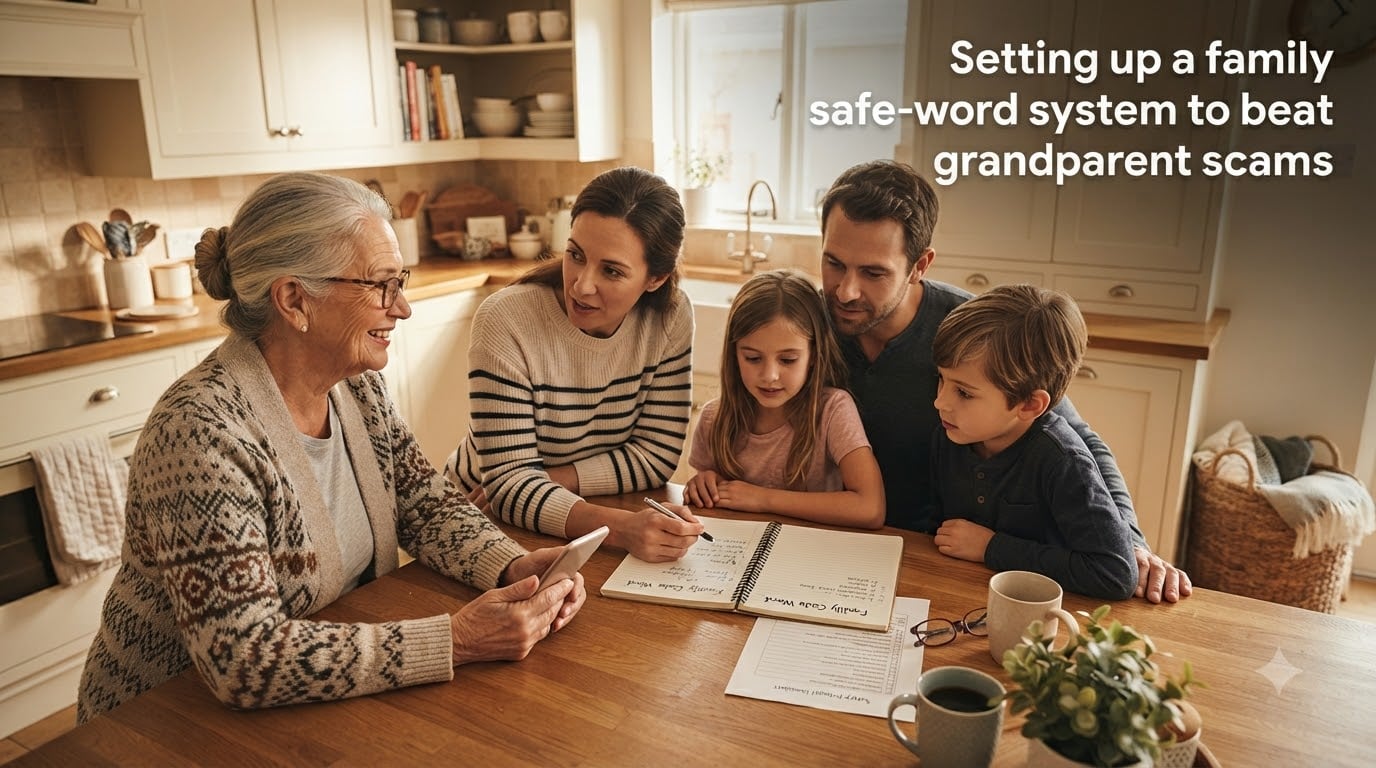
Last year, a grandmother in Ohio got a phone call from someone crying and screaming “Grandma, help me!” The voice sounded exactly like her grandson. He claimed he had been in a car accident, hit a pregnant woman, and needed $14,000 for bail right now. She drove to the bank with her purse full of cash before a teller pulled her aside and asked one simple question: “Does he know the family safe word?”
She froze. There was no safe word. The caller was a scammer using AI voice cloning to imitate her grandson’s voice. She lost everything she had with her that morning.
This guide will show you how to set up a family safe word system to beat grandparent scams before they reach your relatives. We will cover what grandparent scams are, how AI voice cloning makes them terrifying, and a complete step-by-step protocol you can put in place this weekend. By the end, you will have a script for introducing the safe word to skeptical grandparents, a practice drill plan, and a clear picture of what the safe word can and cannot protect against.
Table of Contents
- What Is the Grandparent Scam and Why Does It Work So Well?
- How AI Voice Cloning Turned Grandparent Scams Into a Crisis?
- What Is a Family Safe Word and Why Does It Actually Work?
- How to Choose a Good Safe Word (Dos and Don’ts)
- How to Set Up a Family Safe Word System: Step-by-Step
- How to Introduce the Safe Word to Elderly Family Members
- Practice Drills and Maintenance: Why Repetition Saves Lives
- Beyond the Safe Word: Extra Verification Steps That Add Layers
- What a Family Safe Word Cannot Protect Against?
- FAQs
- Real Scenarios: How a Safe Word Saves the Day?
What Is the Grandparent Scam and Why Does It Work So Well?
A grandparent scam is a phone call fraud in which a criminal pretends to be a grandchild, sibling, or other relative in urgent trouble. The caller begs the victim to wire money or send gift cards immediately, often claiming a car accident, arrest, kidnapping, or medical emergency.
These scams work because they target the strongest emotion humans have: love for family. A 2024 AARP study found that 1 in 4 adults aged 50 and over has experienced a fraud attempt in the last 12 months, and grandparent-style impersonation scams consistently rank among the highest-dollar losses reported to the FBI’s Internet Crime Complaint Center.
The classic grandparent scam script
Most grandparent scams follow a predictable pattern that fraud investigators have mapped out for years:
The caller opens with a vague greeting like “Grandma, it’s me” to make the target guess which grandchild is calling.
The target guesses a name. The scammer immediately locks onto that name and runs with it.
The “grandchild” claims to be in jail, in the hospital, or stranded in another country.
A second scammer joins the line pretending to be a lawyer, police officer, or doctor.
The victim is told to keep the call secret and send money via wire transfer, gift cards, or cryptocurrency.
Pressure escalates with crying, threats, and a deadline measured in minutes.
The genius of the script is that it weaponizes panic. Logical thinking collapses when you believe your grandchild is hurt, and scammers know exactly how to keep you on the rope.
Why elderly victims are especially vulnerable
Seniors are targeted because they often answer unknown numbers, have landlines with no caller ID screening, and tend to live alone with limited second opinions. They also grew up in a generation where a phone call from family carried inherent trust. Cognitive research from Stanford shows that stress hormones like cortisol spike within seconds of hearing a loved one in distress, and that spike directly impairs the brain’s ability to detect deception.
Add in age-related hearing changes that make subtle voice differences harder to catch, and you have a perfect storm. The scam is not a flaw in your grandmother’s intelligence. It is a system designed to bypass intelligence entirely.
How AI Voice Cloning Turned Grandparent Scams Into a Crisis?
The grandparent scam is not new. What changed in the last three years is the technology behind it. AI voice cloning now lets any scammer with $5 and a social media account replicate a person’s voice with enough fidelity to fool their own mother.
How scammers clone a voice in minutes
Modern voice cloning tools need as little as 30 seconds of clean audio to build a working model. Most people have given away far more than that. Think about every TikTok, Instagram story, YouTube video, podcast interview, and Facebook reel where your voice is in the background.
A scammer can scrape that audio in an afternoon, run it through a neural network, and produce a synthetic voice that captures the speaker’s tone, cadence, accent, and even breathing patterns. The Federal Trade Commission issued a specific warning about AI voice clones in 2023, noting that fraud reports involving cloned voices had grown by more than 1,000% year over year.
Why voice recognition no longer protects you
For decades, the rule “I would know my own grandchild’s voice” was enough. That rule is now officially obsolete. A cloned voice can include sobs, breathing, and even the specific laugh a teenager does when nervous. The only thing it cannot replicate is a piece of information the model has never seen.
This is where the family safe word enters. A safe word is a private fact, agreed on in advance by your actual family, that no public dataset will ever contain.
What Is a Family Safe Word and Why Does It Actually Work?
A family safe word is a secret word or phrase that every member of your family memorizes and agrees to use whenever someone calls unexpectedly with an emergency or money request. If the person on the phone cannot produce the safe word, the call is treated as a scam regardless of how convincingly they sound.
This works because a safe word is information that lives only in your family’s collective memory. Scammers can clone voices. They cannot clone a memory. The FCC, FBI, and AARP all now explicitly recommend a family safe word as a primary defense against grandparent scams and AI impersonation.
The principle is simple. Voice can be faked. Names can be guessed. Stories can be researched. But a nonsense word like “platypus sombrero” or a private family reference that nobody outside the family would know cannot be reverse-engineered from the internet. That is the entire magic of the system.
How to Choose a Good Safe Word (Dos and Don’ts)
The strength of your safe word depends entirely on what you pick. A weak safe word is worse than no safe word at all, because it gives false confidence. Here is how to choose well.
Safe word do’s: pick something strange
The best safe words share three qualities:
Unusual. Something nobody would ever say in normal conversation. Reddit users consistently report success with words like “platypus,” “banana,” “pickle tornado,” or random Spanish phrases like “elefante azul.”
Memorable. Easy enough that a panicked 78-year-old can pull it from memory in under 10 seconds. Tying it to a private family memory helps. For example, the name of the waitress at the diner where your family ate every Sunday, or the dog’s middle name from when you were a kid.
Non-digital. Never choose a word that appears anywhere online. If your grandchild posted about loving watermelon on TikTok, do not use watermelon.
Safe word don’ts: avoid guessable words
Stay away from these categories at all costs:
Names of pets, children, or grandchildren, since these are often visible on social media.
Birthdays, addresses, anniversaries, or any combination of digits.
Common words like “family,” “love,” “trust,” or “home.” Scammers guess these first.
Anything tied to a single person who might forget. Spread the burden across multiple family members.
Phrases that can be broken by a partial guess, such as a movie title. The whole phrase must be exact.
A useful test: search the proposed safe word on Google. If more than a few thousand results come back, pick something else. If you cannot find the phrase anywhere on the internet, you have a strong candidate.
How to Set Up a Family Safe Word System: Step-by-Step
Setting up a family safe word system is a single afternoon project. The trick is being deliberate about every step. Here is the exact protocol we recommend.
Step 1: Gather the family for an in-person meeting
A safe word system only works if everyone hears the same instructions at the same time. Schedule a video call or, better yet, a real visit where the most vulnerable family members live. The point is to make this feel like a team decision, not a lecture.
Step 2: Pick your safe word together
Write down three candidate phrases and let the group vote. Consensus matters because buy-in drives compliance. A safe word that grandma helped pick will be remembered. A safe word that was assigned to her will be forgotten the moment a scammer raises the emotional stakes.
Step 3: Define when the safe word is required
Write a short, plain-language rule. The clearest version is: “If anyone calls and asks for money, help, or secrecy, hang up and call me back at this number.” The callback rule is just as important as the safe word itself. Real family members can always call back. Scammers cannot, because they need the victim to stay on the line.
Step 4: Share the word in person only
Never text the safe word. Never email it. Never post it in a family group chat. The whole point is that it lives only in human memory. If it appears in a data breach, a phone backup, or a screenshot, you lose the only protection it offers.
Step 5: Document the protocol somewhere safe
Write down the protocol, not the safe word itself. A simple note that says “If anyone calls asking for money or help, hang up and call Mom at this number” can live in a kitchen drawer, a wallet, or a password manager. The safe word stays in heads only.
Step 6: Build the callback rule into your system
Agree as a family that any genuine emergency will be followed by a callback from the family member in question, or from a designated second contact. If the original caller cannot be reached again, treat the call as a scam. This is the single biggest psychological pressure release you can give an elderly relative. They no longer have to make a decision in the moment. They only have to hang up and dial.
How to Introduce the Safe Word to Elderly Family Members
The hardest part of any family safe word system is not the technology. It is the conversation. Many older adults see this kind of preparation as patronizing, or they do not want to admit they might fall for a scam.
A script you can use at your next family dinner
Here is a script that has worked for families we have advised. Adapt the names and details to fit your situation.
“Hey Grandma, I want to talk to you about something that happened to a family we know. They got a call that sounded exactly like their grandson. He was crying and said he needed money right away. It turned out to be a scammer using AI to copy his voice from TikTok. They lost $20,000 in two hours. The thing is, the family had been meaning to set up a code word for years but kept putting it off. We don’t want to be that family.”
Then pivot to action. “We picked a word this weekend, and we want you in on it too. Here’s how it works. If anyone calls you, including me, and asks for money, you hang up, call me back on the number you already have saved, and ask me for the word. If I can’t give it, you know it’s fake. No matter how upset the person sounds.”
Frame it as protection for the whole family, not as a failing of grandma specifically. Make it part of a tradition. Some families make picking the annual safe word a holiday tradition, just like picking a Christmas movie.
What to do if they push back
You will likely hear some version of “This will never happen to me” or “I’m not the type to fall for that.” Do not argue. Share the FBI statistic that seniors lose $4.8 billion a year to fraud. Show them one news story about a retired teacher who lost her life savings to a cloned-voice scam. Then offer to make it light. “Fine, but if a scammer ever calls pretending to be me, I want you to be able to stump them with our ridiculous code word.”
Most importantly, make the safe word funny. A bizarre, memorable phrase turns a defensive conversation into a shared joke. The families with the highest compliance rates are the ones whose safe words make them laugh.
Practice Drills and Maintenance: Why Repetition Saves Lives
A safe word that has never been used in a low-pressure moment will fail under real pressure. The amygdala literally hijacks the hippocampus during panic, which is why people forget their own address when scared. The only counter is rehearsal.
How to run your first practice drill
Pick a random Tuesday. Have one family member call grandma pretending to be in trouble, using a slightly funny voice or exaggerated scenario. The second she asks for the safe word, the caller breaks character and says “You passed!” Then the whole family debriefs. What felt hard? Was the callback rule clear? Did grandma remember the word within 10 seconds?
Run the drill once a month for the first three months, then quarterly. Keep it light, never punitive. The goal is muscle memory, not anxiety.
Monthly reminders and refreshers
Send a quick family text once a month that says “Quick reminder: if anyone calls asking for money, hang up and call [name] back.” Never include the actual safe word in the reminder. The repetition is about refreshing the protocol, not the password itself. After six months, the protocol becomes automatic.
Beyond the Safe Word: Extra Verification Steps That Add Layers
A safe word is your first line of defense, not your only line. Layered security works best, so add these checkpoints to your family protocol.
The callback rule
Already covered above, but worth repeating: any real emergency will survive a 60-second hang-up and callback. Any scam will collapse under it. Make this the cornerstone of your system.
Video verification for high-stakes calls
If a family member claims to be stranded abroad or in jail, ask for a live video call. Scammers will refuse, freeze, or make excuses about a broken camera. Real relatives can always show their face. This is especially powerful for the small percentage of scams that use deepfake video, since real-time video over a regular phone call is still very difficult to fake convincingly.
Digital security habits
Reduce the raw material available to scammers. Set social media accounts to private. Limit public video content, especially anything with clean voice audio. Remove voice memos from public cloud storage. Turn on two-factor authentication on every important account so that even a successful scam cannot cascade into a deeper compromise.
For elderly relatives, consider enrolling their phone number on the National Do Not Call Registry and enabling built-in spam filters on their device. These do not stop targeted grandparent scams, but they cut down on the background noise that wears down vigilance.
What a Family Safe Word Cannot Protect Against?
Honest limitations build trust, so here is what a safe word cannot do.
When the caller knows the safe word
If a malicious insider has access to your family chat or visits where you discussed the safe word, the system collapses. Mitigate this by sharing the word only with people who genuinely need it, and never writing it down.
When the safe word is forgotten
Under extreme panic, even a well-rehearsed safe word can slip. This is why the callback rule matters more than the word itself. A forgotten word is a hiccup. A trusted callback rule is a wall.
Scams that do not use the phone
A safe word does nothing against text-based scams, email phishing, romance scams, or investment fraud. Pair the safe word protocol with general scam awareness training and good digital hygiene.
FAQs
What is a grandparent scam?
A grandparent scam is a phone fraud where a criminal pretends to be a grandchild or other relative in urgent trouble. The caller claims an emergency like an arrest, car accident, or kidnapping and pressures the victim to send money immediately via wire transfer, gift cards, or cryptocurrency. AI voice cloning has made these scams much harder to detect.
How do I protect elderly parents from phone scams?
Set up a family safe word system, enforce a strict callback rule, run monthly practice drills, enable phone spam filters, register numbers on the National Do Not Call Registry, and use video verification for any high-stakes emergency calls. The combination of layered verification and routine rehearsal is the most effective protection.
What is an example of a good family safe word?
Strong family safe words are unusual, memorable, and impossible to find online. Examples include phrases like platypus sombrero, banana tornado, or elefante azul, or private family references like the name of a childhood pet’s middle name or the waitress at a favorite diner. Avoid pet names, birthdays, and any words that appear in search results.
How does AI voice cloning actually work?
AI voice cloning uses neural networks trained on as little as 30 seconds of clean audio to generate a synthetic voice that captures tone, cadence, accent, and breathing patterns. Scammers harvest this audio from social media videos, podcasts, and public posts, then use off-the-shelf tools to produce convincing cloned voices within minutes.
What should I do if my elderly parent keeps getting scammed?
Contact the local adult protective services, file reports with the FTC and FBI’s Internet Crime Complaint Center, notify their bank to flag suspicious transfers, set up spending alerts on their accounts, and consider adding a trusted contact designation that requires bank approval for large withdrawals. Then implement the family safe word system to prevent future incidents.
Can a family safe word protect against every scam call?
No. A safe word protects against impersonation scams where a fraudster pretends to be a family member, but it does not stop text scams, email phishing, romance scams, or investment fraud. Pair your safe word protocol with general scam awareness, spam filters, and good digital hygiene for full protection.
Real Scenarios: How a Safe Word Saves the Day?
Consider this scenario. Grandpa Bob gets a call at 11 PM. A panicked voice says “Grandpa, I’m in Mexico, I got arrested, please don’t tell Mom, I need $5,000 wired right now or I’m going to jail for years.” The voice sounds exactly like his grandson Marcus.
Without a safe word, Bob is alone in his kitchen at midnight with $5,000 of his retirement in his hand, deciding whether to trust his own ears. With a safe word, Bob says “I love you, but I need the word first.” The scammer hangs up. Bob calls his daughter, who calls Marcus in his dorm room. Everyone laughs about it the next day.
That is the entire point. A safe word turns a high-pressure solo decision into a calm, easy two-minute verification. It gives your elderly relatives permission to doubt, to slow down, and to protect themselves. Every family we have walked through this process says the same thing afterward: “I wish we had done this five years ago.”
Set it up this week. Pick a word you will remember. Rehearse it once. Tell the people you love. The next time a scammer calls, your family will be ready. A family safe word system is one of the few protections against grandparent scams that costs nothing, takes an afternoon to implement, and works against even the most sophisticated AI voice cloning. Pick a strange word, gather your family, rehearse once, and never write it down. The next time a scammer dials your grandmother’s number, she will be ready, and the call will end in seconds instead of dollars.